Ostrich: The World's Largest and Fastest Living Bird
The ostrich is a marvel of nature, holding the title of the heaviest and largest living bird on Earth. These flightless giants are renowned for their incredible speed and massive eggs, serving as a fascinating example of evolutionary adaptation. While they are most commonly associated with the vast landscapes of Africa, their history spans millions of years and multiple continents.
Key Facts
- Maximum Speed: Capable of running up to 70 km/h (43 mph).
- Weight: Adult common ostriches range from 63.5 to 145 kg (140–320 lb).
- Living Species: Two recognized species—the Common ostrich and the Somali ostrich.
- Diet: Omnivorous, primarily consuming plants, seeds, and small animals.
- Global Industry: South Africa produces approximately 70% of the world's ostrich products.
Classification and Biology
Ostriches belong to the genus Struthio within the order Struthioniformes. They are part of the infraclass Palaeognathae, a group of birds known as ratites. Ratites are characterized by their flightlessness or weak flying abilities and include other well-known birds such as emus, cassowaries, rheas, and kiwis.
Physically, ostriches are built for endurance and speed. Because they lack teeth, they swallow sand and pebbles, which act as gastroliths to help grind food in their stomachs.
Evolutionary History
The evolutionary lineage of the Struthionidae family began with the Struthioniformes, which first appeared during the Early Eocene. Evidence suggests that the family likely originated in Asia, with the Ergilornithidae being their closest relatives.
The genus Struthio first appeared in the fossil record approximately 21 million years ago in Namibia, suggesting an African origin for the genus itself. By the middle to late Miocene (5–13 million years ago), ostriches had spread across Eurasia. Fossil evidence and prehistoric art, including Chinese pottery and petroglyphs, indicate that ostriches lived in India, Mongolia, and China until the end of the last ice age.
Distribution and Habitat
Today, wild ostriches are found exclusively in Africa, inhabiting open arid and semi-arid regions such as the Sahel and various savannas. The distribution is split between two primary species:
- Common Ostrich (Struthio camelus): Native to large parts of Sub-Saharan Africa.
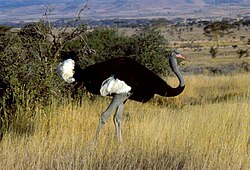
- Somali Ostrich (Struthio molybdophanes): Native to the Horn of Africa.
The Somali ostrich evolved in isolation from the common ostrich due to the geographic barrier created by the East African Rift. While the Masai subspecies of the common ostrich sometimes shares territory with the Somali ostrich, they do not interbreed due to ecological and behavioral differences.
Economic Importance
Ostriches are farmed globally, with major industries located in Namibia and the Philippines. However, South Africa remains the dominant producer, with the industry centered largely around the town of Oudtshoorn.
Humans have utilized ostriches for millennia, harvesting their meat and eggs. In modern commerce, ostrich leather is a highly valued commodity, and their large feathers are used as decorative plumes for ceremonial headgear. Additionally, ostrich fat is processed to create ostrich oil.
Species Summary
| Category | Species Name | Region/Period |
|---|---|---|
| Living | Common Ostrich (S. camelus) | Sub-Saharan Africa |
| Living | Somali Ostrich (S. molybdophanes) | Horn of Africa |
| Extinct | East Asian Ostrich (S. anderssoni) | China to Mongolia (Late Pleistocene) |
| Extinct | Asian Ostrich (S. asiaticus) | Central Asia to China |
| Extinct | Arabian Ostrich (S. c. syriacus) | Arabia (Extinct mid-20th century) |
Frequently Asked Questions
What do ostriches eat?
Ostriches are omnivores. While the majority of their diet consists of plant foods like leafy greens, roots, grasses, fruit, and succulents, they also eat insects (such as locusts) and small animals like frogs, mice, and lizards.
How fast can an ostrich run?
The ostrich is the fastest bird on land, capable of reaching speeds of up to 70 km/h (43 mph).
Where do ostriches live today?
Naturally, they are found in the wild only in Africa, specifically in arid and semi-arid habitats like savannas. However, feral populations have been established in Australia due to escaped birds.
Why do ostriches swallow pebbles?
Since ostriches do not have teeth, they swallow sand and pebbles to help grind and digest their food within their stomachs.
What is the difference between the Common and Somali ostrich?
The Somali ostrich is native to the Horn of Africa and evolved separately from the Common ostrich due to the East African Rift. They are distinguished by genetic, behavioral, and ecological differences.