Ossie Ardiles: The Argentine Legend of Tottenham Hotspur and Beyond
Osvaldo César Ardiles, known globally as Ossie Ardiles, is a towering figure in football history. A skilled and competitive central midfielder, Ardiles bridged the gap between South American flair and English grit, becoming a cult hero in London and a World Cup champion for his native Argentina. From his early days as a street footballer in Córdoba to his tenure as a pioneering manager, Ardiles' career is a testament to technical brilliance and a lifelong passion for the game.
Key Facts
- World Cup Winner: Part of the Argentina squad that won the 1978 FIFA World Cup.
- Tottenham Icon: Spent ten seasons at Tottenham Hotspur, winning the FA Cup (1981) and the UEFA Cup (1984).
- Managerial Pioneer: The first Argentine manager in the English Premier League.
- Global Coach: Managed teams across Argentina, England, Japan, Mexico, Croatia, Israel, and Paraguay.
- Hall of Fame: Inducted into both the Tottenham Hotspur and English Football Halls of Fame.
Early Life and Rise in Argentina
Born on August 3, 1952, in Córdoba, Argentina, Ardiles developed his skills playing in the streets. His exceptional dribbling ability earned him the nickname Pitón (python) from his brother. His talent was evident early on; by 1974, he was named the best player of the interior by El Gráfico. Driven by his ambition for professional football, Ardiles made the bold decision to abandon his law degree studies to pursue the sport full-time.
He began his senior career at Instituto de Córdoba before playing for Belgrano and Huracán. His domestic success paved the way for his call-up to the Argentina national team in 1975 under manager César Luis Menotti.
The Tottenham Hotspur Era
Following the 1978 World Cup, Ardiles moved to England to join Tottenham Hotspur. Over the next decade, he became a cornerstone of the team, collaborating with fellow Argentinian Ricardo Villa and the creative Glenn Hoddle to bring a sophisticated style of play to the English First Division.
Ardiles helped Spurs secure the FA Cup in the 1980–81 season. His popularity was so immense that he and his teammates even recorded a song titled "Ossie's Dream" with the pop duo Chas & Dave.
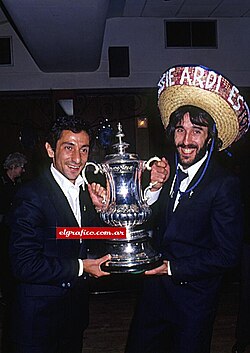
His time in London was not without geopolitical challenges. Due to the outbreak of the Falklands War in 1982, Ardiles found it difficult to remain at White Hart Lane and spent a season on loan with Paris Saint-Germain. Upon his return, he contributed to Tottenham's 1984 UEFA Cup victory, appearing as a substitute in the second leg of the final.
International Glory
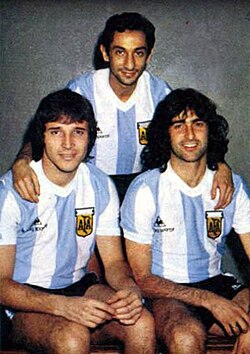
Ardiles' international career is highlighted by the 1978 FIFA World Cup victory on home soil. He earned 51 caps for Argentina, scoring 8 goals. An interesting quirk of his career occurred during the 1982 World Cup, where he wore the number 1 shirt. This was because Argentina assigned numbers alphabetically by surname, with the only exception being Diego Maradona, who was permitted to wear his preferred number 10.
Transition to Management
Ardiles transitioned to coaching in 1989 with Swindon Town. He famously replaced the traditional "long ball" style with a "Samba style" of attacking football, utilizing a diamond formation (a 4–4–2 variant with specific attacking and defensive midfield roles). While he led Swindon to their highest-ever league position and a play-off final victory, the club was denied promotion due to irregular player payments.
His managerial journey continued through several English clubs, including Newcastle United—where he became their first foreign manager—and West Bromwich Albion. He eventually returned to Tottenham as manager in the mid-1990s, where he experimented with a rare five-forward formation not seen in England since the early 1900s.
Beyond England, Ardiles managed in various countries. Notable successes include winning the 2004 Emperor's Cup with Tokyo Verdy and the 1996 J.League Cup with Shimizu S-Pulse.
Career Summary
| Category | Details |
|---|---|
| Playing Position | Central Midfielder |
| Total Club Apps (Goals) | 412 (34) |
| International Caps (Goals) | 51 (8) |
| Major Playing Honors | World Cup (1978), FA Cup (1981), UEFA Cup (1984) |
| Major Managerial Honors | Emperor's Cup (2004), J.League Cup (1996) |
Frequently Asked Questions
Why did Ossie Ardiles leave Tottenham in 1982?
Ardiles left on loan to Paris Saint-Germain because the outbreak of the Falklands War between Britain and Argentina made it difficult for him to remain and play in England at that time.
What was the "Samba style" Ardiles introduced at Swindon Town?
The "Samba style" was an attacking approach to football that moved away from the long ball strategy, utilizing a diamond formation to emphasize creativity and ball possession.
Why did Ardiles wear the number 1 shirt during the 1982 World Cup?
Argentina's policy at the time was to number players alphabetically by their surname. Ardiles' name placed him first, though an exception was made for Diego Maradona to wear number 10.
Which major trophies did Ardiles win as a player?
As a player, he won the FIFA World Cup with Argentina in 1978, the FA Cup with Tottenham Hotspur in 1981, and the UEFA Cup with Tottenham in 1984.
In which countries has Ardiles managed football teams?
Ardiles has managed teams in Argentina, England, Japan, Mexico, Croatia, Israel, Paraguay, Saudi Arabia, Syria, and Malaysia.