Osborne Bulls: A History of Vandalism and Artistic Protest
The Osborne bull, an iconic silhouette found across the Spanish landscape, has evolved from a simple commercial advertisement into a potent symbol of Spanish nationalism. Because of this perceived political meaning, these structures have frequently become targets for political activists, artists, and the elements, reflecting the deep cultural and regional tensions within Spain.
Key Facts
- Political Targets: Bulls in Catalonia and Mallorca are frequently targeted by independentist movements.
- Environmental Damage: Strong winds have repeatedly toppled bulls in regions like Valencia.
- Artistic Interventions: Artists have transformed bulls into cows or canvases for world-famous artworks.
- Recurring Cycle: Many bulls undergo a cycle of destruction, restoration, and subsequent vandalism.
Political Conflict and Regional Tensions
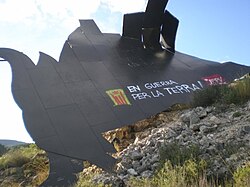
In regions with strong separatist movements, the Osborne bull is often viewed as a symbol of the central Spanish state. In Catalonia, the sole bull located in the municipality of El Bruc became a focal point for Catalan independentists. It was first toppled on October 12, 2002, and again on August 3, 2007. Despite restoration efforts by residents of Masquefa in March 2008, the structure was ultimately demolished on February 24, 2009.
Similar sentiments have appeared in other regions. In January 2008, a bull in the Galician municipality of Trasmiras was painted orange to protest symbols of Spanish nationalism.
Vandalism in Mallorca
The only bull in Mallorca has faced consistent targeting by Catalan separatist groups and graffiti artists. Notable incidents include April 13, 2007, when the bull was painted with the LGBT rainbow flag and had its testicles removed. In December 2012, vandals cut off its horns and the top of its head. After years of disrepair and graffiti, the bull fell during strong winds in December 2021, only to mysteriously reappear in May 2022.
Environmental Damage and Sabotage
Not all incidents are purely political; some are the result of extreme weather, sometimes exacerbated by human interference. In Tavernes de la Valldigna, Valencia, a bull was destroyed by wind gusts reaching 110 kilometers per hour (68 mph) in January 2009.
While the company rebuilt the structure in October of that year, it fell again in December 2016 after vandals sawed through the lower supports. Following another restoration in June 2017, the supports were again sabotaged, leading to the bull's collapse on April 29, 2018.
Artistic Transformations
Some individuals have used the Osborne bull as a canvas for social commentary or artistic experimentation. Between May 8 and 11, 2005, artist Javier Figueredo and three assistants transformed a bull in Casar de Cáceres into a Holstein cow. By adding white spots, a pink bow, and a steel udder, Figueredo aimed to spark cultural interest in the region, though local authorities charged him with vandalism.
Other artists have used the structures to address specific social issues. On May 18, 2017, the urban artist Sam3 reproduced Picasso's Guernica on a bull in Santa Pola, Alicante, as a protest against bullfighting.
Optical Illusions in A Limia
In A Limia, artists have played with visibility. In 2008, a bull was painted white, making it blend into the lighting conditions. More recently, in May 2022, an unknown artist painted a seven-meter (23 ft) bull sky blue, causing it to seemingly disappear into the sky. The Osborne company, viewing this as vandalism of private property, repainted the bull black by late July.
| Location | Date | Nature of Incident | Outcome |
|---|---|---|---|
| El Bruc, Catalonia | 2002–2009 | Political toppling | Ultimately demolished |
| Tavernes de la Valldigna | 2009–2018 | Wind and sabotage | Multiple collapses/restorations |
| Mallorca | 2007–2022 | Graffiti and mutilation | Frequent vandalism |
| Casar de Cáceres | 2005 | Artistic transformation | Converted to a cow |
| Santa Pola, Alicante | 2017 | Political art | Guernica reproduction |
Frequently Asked Questions
Why are Osborne bulls targeted in Catalonia and Mallorca?
They are often viewed by independentist and separatist movements as symbols of Spanish nationalism, making them targets for political protest.
Has weather ever caused the bulls to fall?
Yes, strong wind gusts—such as those reaching 110 km/h in Tavernes de la Valldigna—have caused bulls to collapse, sometimes aided by vandals who weakened the supports.
What is the "Osborne cow"?
The "Osborne cow" was a temporary transformation of a bull in Casar de Cáceres by artist Javier Figueredo, who added white spots and a pink udder to attract cultural interest to the area.
How did the bull in A Limia "disappear"?
Artists painted the bull in colors—first white in 2008 and later sky blue in 2022—that allowed the structure to blend into the sky or lighting conditions.
Was the Guernica painting on a bull a political statement?
Yes, the artist Sam3 reproduced Picasso's Guernica on a bull in Santa Pola specifically to protest bullfighting.