Oregon Supreme Court: A History of Justice and Jurisprudence
The legal foundations of the Pacific Northwest were laid long before Oregon achieved statehood. From the early days of the fur trade and the arrival of pioneer wagon trains on the Oregon Trail, the need for a structured judiciary grew alongside the population. What began as informal gatherings of settlers to resolve estate disputes has evolved into the sophisticated Oregon Supreme Court, the state's highest judicial authority.
Key Facts
- First Magistrate: John Kirk Townsend presided over the region's first trial in 1835.
- Pre-Statehood Roots: The court's origins date back to 1841 meetings at Champoeg to handle the estate of Ewing Young.
- Evolution of Size: The court grew from four justices at statehood to its current seven-member composition by 1913.
- First Female Member: Betty Roberts was appointed as an associate justice in 1982.
- Administrative Shift: In 1981, the Chief Justice became the administrative head of the entire Oregon judicial system.
The Pre-Statehood Era
The journey toward a formal judiciary began in 1841. Following the death of pioneer Ewing Young, who left no will or heir, settlers met at Champoeg to establish a government capable of executing his estate. While a full government was not immediately realized, the settlers elected Dr. Ira L. Babcock as a Supreme Judge to exercise probate powers from 1841 to 1843.
By 1843, further meetings at Champoeg established the Provisional Government of Oregon. This system featured a Supreme Judge and two justices of the peace for trial-level courts. During this period, the region remained without foreign jurisdiction until 1846, when a boundary dispute settlement gave the United States control of the land south of the 49th parallel.
The Territorial Period
When the U.S. Congress created the Oregon Territory in 1848, William P. Bryant was appointed as the first judge of the Oregon Supreme Court. During this era, justices were appointed by the President of the United States and practiced riding circuit. This meant they traveled throughout the state, serving as both trial-level judges and appellate judges.
The Transition to Statehood
Upon achieving statehood in 1859, the court consisted of four justices, each representing one of the state's judicial districts. Under the 1857 constitution, these justices served dual roles as both circuit and supreme court judges until the state population reached 100,000.
As the population grew, the system evolved. In 1862, a fifth justice was added and the court's first clerk was hired. By 1878, the legislature officially separated the circuit and supreme courts, ending the practice of riding circuit. The Supreme Court was initially reduced to three members, with the Chief Justice position rotating based on seniority or term expiration.
Breaking Barriers and Legal Milestones
The court's history is marked by significant social and legal shifts. On April 13, 1886, Mary Leonard became the first woman admitted to the state bar following a legislative change. In 1906, the court upheld a maximum hour law for women in State v. Muller, a decision later upheld by the U.S. Supreme Court in 1908.
Throughout the 20th century, the court handled several landmark cases that were eventually overturned by the U.S. Supreme Court, including De Jonge v. Oregon (1937) regarding Communist Party organizers and United States v. Oregon (1961) concerning veterans' estates. More recently, the court ruled on land use laws, such as the 2006 decision in Macpherson v. Department of Administrative Services, which upheld the constitutionality of Measure 37.

Administrative Evolution and Modern Structure
The creation of the Oregon Court of Appeals in 1969 shifted the Supreme Court's role; it now generally hears appeals from the intermediate court rather than directly from trial courts, except in specific cases like the death penalty. In 1981, the role of the Chief Justice was expanded from a titular head to the administrative leader of the entire state judicial system.
| Period/Year | Key Change/Event | Court Composition/Status |
|---|---|---|
| 1841 | Champoeg Meetings | Probate powers established |
| 1848 | Territorial Status | Presidential appointments; circuit riding |
| 1859 | Statehood | 4 Justices (dual circuit/supreme roles) |
| 1878 | Court Separation | Circuit and Supreme courts split; 3 members |
| 1913 | Final Expansion | Expanded to 7 Justices |
| 1969 | Court of Appeals Created | Shift to intermediate appellate structure |
Court Locations and Outreach
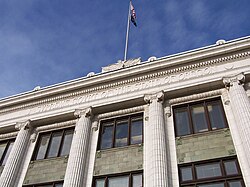
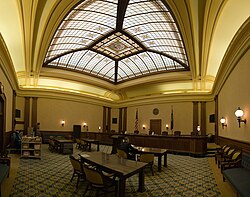
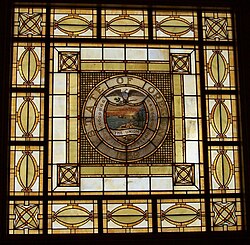
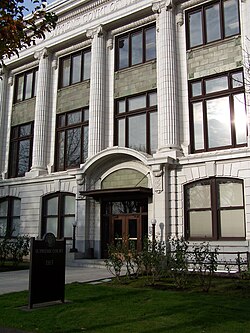
The court has occupied several sites in downtown Salem. The first was the Territorial Capitol Building (1854–1855), which burned down shortly after occupancy. A second capitol building housed the court on its third floor until it also burned in 1935. The current Supreme Court Building, completed in 1914, is now the oldest remaining building on the Capitol Mall.
Beyond its permanent home, the court maintains an educational presence by traveling to high schools, colleges, and the state's three law schools: Willamette University College of Law, University of Oregon Law School, and Lewis & Clark Law School.
Frequently Asked Questions
Who was the first judge of the Oregon Supreme Court?
William P. Bryant was appointed as the first judge of the Oregon Supreme Court in 1848, following the creation of the Oregon Territory.
What does "riding circuit" mean in the context of Oregon's legal history?
Riding circuit was a practice where justices traveled around the state to act as trial-level judges in various districts while also performing their duties as appellate judges for the supreme court.
When was the first woman admitted to the Oregon state bar?
Mary Leonard was admitted to the state bar on April 13, 1886, after a year-long legal and legislative battle.
How many justices currently serve on the Oregon Supreme Court?
The court has consisted of seven justices since it was expanded to that size in 1913.
What is the current role of the Chief Justice?
Since 1981, the Chief Justice has served as the administrative head of the entire Oregon judicial system, rather than just the head of the Supreme Court.