Order of the Precious Crown: Classes and Insignia
The Order of the Precious Crown is a distinguished honor traditionally conferred upon female royalty. Unlike many of its European counterparts, this order maintains the unique provision that it may be conferred posthumously, ensuring that merit and status are recognized regardless of the recipient's passing.
Originally conceived with eight distinct classes, the order utilizes a sophisticated system of badges, stars, and ribbons to denote the rank of the recipient. These insignia blend traditional Japanese symbolism with formal heraldic elements.
Key Facts
- Primary Recipients: Typically conferred to female royalty.
- Posthumous Awards: Can be awarded after the recipient's death.
- Original Structure: Established with eight classes.
- Current Status: The 7th and 8th classes were abolished in 2003.
- Core Symbolism: Features the ancient Japanese crown, the Ho-o (phoenix), and the Rising Sun.
The Insignia and Design
The Badge
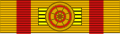
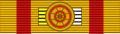
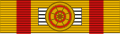
The central badge of the order is a gold oval medallion featuring floral designs at its four ends. At the heart of the medallion is an ancient Japanese crown set against a blue background and encircled by a red ring. This badge is suspended from a smaller, class-specific badge on a yellow ribbon with red stripes near the borders.
The method of wearing the ribbon depends on the rank: the 1st class is worn as a sash on the right shoulder, while all other classes are worn as a bow on the left shoulder.
The Star
Reserved exclusively for the 1st class, the star consists of five rays studded with pearls, with floral designs filling the spaces between the rays. The central disc depicts a Ho-o (a mythical Japanese phoenix) on a blue background, surrounded by a red ring emblazoned with a laurel wreath.
The Medals (6th and 7th Classes)
The medals for the 6th and 7th classes are crafted from golden bronze. The face of the medal displays the crossed flags of Japan and the Emperor, both surmounted by the Rising Sun. The obverse side features a conventional monumental shaft flanked by branches of laurel and palm.
Classification of the Order
The order is divided into specific classes, each associated with a particular name or floral motif. While the order began with eight levels, the two lowest tiers were removed in 2003.
| Class | Title / Motif | Ribbon Bar Designation |
|---|---|---|
| 1st Class | Grand Cordon | Paulownia |
| 2nd Class | Peony | Peony |
| 3rd Class | Butterfly | Butterfly |
| 4th Class | Wistaria | Wisteria |
| 5th Class | Apricot | Apricot |
| 6th Class | Ripple | Ripples |
| 7th Class | Medal (Abolished 2003) | Medal |
| 8th Class | (Abolished 2003) | Medal |
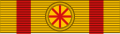
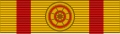
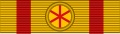
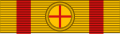
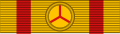
The visual distinction between these classes is maintained through the specific designs of the smaller badges and the corresponding ribbon bars used for formal attire.
Frequently Asked Questions
Who typically receives the Order of the Precious Crown?
The honor is typically conferred upon female royalty.
Can the order be awarded after a person has died?
Yes, unlike many European orders, the Order of the Precious Crown may be conferred posthumously.
What happened to the 7th and 8th classes?
Both the 7th and 8th classes were abolished in 2003.
What is the significance of the Ho-o on the 1st class star?
The Ho-o is a phoenix, a mythical bird that serves as a central symbol on the blue background of the 1st class star's disc.
How is the 1st class ribbon worn differently from other classes?
The 1st class is worn as a sash on the right shoulder, whereas the other classes are worn as a bow on the left shoulder.