Oracle Corporation: A Legacy of Enterprise Software and Cloud Innovation
From its origins as a specialized software development lab to its current status as a global powerhouse in cloud computing and enterprise software, Oracle Corporation has fundamentally shaped the modern digital landscape. Founded in 1977, the company has evolved through several iterations—including Software Development Laboratories and Relational Software, Inc.—to become a cornerstone of the S&P 500 and a leader in managing the world's most critical data.

Headquartered in Austin, Texas, Oracle serves a worldwide market, providing the essential infrastructure that powers industries ranging from financial services to healthcare. The company's journey is marked by strategic acquisitions and a relentless focus on integrating hardware and software to create high-performance environments for complex business operations.
Key Facts

- Founded: June 16, 1977, in Santa Clara, California.
- Founders: Larry Ellison, Bob Miner, and Ed Oates.
- Core Industries: Enterprise software, business software, cloud computing, computer hardware, and consulting.
- Major Products: Oracle Database, Oracle Cloud, Oracle ERP, and Oracle Applications.
- Global Reach: Serves customers worldwide, with significant revenue from the United States (55.9%).
The Evolution of Oracle's Product Ecosystem
At the heart of Oracle's success is its sophisticated suite of database technologies. While the Oracle Database remains a flagship product, the company has expanded its capabilities through various specialized technologies designed for different computing needs.
Database and Middleware Solutions
Oracle offers a diverse array of database management tools, including:
- Berkeley DB: Provides embedded database processing.
- TimesTen: Optimized for in-memory database operations.
- Oracle Essbase: A multi-dimensional database management tool.
- Oracle NoSQL Database: A scalable, distributed key-value database.
Beyond data storage, Oracle provides critical middleware—the software that connects different applications and data sources—and specialized tools like Oracle Secure Enterprise Search to ensure seamless enterprise connectivity.
Enterprise Applications and Management
Oracle's software portfolio extends deep into business operations through various product lines, including the Oracle E-Business Suite and several acquired platforms such as PeopleSoft, Siebel, and JD Edwards. These tools allow organizations to manage everything from human resources to customer relationship management (CRM) and supply chain logistics.
Hardware and Engineered Systems
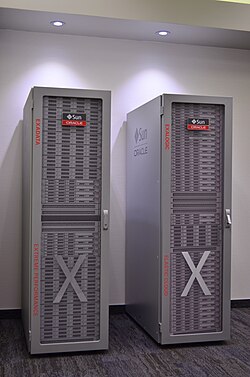
A defining characteristic of Oracle is its ability to deliver engineered systems—pre-assembled hardware and software bundles designed to work together with maximum efficiency. This approach was significantly bolstered by the acquisition of Sun Microsystems, which brought the Sun hardware range into the Oracle portfolio.
Key hardware offerings include:
- Exadata Database Machine: An integrated storage and database solution.
- Exalogic Elastic Cloud: An integrated application server.
- SPARC Servers: High-performance servers and M-series mainframes.
- Big Data Appliance: An integrated solution for map-reduce and big data processing.
Financial Performance and Corporate Scale
Oracle has demonstrated consistent growth and massive scale over the decades. As of 2025, the company reported a total revenue of US$ 57.40 billion and a net income of US$ 12.44 billion. With approximately 141,000 employees, Oracle maintains a massive global footprint.
| Year | Revenue (Million USD) | Net Income (Million USD) | Employees (Approx.) |
|---|---|---|---|
| 2015 | 38,226 | 9,938 | 132,000 |
| 2018 | 39,831 | 3,825 | 137,000 |
| 2021 | 40,479 | 13,746 | 132,000 |
| 2024 | 52,961 | 10,467 | 159,000 |
| 2025 | 57,399 | 12,443 | N/A |
Frequently Asked Questions
What are Oracle's primary business sectors?
Oracle operates primarily in enterprise software, business software, cloud computing, computer hardware, and professional consulting services.
How has Oracle expanded its technology portfolio?
Oracle has grown through significant acquisitions, including Sun Microsystems, PeopleSoft, Siebel, and Cerner, allowing it to integrate hardware, software, and specialized industry applications.
What is an "engineered system" in the context of Oracle?
An engineered system is a pre-configured, pre-assembled bundle of hardware and software designed by Oracle to work together optimally for specific enterprise tasks, such as database management or big data analytics.
Where is Oracle's headquarters located?
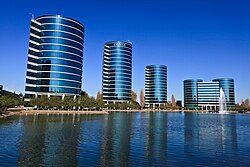
While formerly based in Redwood Shores, California, Oracle's current headquarters is located in Austin, Texas.
What is the significance of the Oracle Database?
The Oracle Database is a foundational product for the company, known for its reliability and security, often marketed with the concept of being "unbreakable" for enterprise-level data management.