Open Access Publishing: Breaking Barriers to Scientific Knowledge
Open access (OA) is a framework of principles and practices designed to make nominally copyrightable publications available to readers without access charges or other restrictive barriers. While many forms of media are freely available, the open access movement focuses primarily on peer-reviewed research literature and academic journals.
The urgency for open access stems from a phenomenon known as the serials crisis. Unlike general interest magazines or fiction, where a reader might substitute a modern book with a public domain alternative, critical scientific data is often time-sensitive. For example, an emergency room physician treating a life-threatening poisoning requires the most current research; a 90-year-old copyright-expired article is useless if it predates the invention of life-saving medications like prednisone (1954).

Key Facts
- Growth: From approximately 4,800 active OA journals in 2009, the number grew to over 12,500 listed in the Directory of Open Access Journals (DOAJ) by February 2019.
- Libre vs. Gratis: "Gratis" OA refers to free reading, while "Libre" OA removes barriers to copying and reuse through open licenses.
- Impact: OA publications generally see higher citation rates, more HTML views, and more PDF downloads compared to non-OA publications.
- Funding: Many OA journals utilize Article Processing Charges (APCs) to cover costs, though some are subsidized or fee-free.
The Color Naming System of Open Access
To categorize the various ways research is made available, the industry uses a color-coded system. These categories define who pays for the publication and where the content is hosted.
Gold and Hybrid OA
Gold OA occurs when the final version of an article is made freely available by the publisher immediately upon publication. Hybrid OA refers to subscription-based journals that allow authors to make individual articles open access, typically upon payment of a fee.
![Licenses used by gold and hybrid OA journals in DOAJ[60]](/images/36/73/3673438bd9bc8dbfc50d1d3e3949680679cec73c0dd88e42c87d16314291e0c5.png)
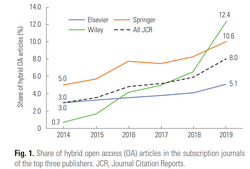
Green and Bronze OA
Green OA involves the self-archiving of a version of the paper (such as a preprint or postprint) in an institutional or subject-based repository. Bronze OA describes articles that are free to read on a publisher's website but lack a formal open license, meaning the publisher can revoke access at any time.
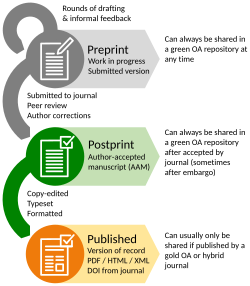
![Length of embargo times for bronze Elsevier journals[115]](/images/0e/29/0e294ed6dcb586c3de5363422b32556ad21258abdf7f254f174f6cdd30d72eac.png)
Diamond, Platinum, and Black OA
Diamond and Platinum OA journals are free for both the reader and the author, typically funded by institutions, societies, or grants. Black OA refers to the unauthorized liberation of paywalled content, often via shadow libraries.
![Download rate for articles on Sci-Hub (black open access)[35]](/images/db/b1/dbb10c61bc86b7a54d070ba433752b0a26da451608d9b10c8e5a079aba21d260.png)
Funding and Infrastructure
The transition to open access requires new financial models. Many Gold OA journals employ Article Processing Charges (APCs), which are fees paid by authors or their funders to cover the costs of publication.
![Article processing charges by gold OA journals in DOAJ[60]](/images/b1/b5/b1b5c6d69a6b42cb3ec42b90f2747759ea45d556073c8dd58cde926039a9521f.png)
To manage these publications, the community relies on various infrastructures, including the Registry of Open Access Repositories (ROAR) and the Directory of Open Access Journals (DOAJ). These tools ensure that research is discoverable and compliant with funder mandates.
![Number of open access repositories listed in the Registry of Open Access Repositories[243]](/images/10/21/102150f2a0880f22e0a5b54155e544dd4a51147e5a5799dab3d5ab4fde6d8252.png)
Impact on Scholarly Communication
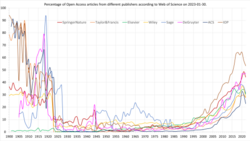
Open access significantly alters the reach of scientific work. Data indicates a clear "open access advantage" regarding visibility and influence.
| Metric | Open Access (OA) | Non-Open Access |
|---|---|---|
| Readership | Higher (Increased HTML views/PDF downloads) | Lower (Limited by subscriptions) |
| Citation Rate | Generally Higher | Generally Lower |
| Accessibility | Immediate and Global | Restricted to paying institutions |
| Reuse Rights | Often permitted via open licenses | Strictly controlled by copyright |
![Comparison of OA publications to non-OA publications for academic citations (n=44),[177] HTML views (n=4),[178][179][180][181] PDF downloads (n=3),[179][180][181] Twitter (n=2),[182][178] Wikipedia (n=1)[183]](/images/2f/31/2f3173154704d3632ce5b74c91cdd000fe93ae8c9958cea40133ee6154e9d8b6.png)
The Role of Preprints
Preprints—versions of manuscripts shared before formal peer review—accelerate the dissemination of knowledge. While they allow for rapid feedback, the community continues to balance this speed with the rigorous validation provided by traditional peer review.
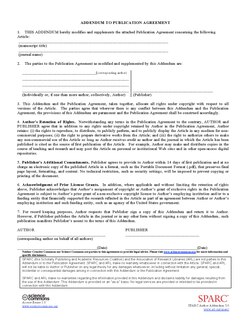
Challenges and Inequalities
Despite its benefits, open access introduces new disparities. The shift from "reader-pays" to "author-pays" (via APCs) can create barriers for researchers in low-income countries or those without significant institutional funding. This has led to concerns regarding gender inequality and geographic imbalances in who can afford to publish in high-impact Gold OA journals.
![Gold OA vs green OA by institution for 2017 (size indicates number of outputs, colour indicates region). Note: articles may be both green and gold OA so x and y values do not sum to total OA.[171][172]](/images/84/d7/84d7db235fdfe42d5c9719b39e67c0fb57e37721060790c267be4890a7aae8d7.jpg)
Frequently Asked Questions
What is the difference between Gratis and Libre open access?
Gratis open access means the work is free to read, but the copyright remains restrictive. Libre open access means the work is both free to read and free to reuse or redistribute, typically governed by an open license.
What are Article Processing Charges (APCs)?
APCs are fees charged by some open access publishers to authors (or their funding bodies) to cover the costs of editing, peer review, and hosting the article, since the journal does not collect subscription fees from readers.
What is an embargo period?
An embargo period is a set amount of time that a publisher requires to pass after the initial publication of an article before the author is allowed to self-archive a version of it in a Green OA repository.
How does open access affect a researcher's citation rate?
Research suggests that open access articles tend to have higher citation rates because they are accessible to a wider global audience, including researchers at institutions that cannot afford expensive journal subscriptions.
What is the Directory of Open Access Journals (DOAJ)?
The DOAJ is a community-curated online directory that indexes and provides metadata for high-quality, open access, peer-reviewed journals, helping researchers find legitimate OA venues for their work.