Open Access Evolution in Portugal: From Early Repositories to National Policy
The landscape of scientific communication in Portugal has undergone a significant transformation over the last two decades. By shifting toward Open Access—the practice of making research outputs freely available to the public without subscription barriers—the country has enhanced the visibility and accessibility of its academic contributions.
The Foundations of Digital Archiving
The movement began at the institutional level, led by the University of Minho. In 2003, the university established RepositóriUM, one of the first dedicated digital archives for research. This was followed in 2004 by the implementation of an institutional policy for self-archiving, a process where authors deposit a version of their work into a digital repository to ensure long-term access.
Following this lead, other higher education institutions began creating their own repositories. This era also saw the launch of SciELO Portugal, a platform specifically designed for the publication of open access journals, further diversifying how scientific knowledge was disseminated.
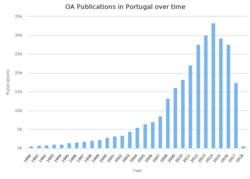
National Integration and International Collaboration
As individual efforts grew, the need for a centralized system became apparent. In 2008, the Open Access Scientific Repository of Portugal (RCAAP) was launched, providing a unified framework for the country's scientific output.
Portugal also expanded its horizons through international diplomacy. In October 2009, the Ministers of Science and Technology from Portugal and Brazil signed a bilateral agreement. This partnership culminated in the first Luso-Brazilian Open Access Conference, held in Braga, Portugal, in November 2010.
The Role of National Funding Agencies
The transition to open access was solidified when it became a requirement for funding. On May 5, 2014, the Fundação para a Ciência e Tecnologia (FCT), Portugal's primary scientific research funding agency, put its official open access policies into force. This mandate ensured that research funded by the state would be accessible to the global scientific community.
| Year | Milestone | Entity/Initiative |
|---|---|---|
| 2003 | Creation of RepositóriUM | University of Minho |
| 2004 | Self-archiving policy defined | University of Minho |
| 2008 | Launch of RCAAP | National Repository |
| 2009 | Science and Technology Agreement | Portugal and Brazil |
| 2010 | 1st Luso-Brazilian Open Access Conference | Braga, Portugal |
| 2014 | Open Access policies enforced | FCT |
Key Facts
- RepositóriUM (2003) was a pioneering initiative by the University of Minho.
- RCAAP serves as the centralized Open Access Scientific Repository of Portugal.
- SciELO Portugal focuses specifically on open access journal publications.
- The FCT mandated open access policies for funded research starting May 5, 2014.
- International cooperation was strengthened via a 2009 agreement with Brazil.
Frequently Asked Questions
What is RepositóriUM?
RepositóriUM is a digital repository created by the University of Minho in 2003 to facilitate the open access and archiving of academic work.
What is the purpose of RCAAP?
The Open Access Scientific Repository of Portugal (RCAAP), launched in 2008, acts as a national aggregator for scientific research produced in Portugal.
How did the FCT influence open access in Portugal?
The Fundação para a Ciência e Tecnologia (FCT) implemented official open access policies on May 5, 2014, making it a standard for research funded by the agency.
What was the significance of the 2010 Luso-Brazilian conference?
The conference in Braga was the result of a 2009 agreement between the Ministers of Science and Technology of Portugal and Brazil to collaborate on open access initiatives.
What is self-archiving in the context of Portuguese universities?
Self-archiving is the practice of authors depositing their research papers into an institutional repository, a policy formally defined by the University of Minho in 2004.