Old World Sparrows: Biology, Taxonomy, and Behavior of the Passeridae Family
Old World sparrows are a group of small passerine birds (perching birds) that make up the family Passeridae. Often referred to as "true sparrows," these birds are distinct from New World sparrows and other similarly named species. While many are found in wild habitats, several species have become iconic fixtures of urban environments, nesting on buildings and thriving in cities worldwide.
Primarily seed-eaters, these birds also consume small insects. In urban settings, some species act as scavengers, consuming a wide variety of food scraps similar to the habits of gulls or pigeons.
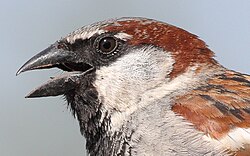
Key Facts
- Family: Passeridae, containing 43 species across eight genera.
- Distribution: Indigenous to Europe, Africa, and Asia, with several naturalized species in the Americas and Australia.
- Diet: Primarily seeds and small insects.
- Physical Traits: Small, plump bodies with powerful, stubby beaks designed for seed-cracking.
- Social Structure: Highly gregarious, often forming large flocks and roosting aggregations.
Physical Characteristics and Adaptations
Old World sparrows are generally characterized by their plump frames, brown and grey plumage, short tails, and strong beaks. Size varies significantly across the family: the chestnut sparrow (Passer eminibey) is one of the smallest at 11.4 cm and 13.4 g, while the parrot-billed sparrow (Passer gongonensis) is among the largest, reaching 18 cm and 42 g.
While they resemble finches, sparrows possess unique anatomical features. They have a vestigial dorsal outer primary wing feather and a specialized bone in the tongue called the preglossale, which stiffens the tongue to help hold seeds. Their digestive systems, including elongated alimentary canals, are further specialized for processing seeds.
Taxonomy and Classification
The family Passeridae was first introduced as Passernia by Constantine Samuel Rafinesque in 1815. Modern classification generally divides the family into three main groups: the true sparrows (genus Passer), the snowfinches (genus Montifringilla), and the rock sparrows (Petronia and the pale rockfinch).
Taxonomists have historically struggled to place sparrows, sometimes grouping them with weavers (Ploceidae) or finches (Fringillidae) due to similar bill structures and breeding behaviors. Recent molecular and skeletal evidence has also identified the cinnamon ibon of the Philippines as a sister taxon to the sparrows, placing it in its own subfamily within Passeridae.
It is important to distinguish these birds from New World sparrows (family Passerellidae), which are related to Old World buntings, and the Java sparrow, which is an estrildid finch.
Summary of Passeridae Genera and Species
| Genus | Notable Species | General Grouping |
|---|---|---|
| Passer | House sparrow, Eurasian tree sparrow | True Sparrows |
| Montifringilla | Tibetan snowfinch, Black-winged snowfinch | Snowfinches |
| Petronia | Rock sparrow | Rock Sparrows |
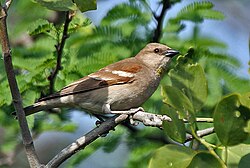
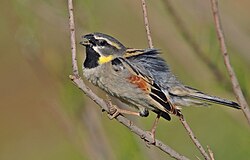
| Gymnoris | Yellow-throated sparrow, Sahel bush sparrow | Bush Sparrows |
| Hypocryptadius | Cinnamon ibon | Forest Canopy Sparrow |
Distribution and Habitat
Indigenous to Europe, Africa, and Asia, Old World sparrows have expanded their range through human intervention. The house sparrow, for instance, is now found across North America, South America, and most of Australia. These birds typically prefer open habitats such as scrubland, deserts, and grasslands.
Specialized habitats exist within the family: snowfinches reside in high latitudes, while the cinnamon ibon is uniquely found in the canopy of cloud forests in the Philippines.
Behavior and Ecology
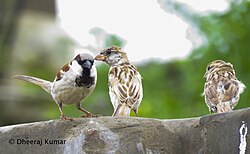
Sparrows are intensely social. Most species form flocks during the non-breeding season and gather in massive roosting aggregations for cover in trees or reed beds. In Egypt, single roosts of house sparrows have been recorded with up to 10,000 individuals.
One of the most distinctive behaviors of the Passeridae family is dust bathing. Sparrows scratch a hole in the earth and fling sand or dirt over their bodies with their wings to maintain plumage. They also engage in water bathing and snow bathing, often as a social activity followed by group singing and preening.
Relationship with Humans
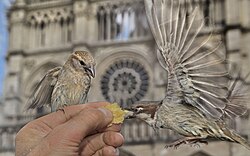
Due to their adaptation to urban environments, Old World sparrows are among the most familiar wild birds to humans. While they can be agricultural pests—particularly the house and Sudan golden sparrows—they also provide a benefit by consuming insect pests. Historically, attempts to eradicate them, such as the Great Sparrow Campaign in 1950s China, led to unintended increases in insect infestations.
Culturally, sparrows have appeared in ancient Egyptian hieroglyphs and the works of Shakespeare and Chaucer. In ancient Greece, they were associated with Aphrodite. Despite their unremarkable songs, they have been kept as pets since the Roman era, though they are difficult to raise without a high-insect diet.
Frequently Asked Questions
Are Old World sparrows the same as New World sparrows?
No. Old World sparrows belong to the family Passeridae, while New World sparrows belong to the family Passerellidae and are more closely related to buntings.
What is the purpose of the preglossale bone?
The preglossale is an extra bone in the sparrow's tongue that helps stiffen it, making it easier for the bird to hold and manipulate seeds.
Why do sparrows take dust baths?
Dust bathing is a grooming behavior used to clean their feathers and remove parasites by flicking dirt or sand over their bodies.
How many eggs does a house sparrow typically lay?
A house sparrow typically lays between 3 and 6 greenish-white eggs, though clutches can range from 1 to 8 eggs, with an incubation period of 10 to 14 days.
Are sparrows considered pests?
Some grain-eating species can be agricultural pests, but they also provide ecological balance by eating insects that would otherwise damage crops.