Nuclear Vessel Decommissioning and Disposal Records
The decommissioning of nuclear-powered naval vessels is a complex, multi-year process involving the removal of radioactive materials and the eventual dismantling of massive steel hulls. This process, known as recycling or disposal, ensures that hazardous materials are handled safely before a ship is broken up for scrap.
From massive aircraft carriers to stealthy attack submarines, the lifecycle of these vessels ends with a rigorous sequence of de-fueling and inactivation. While most are destined for the breaker's yard, some are preserved as memorials or converted into specialized training platforms.
Key Facts
- Enterprise (CVN-65) is slated for commercial breakup in Mobile, Alabama, with a target completion date of November 2029, though legal protests have delayed the process.
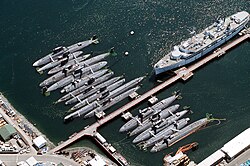
- Puget Sound Naval Shipyard serves as a primary site for the storage and disposal of decommissioned nuclear submarines.
- Moored Training Ships (MTS) are decommissioned vessels, such as the Sam Rayburn and Daniel Webster, converted into stationary platforms for nuclear training.
- Memorial Preservation: Certain vessels, marked by a dagger in official records, have had portions of their hulls preserved as memorials.
Aircraft Carrier Disposal
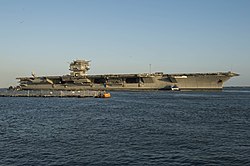
The disposal of nuclear aircraft carriers represents one of the largest engineering challenges in naval decommissioning. The ex-Enterprise (CVN-65) began its inactivation process in February 2017. After being de-fueled, it was announced in September 2023 that the vessel would be broken up at a commercial shipyard once all hazardous materials were removed.
In May 2025, a contract was awarded to a consortium including NorthStar Maritime Dismantlement Services and Modern American Recycling and Radiological Services to perform the work in Mobile, Alabama. However, as of August 2026, the hull remains at Hampton Roads due to a legal protest in the Court of Federal Claims that reopened the contract process in February 2026.
Nuclear Cruiser Decommissioning
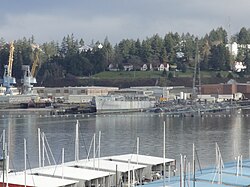
Nuclear-powered cruisers, designated as CGN, have undergone varying levels of disposal. While many, such as the ex-Bainbridge and ex-Virginia, have completed the process, others remain in transition. The ex-Long Beach (CGN-9) is a notable example of an incomplete disposal; it has been partially dismantled and remained moored at Puget Sound as of 2018.
Nuclear Submarine Disposal and Conversion
The US Navy manages two primary types of nuclear submarines for disposal: Attack Submarines (SSN) and Ballistic Missile Submarines (SSBN). Many SSBNs, such as those of the George Washington class, were converted to SSNs briefly before their arrival at the Puget Sound Naval Shipyard (PSNS) for decommissioning.
Attack Submarines (SSN)
The disposal of SSNs ranges from early pioneers like the ex-Seawolf (SSN-575) to more modern Los Angeles-class boats. Some vessels, such as the ex-Philadelphia and ex-Memphis, have been de-fueled and inactivated but not yet fully dismantled. Others, like the ex-La Jolla (SSN-701) and ex-San Francisco (SSN-711), are being converted into moored training ships.
Ballistic Missile Submarines (SSBN)
SSBN disposal often involves the conversion of vessels into Moored Training Ships (MTS). These are stationary platforms used to train nuclear technicians. For example, the Sam Rayburn (SSBN-635) was converted to MTS-635, achieving initial criticality in July 1989. These conversions include specialized mooring and power-absorption mechanisms for the propulsion shaft.
Summary of Vessel Disposal Status
| Vessel Name | Hull Number | Type | Status/Completion |
|---|---|---|---|
| Enterprise | CVN-65 | Aircraft Carrier | Stored at Hampton Roads (Pending) |
| Long Beach | CGN-9 | Cruiser | Partially Dismantled |
| Sam Rayburn | SSBN-635 | Ballistic Submarine | Converted to MTS-635 |
| Los Angeles | SSN-688 | Attack Submarine | Completed March 2013 |
| NR-1 | NR-1 | Research Sub | De-fueled, inactivated |
Frequently Asked Questions
What does "de-fueled and inactivated" mean?
This refers to the process of removing the nuclear fuel from the ship's reactors and shutting down all shipboard systems, rendering the vessel non-operational and preparing it for final dismantling.
What is a Moored Training Ship (MTS)?
An MTS is a decommissioned nuclear submarine that has been converted into a stationary training platform. These ships are moored at specific sites, such as Naval Weapons Station Charleston, to provide hands-on experience for nuclear personnel.
Why are some vessels listed as "incomplete" in disposal?
Disposal can be delayed by legal protests, funding issues, or the decision to preserve parts of the hull as memorials. For example, the ex-Long Beach remains partially dismantled at Puget Sound.
Where are decommissioned nuclear submarines typically sent?
Many are sent to the Puget Sound Naval Shipyard (PSNS) for the recycling process, where the nuclear components are handled and the remaining hull is scrapped.
How long does the disposal process take?
The timeline varies wildly. Some submarines were processed in a few years, while the ex-Enterprise aircraft carrier has a projected timeline extending to 2029, spanning over a decade from its initial inactivation in 2017.