Nuclear Submarines: The Evolution of Underwater Power
Nuclear submarines represent a pinnacle of naval engineering, utilizing nuclear propulsion—the use of a nuclear reactor to generate steam for propulsion—to achieve capabilities far beyond traditional diesel-electric vessels. By removing the need to surface for oxygen to run engines, these vessels can remain submerged for months, making them the ultimate tools for stealth, endurance, and strategic deterrence in underwater warfare.
Key Facts
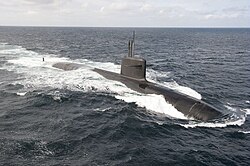
- First Vessel: The USS Nautilus (SSN-571) was the world's first nuclear-powered submarine, commissioned in 1954.
- Strategic Advantage: Nuclear power allows submarines to stay submerged indefinitely, limited only by food supplies for the crew.
- Global Operators: As of 2026, six nations deploy nuclear strategic submarines: the US, Russia, UK, France, China, and India.
- Cold War Scale: The Soviet Union and Russia built 245 nuclear submarines between the late 1950s and 1997, more than all other nations combined.
- Future Tech: Russia is developing the Poseidon, a nuclear-powered and nuclear-armed unmanned underwater vehicle (UUV).
The Dawn of Nuclear Propulsion
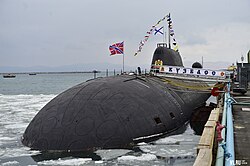
The journey toward nuclear-powered naval warfare began in the United States. In July 1951, the U.S. Congress authorized the construction of the Nautilus, led by Captain Hyman G. Rickover. Developed by the Naval Reactors Branch of the Bureau of Ships and the Atomic Energy Commission, with a reactor built by the Westinghouse Corporation, the USS Nautilus was commissioned on September 30, 1954.
Measuring 320 feet (98 m) in length and costing approximately $55 million, the Nautilus proved the viability of nuclear power at sea. This breakthrough prompted the British Admiralty and the Soviet Union to accelerate their own nuclear programs.
The Soviet Response
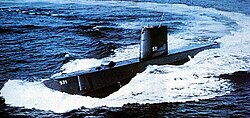
The Soviet Union began developing nuclear propulsion in the early 1950s at the Institute of Physics and Power Engineering in Obninsk. Despite facing significant technical hurdles, including radiation leaks and steam generation issues, the Soviets launched the K-3 Leninskiy Komsomol (a November-class submarine) in 1958.
Strategic Deterrence and the Cold War
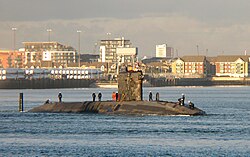
Nuclear power was particularly transformative for Ballistic Missile Submarines (SSBNs). These vessels serve as a "second strike" capability, meaning they can survive an initial nuclear attack and launch retaliatory missiles from hidden locations.
The USS George Washington became the first operational SSBN in November 1960, carrying 16 Polaris A-1 missiles. The Soviet Union followed closely with the K-19 (Hotel class) in November 1960, though it initially carried fewer missiles. By 1967, the Soviets introduced the Yankee class with 16 missiles, while the U.S. had already commissioned 41 SSBNs, famously known as the "41 for Freedom."
![The nuclear-powered VMF Typhoon-class submarines were the world's largest-displacement submarines.[19]](/images/f1/23/f1231e8cd4d8c11fe5d5c0f086ee3c370edbc26d3ae15fe43a20128ba7219a87.jpg)
Global Proliferation and Modern Fleets
During the Cold War, Soviet shipyards such as Sevmash and Admiralteyskiye Verfi produced submarines at a staggering rate. Today, the landscape has shifted to a small group of nuclear-capable nations. The United States is currently developing the Columbia-class, expected to enter service in 2031 with 16 missile tubes and a 42-year service life.
Current Global Nuclear Submarine Fleet
The following table summarizes the operational nuclear submarine capabilities of major powers based on available data.
| Country | Notable Classes/Types | Primary Role |
|---|---|---|
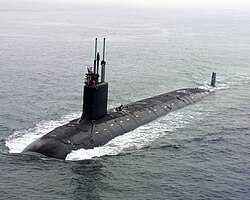
| United States | Virginia, Ohio, Los Angeles, Seawolf | Attack & Ballistic Missile |
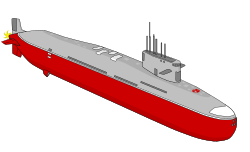
| Russia | Borei, Yasen, Akula, Oscar | Attack, Cruise & Ballistic Missile |
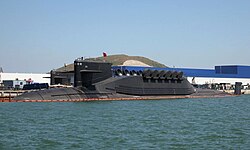
| China | Type 094 (Jin), Type 093 (Shang) | Attack & Ballistic Missile |
| United Kingdom | Astute | Attack |
| France | Suffren, Rubis | Attack |
| India | Arihant | Ballistic Missile |
Technological Frontiers and Risks
The future of underwater warfare is moving toward automation. Russia's Poseidon project involves a nuclear-powered unmanned underwater vehicle (UUV) designed to travel at 130 km/h. The primary advantage of a UUV is the preservation of human life; unlike an SSBN, which reveals its location upon launching a missile, a UUV can deliver a payload while the "mothership" remains hidden and safe from a third-strike retaliation.
Safety and Decommissioning
The history of nuclear submarines is not without tragedy. Reactor accidents have occurred, most notably on the Soviet K-19 in 1961, where a loss-of-coolant accident resulted in eight deaths. Other significant losses include the USS Thresher and the K-278 Komsomolets. Decommissioning these vessels requires complex processes to safely remove nuclear fuel and dismantle radioactive components.
Frequently Asked Questions
What is the difference between an attack submarine and an SSBN?
An attack submarine (SSN) is designed to hunt and destroy other ships and submarines. A ballistic missile submarine (SSBN) is a strategic deterrent designed to carry and launch nuclear missiles from underwater.
Why is nuclear power better than diesel for submarines?
Nuclear reactors do not require oxygen to operate, allowing submarines to stay submerged for months. Diesel-electric submarines must periodically surface or use a snorkel to run their engines and recharge batteries, making them more vulnerable to detection.
Which country has built the most nuclear submarines?
The Soviet Union and Russia have built the most, with a total of 245 nuclear submarines constructed between the late 1950s and 1997.
What is the Poseidon UUV?
The Poseidon is a Russian nuclear-powered, nuclear-armed unmanned underwater vehicle designed as a second-strike weapon to hit coastal cities while keeping the launching submarine's location secret.
Which countries are currently developing nuclear submarines?
Beyond the six current operators, Brazil, Australia (via the AUKUS pact), and North Korea have ongoing projects to build nuclear-powered submarines.