Nuclear Research Reactors: Purpose, Technology, and Global Application
While most people associate nuclear reactors with the massive power plants that generate electricity, there is an entire class of facilities known as research reactors. Unlike power reactors, which are designed for heat generation, electricity production, or maritime propulsion, research reactors are primarily utilized as a neutron source. These non-power reactors provide a controlled environment for scientific discovery, material analysis, and the production of critical medical isotopes.
Key Facts
- Primary Function: Serving as a source of neutrons for research and industrial applications.
- Fuel Requirements: Often require higher enrichment levels of Uranium-235 than power reactors.
- Medical Utility: Used as isotope reactors to produce radioisotopes for healthcare.
- Nonproliferation: Global efforts are underway to convert reactors from Highly Enriched Uranium (HEU) to Low Enriched Uranium (LEU).
- Operational Scale: Generally operate at lower temperatures and require less fuel than power reactors.
The Purpose of Research Reactors
The primary value of a research reactor lies in the neutrons it produces. These particles are essential for several high-precision scientific and industrial processes:
- Neutron Scattering: Used to study the structure and dynamics of materials.
- Non-Destructive Testing: Analyzing the internal integrity of components without damaging them.
- Material Analysis: Testing how materials behave under intense radiation.
- Radioisotope Production: Creating isotopes used in medical diagnostics and industrial tracers.
- Education: Providing hands-on training for students and public outreach regarding nuclear science.
In modern science, reactors optimized for beamline experiments often operate alongside or compete with spallation sources for high-energy neutron research.
Technical Design and Operation
Research reactors are technically simpler than their power-generating counterparts and operate at significantly lower temperatures. Because they are not designed to boil water for turbines, they require far less fuel, and there is a lower buildup of fission products over time.
However, they possess a very high power density in the core, necessitating specialized design features. To maintain the fission process, they utilize a moderator—a material used to slow down neutron velocities—and reflectors to prevent neutrons from escaping the core, thereby maximizing neutron production.
Cooling is typically achieved through water via natural or forced convection. A critical distinction lies in the fuel enrichment. While power reactors use low levels of enrichment, research reactors typically use uranium enriched up to 20% U-235. Some specialized reactors use 93% U-235, which is categorized as "weapons-grade" fuel.
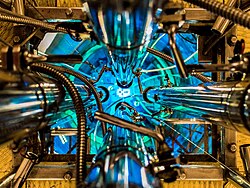
The Transition to Low Enriched Uranium (LEU)
To support global nonproliferation policies, the International Atomic Energy Agency (IAEA) and the U.S. Department of Energy began a program in 1978 to convert research reactors from Highly Enriched Uranium (HEU) to Low Enriched Uranium (LEU). This was particularly relevant given the "Atoms for Peace" program, through which the U.S. had supplied HEU to 41 countries.
The transition has proven challenging. A 2016 report from the National Academies of Sciences, Engineering, and Medicine indicated that full conversion might not be completed until 2035. The primary technical hurdle is the development of LEU fuel for high neutron flux reactors that can resist swelling and failure. As of 2020, approximately 72 HEU research reactors remained in operation.
Global Construction and Reactor Classes
The market for designing and constructing research reactors has consolidated over the decades. While many companies were active in the mid-20th century, only a few key players remain today. A notable example is the Open-pool Australian lightwater reactor (OPAL), which was awarded to the Argentine company INVAP after a competitive international tender in 1999.
Various classes of research reactors exist to suit different needs, including:
- TRIGA: A highly successful class with over 50 installations worldwide.
- OPAL: Developed by INVAP (Argentina).
- SLOWPOKE: Developed by AECL (Canada), which also served as the basis for the Miniature Neutron Source Reactor (MNSR) exported by China.
- DIDO: A class of high-flux reactors with six installations globally.
- Argonaut and Aqueous Homogeneous reactors: Other specialized design types.
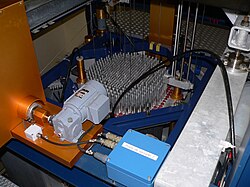
Summary of Notable Research Reactors
| Reactor Name | Country | Institution | Power Level | Status/Date |
|---|---|---|---|---|
| NRU | Canada | Chalk River Laboratories | 135 MW | 1957 |
| Advanced Test Reactor | USA | Idaho National Laboratory | 250 MW | Active |
| OPAL | Australia | ANSTO | 20 MW | 2006 |
| ILL High-Flux Reactor | France | Institut Laue-Langevin | 63 MW | Active |
| ZEEP | Canada | Chalk River Laboratories | N/A | Closed 1973 |
| BER II | Germany | Helmholtz-Zentrum Berlin | 10 MW | Closed 2019 |
Frequently Asked Questions
How do research reactors differ from power reactors?
Research reactors are designed to produce neutrons for scientific study and isotope production rather than generating heat for electricity. They generally operate at lower temperatures and use different fuel enrichment levels than power reactors.
What is the difference between HEU and LEU?
HEU (Highly Enriched Uranium) contains a higher percentage of U-235 (often 20% up to 93%), while LEU (Low Enriched Uranium) contains a lower percentage. HEU is more susceptible to proliferation for weapons, which is why international programs aim to convert reactors to LEU.
What are isotope reactors?
Isotope reactors are a specific type of research reactor optimized for the production of radioisotopes, which are essential for medical treatments, diagnostics, and various industrial applications.
Why is the conversion to LEU taking so long?
The conversion is slowed by the technical difficulty of creating LEU fuel for high neutron flux reactors that is reliable and does not suffer from physical swelling during operation.
What is a moderator in a nuclear reactor?
A moderator is a material used to slow down fast neutrons produced during fission, increasing the likelihood that they will cause further fission events and maintain a steady chain reaction.