The Evolution of Nuclear Power in South Korea
Nuclear power plays a critical role in South Korea's energy landscape, currently providing approximately 30% of the nation's electricity. With a total electrical generation capacity of 20.5 GWe from 23 reactors, nuclear energy accounts for 22% of the country's total electrical generation capacity. As South Korea navigates shifting political landscapes and technological advancements, its nuclear sector remains a focal point of national policy and international export ambitions.
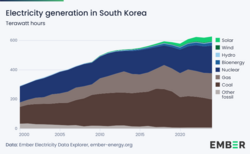
Key Facts
- Current Capacity: 20.5 GWe from 23 reactors.
- Electricity Share: Nuclear power provides 30% of South Korea's electricity.
- Operational Efficiency: South Korean plants operate at a 93.4% rate, higher than the U.S. (89.9%) and France (76.1%).
- Export Goal: South Korea aims to export 80 nuclear reactors by 2030.
- Technological Milestone: The KSTAR fusion reactor recently held a plasma loop at 100 million degrees Celsius for 48 seconds.
A History of Shifting Energy Policies
The trajectory of South Korean nuclear policy has been defined by significant political shifts. In 2012, the government planned a massive expansion to reach a 60% nuclear share by 2035. However, following scandals involving the falsification of safety documentation, the plan was scaled back in 2013.
The landscape changed dramatically following the 2011 Fukushima Daiichi disaster in Japan. Concerns regarding earthquake risks and safety led the administration of President Moon Jae-in, elected in 2017, to pursue a gradual phase-out of nuclear power. Under this policy, while existing construction projects were completed, no new reactors were to be built, with the intention of replacing aging plants as they reached their 40-year end-of-life.
In a recent reversal, President Yoon Suk Yeol shifted policy again in 2023. The current administration has resumed the construction of nuclear reactors, aiming to expand nuclear's share of electricity generation to 34.6% by 2036.
Nuclear Reactor Overview and Technology
South Korea utilizes several types of reactor technologies, most notably Pressurized Water Reactors (PWR) and Pressurized Heavy Water Reactors (PHWR). A flagship technology is the APR-1400, a highly advanced PWR model. According to the Ministry for a Knowledge Economy, the APR-1400's fuel costs are 23% lower than the French-designed EPR.
The safety and reliability of South Korean plants are notable. The country has recorded some of the lowest emergency shutdown rates globally, a result of highly standardized operating procedures. The APR-1400 is specifically engineered to meet modern international safety requirements, including resistance to aircraft impacts.
Major Nuclear Power Plants
| Plant Name | Location (Town/Province) | Primary Technology | Current Capacity (MWe) | Planned Capacity (MWe) |
|---|---|---|---|---|
| Kori | Gijang, Busan | PWR | 6040 | 7937 |
| Hanul | Uljin, Gyeongbuk | PWR | 5900 | 8700 |
| Wolsong | Gyeongju, Gyeongbuk | PHWR / PWR | 2779 | 4779 |
| Hanbit | Yeonggwang, Jeonnam | PWR | 5900 | N/A |
Challenges: Safety Scandals and Public Sentiment
The industry has faced significant hurdles, particularly regarding transparency. In 2012 and 2013, major scandals emerged involving the use of counterfeit parts and the falsification of safety certificates and quality assurance documents. These incidents led to the shutdown of several reactors and the indictment of numerous individuals, including high-ranking executives.
These safety concerns fueled a robust anti-nuclear movement. Comprised of environmental groups, religious organizations, and unions, the movement gained momentum after the Fukushima disaster. Protesters have consistently advocated for a nuclear-free future, citing risks of radiation, environmental pollution, and food contamination.
Global Ambitions and Nuclear Research
Beyond domestic power, South Korea is a growing player in the global nuclear market. The nation has already secured agreements for a research reactor in Jordan and four APR-1400 reactors in the United Arab Emirates. The government's strategic goal is to export 80 reactors by 2030.
Research continues at the cutting edge of physics. While traditional research reactors like the HANARO (High-Flux Advanced Neutron Application Reactor) serve scientific needs, South Korea is also making strides in nuclear fusion—the process of powering stars. The KSTAR (Korea Superconducting Tokamak Advanced Research) device is a leading superconducting tokamak research tool. In 2024, KSTAR set a record by maintaining a plasma loop at 100 million degrees Celsius for 48 seconds.
Frequently Asked Questions
What is the difference between PWR and PHWR technology?
PWR stands for Pressurized Water Reactor, which uses water as both a coolant and a neutron moderator. PHWR stands for Pressurized Heavy Water Reactor, which uses heavy water (deuterium oxide) as the moderator and coolant.
Why did South Korea change its nuclear policy multiple times?
Policy shifts were driven by changing political administrations. The Moon Jae-in administration pursued a phase-out due to safety concerns and public sentiment following the Fukushima disaster, while the Yoon Suk Yeol administration reversed this to expand nuclear output for energy security.
How safe are South Korean nuclear reactors?
South Korean plants are noted for having some of the lowest emergency shutdown rates in the world due to standardized procedures. Modern models like the APR-1400 are designed to meet strict international safety standards, including aircraft impact resistance.
What is KSTAR?
KSTAR (Korea Superconducting Tokamak Advanced Research) is an advanced superconducting tokamak fusion research device used to study nuclear fusion, the process of fusing atomic nuclei to release energy.
What were the 2013 nuclear scandals?
The scandals involved the discovery of counterfeit parts and falsified safety documentation and quality assurance certificates used in several reactors, leading to temporary shutdowns and legal action against several officials.