Northern Saw-whet Owl: Breeding Habits and Hunting Ecology
The northern saw-whet owl is a master of the nocturnal forest, utilizing specialized biological adaptations to thrive in dense wooded habitats. From its unique mating strategies to its precision hunting capabilities, this small raptor exhibits a complex set of behaviors that allow it to compete and survive alongside other predators.
Key Facts
- Diet: Primarily small mammals, specifically rodents like deer mice and voles.
- Mating System: Practices sequential polyandry, where females may mate with multiple males in one season.
- Hunting Ability: Can hunt in complete darkness using asymmetrical ear openings for precise sound localization.
- Nesting: Utilizes natural tree cavities or old woodpecker holes.
- Range Note: Breeding has been recorded as far southeast as the Southern Appalachian mountains.
Breeding and Reproductive Behavior
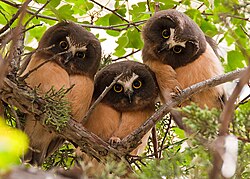
Northern saw-whet owls typically lay between four and six white eggs. These are placed in natural tree cavities or holes previously excavated by woodpeckers. To attract a mate, males often sing from a potential nest site and cache food there to demonstrate their ability to provide.
The division of labor during nesting is distinct: the father handles all hunting duties while the mother remains on the eggs to incubate them. Interestingly, these owls engage in sequential polyandry—a mating system where a female produces multiple clutches of eggs with different males within a single breeding season. Once the first brood has developed their feathers, the mother leaves the father to care for the offspring and seeks a new male to begin another clutch.
Competition and Predation
Nesting is not without risk. Saw-whet owls must compete for limited cavity space with squirrels, starlings, and boreal owls. These competitors may destroy nests or prey upon nestlings. Additionally, the owls face threats from predators such as corvids (crows and jays) and martens. Because they prefer dense thickets and brush, they often overlap in range with Accipiter hawks and other larger owls, all of which may prey on saw-whet owls of any age.
Hunting and Dietary Specialization
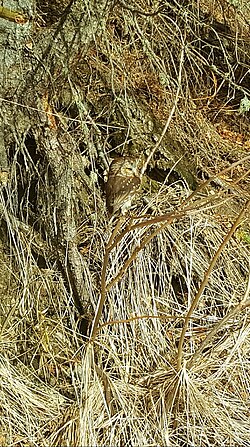
The northern saw-whet owl is an elite nocturnal hunter, capable of locating prey in total darkness. This is made possible by vertically asymmetrical ears and differently shaped ear openings. Because sound reaches each ear at a different time and intensity, the owl can pinpoint the exact location of its prey by hearing alone.
Research indicates a frequency sensitivity between 0.7 and 8.6 kHz, with peak sensitivity occurring between 1.6 and 7.1 kHz. Using this auditory precision, the owl waits on a high perch before swooping down on its target.
Dietary Composition
The diet of the northern saw-whet owl is overwhelmingly focused on small mammals. Various studies highlight this preference:
- A review of ten studies found mammals made up 88% to 100% of their diet, with rodents accounting for 85% to over 99%.
- In Wisconsin, deer mice were the primary prey (~68%), followed by voles (~16%) and shrews (~9%).
- In Montana, voles were the dominant food source at 60%.
- In Illinois, research confirmed a strong preference for small mammals (89%), with voles making up 55% of the prey.
While rodents are the staple, they occasionally hunt chipmunks, red squirrels, flying squirrels, moles, bats, and small birds such as chickadees, kinglets, sparrows, and swallows. They are capable of taking birds as large as a rock dove, which can be four times the owl's own weight. On the Pacific coast, their diet expands to include aquatic insects, frogs, and crustaceans.
Ecological Niche and Adaptation
When compared to other raptors, the northern saw-whet owl occupies a specific niche. For example, while the northern pygmy owl consumes a significant amount of birds (over one-third of its diet), the saw-whet owl relies almost exclusively on small mammals (98%). This differentiation allows multiple predator species to coexist in the same area by targeting different primary food sources.
| Species | Primary Prey Focus | Key Dietary Characteristic |
|---|---|---|
| Northern Saw-whet Owl | Small Mammals (Rodents) | Up to 98-100% mammal-based diet |
| Northern Pygmy Owl | Mixed (Mammals and Birds) | Over 1/3 of prey are birds |
| Long-eared Owl | Small Mammals | More tied to specific mammal species than the saw-whet |
Frequently Asked Questions
How do northern saw-whet owls hunt in total darkness?
They use vertically asymmetrical ears and uniquely shaped ear openings to detect the timing and intensity of sounds, allowing them to precisely localize prey by hearing alone.
What is sequential polyandry in saw-whet owls?
Sequential polyandry is a mating strategy where a female mates with one male to produce a clutch of eggs, then leaves the male to raise the offspring while she finds another male to produce a second clutch.
What are the primary prey animals for this species?
Their diet consists mainly of rodents, specifically deer mice and various species of voles, though they occasionally eat shrews, small birds, and other small mammals.
Where is the most southeastern breeding area for these owls in the US?
The most southeastern known breeding area is in the Southern Appalachian mountains, where nesting owls were found in breeding boxes in 2014.
Which animals compete with saw-whet owls for nesting sites?
They compete for tree cavities and woodpecker holes with boreal owls, starlings, and squirrels.