Norfolk Constabulary: A Comprehensive History of Policing in Norfolk
The evolution of law enforcement in Norfolk reflects the broader transition of British policing from small, localized parish watches to a professional, centralized county force. From the early 19th-century efforts to curb local disturbances to the modern integration of university-led training, the Norfolk Constabulary has adapted to the changing needs of the community for nearly two centuries.
Key Facts
- Founded: The Norfolk County Constabulary was established on November 22, 1839.
- First County Force: It was among the first county police forces formed in England.
- Major Mergers: Amalgamated with Norwich City, Great Yarmouth, and King's Lynn forces over several decades.
- Pioneering Move: Became the first English police force to abolish Police Community Support Officers (PCSOs) in 2018.
- Modern Strength: Reached a force strength of 1,888 officers by May 2022.
The 19th and 20th Century Foundations
Policing in Norfolk began with fragmented, local efforts. Wymondham, for example, operated its own parish police force from November 1833 until 1840, established under the Watching and Lighting Act 1833 to address constant depredation and disturbances. This small force consisted of only three constables.
Following the Municipal Corporations Act 1835, which mandated that local councils appoint paid constables, the Norwich City Police, Great Yarmouth Borough Police, and King's Lynn Borough Police were all formed in 1836. The Norwich City Police grew significantly, maintaining a strength of approximately 100 constables between 1858 and 1901.
The landscape shifted with the County Police Act 1839, leading to the creation of the Norfolk County Constabulary on November 22, 1839. Beginning operations in 1840, the force initially recommended a structure of one chief constable, 12 superintendents, and 120 constables distributed across roughly 12 districts. Upon its inception, the Wymondham Police were merged into this new county force.
Consolidation and Growth
Throughout the mid-20th century, smaller borough forces were gradually absorbed into the county structure. Thetford's borough force merged with the Norfolk County Constabulary in 1857, while the King's Lynn Borough Police joined in 1947 following the Police Act 1946. By 1910, the Great Yarmouth Borough Police operated with 68 constables and six horses.
By 1965, the Norfolk County Constabulary had an official establishment of 636 officers, though its actual strength was 529. A major reorganization occurred in 1968 under the Police Act 1964, when the force amalgamated with the Norwich City and Great Yarmouth Borough police to form the Norfolk Joint Constabulary. In 1974, the organization returned to its current name, the Norfolk Constabulary.
Modern Developments in the 21st Century
The early 2000s brought discussions of regionalization. In March 2006, the Home Secretary proposed merging Norfolk with the Cambridgeshire and Suffolk constabularies to create a strategic force for East Anglia. While the Norfolk Police Authority supported the idea, the neighboring forces did not. By July 2006, the Home Office reviewed the principle of the merger, leading Norfolk Constabulary to resume the recruitment of a permanent chief constable.
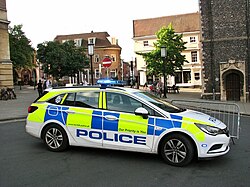
The force has also seen changes in its public image and staffing models. Uniforms shifted to black combat-style trousers and polo shirts in 2008; after a brief trial of traditional white shirts and ties in 2012, the force returned to the polo shirt.
In 2018, Norfolk became the first force in England to abolish the role of Police Community Support Officers (PCSOs), making 150 PCSOs redundant. This move allowed for the recruitment of 97 new staff, including 81 police officers. Additional funding from a 5.5% rise in the police precept of council tax further enabled the hiring of 17 officers and six staff members.
Recruitment and Training Evolution
A national uplift programme announced by the Prime Minister in 2019 allocated 224 new officers to Norfolk. This initiative saw a significant shift in demographics, with nearly half of all new recruits in 2020/2021 being female. As of May 2022, the force had recruited 211 additional officers through the uplift programme, bringing total strength to 1,888.
Training has also been modernized. In 2022, the force began utilizing the Police Education Qualifications Framework (PEQF)—a standardized professional training system—at the new Hethersett Old Hall training centre in partnership with Anglia Ruskin University.
Leadership and Sacrifice
The Norfolk Constabulary has been led by a succession of Chief Constables, ranging from the early leadership of Colonel Richard Montague Oakes in 1840 to the current leadership of Paul Sanford.
| Era/Years | Chief Constable |
|---|---|
| 1840 - n.d. | Colonel Richard Montague Oakes |
| 1880 - 1909 | Sir Paynton Pigott |
| 1928 - 1956 | Captain Stephen Hugh Van Neck |
| 1956 - 1975 | (Frederick) Peter Collison Garland |
| 2013 - 2021 | Simon Bailey |
| 2021 - Present | Paul Sanford |
The force also remembers those who made the ultimate sacrifice. The Police Roll of Honour Trust and Police Memorial Trust commemorate officers killed in the line of duty, including PC Charles William Alger, who was shot in 1909, and PC Robert Craig Orr McLaren, who died in a vehicle crash during a pursuit in 1981.
Frequently Asked Questions
When was the Norfolk County Constabulary first established?
The Norfolk County Constabulary was founded on November 22, 1839, under the County Police Act 1839, making it one of the first county forces in England.
What was the Norfolk Joint Constabulary?
The Norfolk Joint Constabulary was the name of the force from 1968 to 1974, created after the Norfolk County Constabulary amalgamated with the Norwich City Police and Great Yarmouth Borough Police.
Why did Norfolk abolish PCSOs in 2018?
Norfolk abolished the use of Police Community Support Officers to reallocate resources, allowing the force to recruit 97 new staff members, including 81 full police officers.
How is new officer training handled in Norfolk today?
Since 2022, recruits are trained under the Police Education Qualifications Framework (PEQF) at the Hethersett Old Hall training centre in partnership with Anglia Ruskin University.
How many officers were in the force as of May 2022?
Following a national uplift programme, the force strength reached 1,888 police officers by May 2022.