Nominal GDP per Capita: Global Trends and Economic Indicators
Nominal gross domestic product (GDP) per capita is a fundamental economic metric calculated by dividing a country's total value of finished goods and services (GDP) by its total population. While it is frequently used as a proxy to gauge a nation's standard of living, it is important to recognize that this figure is not a direct measure of personal income.
To get a more accurate picture of individual prosperity, economists look toward measures of personal income, such as average wage, real income, median income, disposable income, and gross national income (GNI) per capita. Furthermore, nominal GDP does not account for social or environmental costs and benefits, which can significantly impact the actual quality of life.
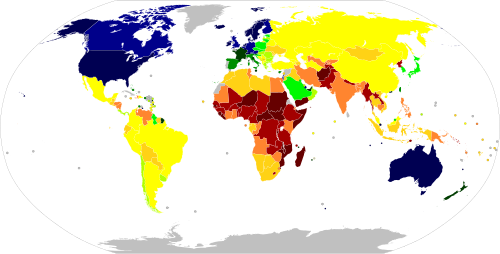
Key Facts
- Nominal GDP per capita is the total economic output divided by the population.
- Purchasing Power Parity (PPP) is used to adjust for cost-of-living differences between countries.
- Exchange rate fluctuations can cause a country's nominal GDP ranking to change even if the actual standard of living remains stable.
- Tax havens often show artificially inflated GDP figures due to corporate accounting and shell companies.
- Modified GNI (GNI*) was created by the Central Bank of Ireland to provide a more accurate economic statistic by removing distortions from multinational tax planning.
Comparing Nominal GDP and PPP
Because nominal GDP is calculated using current market exchange rates, it is susceptible to volatility. To mitigate this, comparisons are often made using Purchasing Power Parity (PPP). PPP adjusts for the different costs of goods and services in different countries, effectively removing the exchange rate problem.
However, PPP is not a perfect solution. It requires more estimation than nominal GDP and does not reflect the actual value of economic output in international trade. Generally, PPP per capita figures show a narrower spread between wealthy and poor nations than nominal GDP figures do.
The Impact of Tax Havens on Economic Data
A significant challenge in analyzing global GDP data is the presence of tax havens. Jurisdictions such as Bermuda, the Cayman Islands, Ireland, and Luxembourg often report exceptionally high GDP per capita figures that are materially distorted by tax-planning activities of foreign multinationals.
Much of this growth is artificial. Approximately $12 trillion—nearly 40 percent of all global foreign direct investment positions—consists of financial investments passing through empty corporate shells with no real economic activity. Eight major "pass-through" economies host over 85 percent of the world's investment in these special purpose entities: the Netherlands, Luxembourg, Hong Kong SAR, the British Virgin Islands, Bermuda, the Cayman Islands, Ireland, and Singapore.
The Case of Ireland
Ireland serves as a primary example of this distortion. In 2015, Irish GDP was 143% of its Modified GNI (GNI*). To address this discrepancy, the Central Bank of Ireland developed GNI* to better reflect the actual economy, a metric subsequently adopted by the IMF and OECD.
Global GDP per Capita Data
The following table provides a comparison of GDP per capita estimates from the International Monetary Fund (IMF), the World Bank, and the United Nations. All figures are expressed in current United States dollars.
| Country/Territory | IMF (2026) | World Bank (2025) | United Nations (2023-24) |
|---|---|---|---|
| Monaco | N/a | 288,002 (2024) | 288,002 |
| Liechtenstein | 226,809 | 220,167 (2024) | 216,392 |
| Luxembourg | 158,733 | 147,252 | 138,596 |
| Bermuda | N/a | 142,250 (2024) | 136,766 |
| Ireland | 140,186 | 131,593 | 109,874 |
| Switzerland | 126,177 | 114,769 | 104,973 |
| United States | 94,430 | 90,027 | 84,817 |
| China | 14,874 | 13,862 | 13,206 |
| India | 2,813 | 2,703 | 2,724 |
| World (Average) | 14,217 | 14,406 | 13,097 |
Frequently Asked Questions
Why is nominal GDP per capita not a perfect measure of living standards?
It does not account for the cost of living in different countries, ignores income inequality (it is an average, not a median), and fails to include social and environmental factors that contribute to quality of life.
What is the difference between nominal GDP and PPP?
Nominal GDP uses current market exchange rates, while Purchasing Power Parity (PPP) adjusts for the cost of goods and services in each country, providing a more accurate comparison of actual buying power.
How do tax havens distort GDP data?
Tax havens often host shell companies and special purpose entities. The financial flows and corporate accounting entries associated with these entities inflate the GDP figures without creating real economic activity or increasing the wealth of the local population.
What is Modified GNI (GNI*)?
Modified GNI is a statistic created by the Central Bank of Ireland to provide a more accurate measure of the national economy by removing the distortions caused by the tax-planning activities of foreign multinational corporations.
Why are some countries missing from IMF rankings?
Certain UN members, such as Cuba, Monaco, and North Korea, are not members of the International Monetary Fund (IMF), and therefore their economies are not ranked in IMF-specific charts.