No Toilet, No Bride: Leveraging Marriage Markets for Sanitation in India
In 2005, state authorities in Haryana, India, launched a provocative public health campaign titled No Toilet, No Bride. This initiative sought to tackle a critical infrastructure gap by encouraging young women to refuse marriage proposals from men whose homes lacked latrines. By linking sanitation to social status and marriageability, the campaign aimed to transform the rural landscape of Haryana.
At the time of the launch, approximately 70% of rural households in Haryana practiced open defecation. This lack of infrastructure led to widespread fecal pollution and the spread of disease. Beyond health risks, open defecation posed severe safety concerns for women, who often faced harassment and staring from men. To avoid this, many women waited until nightfall to attend to their needs, a practice that unfortunately led to numerous cases of sexual assault in rural communities.
The Strategy: Marriage as Social Leverage
Recognizing that private latrines were highly valued by women, campaigners identified the marriage arrangement process as a unique moment of social power. In a patrilocal society—where a bride typically moves into the groom's family home—the demand for a toilet became a precondition for marriage.
The state promoted this shift through a wide-reaching media blitz. Billboards, radio advertisements, and posters featured slogans such as "No Toilet, No Bride" and "No Loo, No 'I Do'." Additionally, village walls were painted with Hindi phrases stating, "I won't allow my daughter to marry into a home without toilets," signaling a collective shift in parental and bridal expectations.
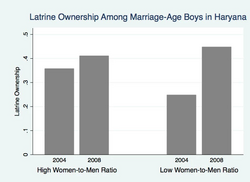
Measuring the Impact on Sanitation
The campaign's influence extended beyond Haryana. By 2011, reports from The Deccan Herald indicated that bridal families in Delhi were incorporating questions about the groom's family's latrine facilities into their marriage negotiations.
Scientific studies have since quantified the campaign's effectiveness. A 2012 study revealed a 15% overall increase in male investment in sanitation across Haryana. Interestingly, the effect was significantly stronger in marriage markets where men outnumbered women (a 26% increase) compared to areas where women outnumbered men (a 6% increase). This suggests that skewed sex ratios increased the bargaining power of women.
Further research in 2017 confirmed these findings, showing a 21% increase in private bathrooms in households with boys active in the marriage market. Conversely, households without marriage-age sons saw no significant change in sanitation investment.
| Metric/Group | Increase in Sanitation/Bathrooms |
|---|---|
| Overall male investment in Haryana (2012 study) | 15% |
| Areas with more men than women (2012 study) | 26% |
| Areas with more women than men (2012 study) | 6% |
| Households with marriage-market active boys (2017 study) | 21% |
| Households without marriage-market active boys (2017 study) | No significant effect |
Expansion and Global Interest
The campaign's logic eventually led to more formal requirements. In 2013, authorities in the Sehore district required prospective grooms to submit photographs of themselves with a functioning toilet to register for mass marriage events and receive benefits. By 2017, a scheduled caste community in Sheopur made toilet certificates mandatory for marriage.
This movement also gained traction among various religious and regional groups. In 2017, 1,200 representatives from 110 villages across Haryana, Punjab, and Himachal Pradesh—mostly from Muslim communities—unanimously decided to require certificates of functioning toilets before solemnizing marriages. The concept even reached international attention in 2017, when Ghanaian politician Cecilia Dapaah proposed adopting the "No Toilet, No Bride" demand in Ghana.
Key Facts
- Launch: Started in 2005 in Haryana, India.
- Primary Goal: To reduce open defecation (practiced by 70% of rural Haryana households at launch) and improve women's safety.
- Mechanism: Used the marriage market to give women bargaining power to demand home latrines.
- Effectiveness: Led to a 21% increase in private bathrooms for households with marriage-age sons.
- Demographic Influence: The campaign was most effective in areas where men outnumbered women.
- Formalization: Some districts and communities eventually required photographic evidence or certificates of functioning toilets for marriage.
Frequently Asked Questions
Why was the "No Toilet, No Bride" campaign created?
The campaign was created to combat fecal pollution and diseases caused by open defecation, and to protect women from harassment and sexual assault that occurred when they were forced to defecate in the open.
How did the campaign influence the marriage market?
It encouraged women and their families to make the existence of a functioning latrine in the groom's home a mandatory precondition for marriage, shifting the social power dynamic during negotiations.
Did the campaign work in all areas equally?
No. Research showed it was significantly more effective in areas where there were more men than women, as this skewed sex ratio increased the bargaining power of the brides.
What evidence was required in some regions to prove toilet ownership?
In some areas, such as the Sehore district, grooms were required to provide photos of themselves with their toilets, while other communities required official certificates confirming the toilet was functioning.
Has this initiative been proposed outside of India?
Yes, in 2017, Ghanaian politician Cecilia Dapaah proposed that Ghana adopt the "No Toilet, No Bride" demand.