NIH Police: Department Structure and Security Operations
The National Institutes of Health (NIH) maintains a comprehensive security apparatus to ensure the safety of its campuses, personnel, and research assets. Central to this effort is the NIH Police, a specialized law enforcement agency comprising approximately 105 officers dedicated to maintaining order and security across the institution's facilities.
Key Facts
- The department consists of roughly 105 sworn officers.
- Security is a joint effort between the NIH Police and the contracted Guard Force Operations Branch (GFOB).
- The force includes specialized units such as K9, Intelligence, and Tactical Medical Officers.
- Perimeter security is managed by a combination of police officers, contracted guards, and security technicians.
Organizational Structure and Specialized Units
The NIH Police department is organized into several functional units to address a wide array of security needs, ranging from routine patrols to high-stakes emergency responses. These specialized divisions ensure that the department can handle diverse operational requirements efficiently.
The department's capabilities are divided among the following units:
- Patrol Units: The primary visible presence providing general law enforcement.
- K9: Canine units trained for specific detection and security tasks.
- Investigators and Intelligence Unit: Focused on gathering information and conducting detailed inquiries.
- Special Response Team: A tactical unit prepared for high-risk incidents.
- Training Division and Firearms Instructors: Ensuring all personnel maintain professional standards and proficiency.
- Tactical Medical Officers: Specialized personnel providing medical support in tactical environments.
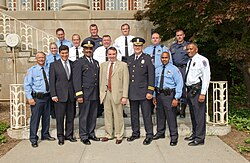
Campus Security and Perimeter Defense
Security at the NIH is a multi-layered operation. While the NIH Police provide law enforcement authority, the Guard Force Operations Branch (GFOB)—a contracted security force—manages physical security at campus gates.
The perimeter defense strategy relies on three distinct roles to maintain a secure environment:
- Police Officers: Providing sworn law enforcement oversight.
- Contracted Security Guards: Managing access control and physical presence.
- Security Technicians: Maintaining the technical infrastructure and surveillance systems.
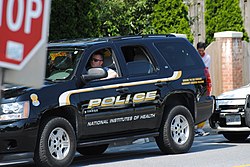
Rank Hierarchy
The NIH Police follow a structured chain of command to ensure clear communication and operational leadership. The hierarchy progresses from entry-level patrol roles to executive leadership.
| Rank Level | Title |
|---|---|
| Entry/Junior | Patrol Officer |
| Junior | Patrol Officer First Class |
| Junior/Mid | Corporal |
| Mid | Master Patrol Officer |
| Supervisory | Sergeant |
| Management | Lieutenant |
| Management | Captain |
| Senior Leadership | Major |
| Executive | Deputy Chief |
| Executive | Chief |
Frequently Asked Questions
How many officers are in the NIH Police department?
The department consists of approximately 105 officers.
What is the difference between the NIH Police and the GFOB?
The NIH Police are sworn law enforcement officers, whereas the Guard Force Operations Branch (GFOB) is a contracted security force primarily responsible for physical security at campus gates.
Who is responsible for perimeter security at NIH campuses?
Perimeter security is maintained by a combination of Police Officers, Contracted Security Guards, and Security Technicians.
What specialized units exist within the NIH Police?
Specialized units include Patrol Units, K9, Investigators, the Intelligence Unit, the Special Response Team, the Training Division, Firearms Instructors, and Tactical Medical Officers.
What is the highest rank in the NIH Police structure?
The highest rank in the department is the Chief.