Nicolas Slonimsky: The Polymath of 20th Century Music
Nicolas Slonimsky was a towering figure in the world of music, operating at the intersection of performance, scholarship, and composition. A Russian-American musicologist, conductor, pianist, and lexicographer, Slonimsky spent over a century documenting and shaping the musical landscape of the modern era. While he was a formidable performer and conductor, he is perhaps most revered today for his exhaustive reference works that continue to influence musicians across genres, from classical avant-garde to jazz.
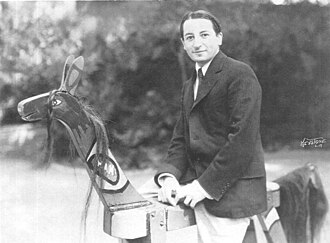
Born Nikolai Leonidovich Slonimskiy in Saint Petersburg on April 27, 1894, Slonimsky was raised within the Russian intelligentsia. His early musical foundation was laid by his maternal aunt, Isabelle Vengerova, who would later help found the Curtis Institute of Music in Philadelphia.
Early Life and Migration
The turbulence of the Russian Revolution in 1917 forced Slonimsky to flee his homeland. His journey took him through Kiev and Constantinople before he settled in Paris. In France, he worked as an accompanist for the conductor Serge Koussevitzky and toured Europe with tenor Vladimir Rosing. This period of migration expanded his musical horizons and established the international connections that would define his career.
In 1923, Slonimsky moved to the United States at the invitation of Rosing, who had become the director of opera at the Eastman School of Music in Rochester, New York. This move marked the beginning of his long and influential tenure in America.
A Champion of the Avant-Garde
Slonimsky's career as a conductor was characterized by a fearless commitment to contemporary music. After a period in Boston—where he served as a bilingual secretary and pianist for Serge Koussevitzky of the Boston Symphony Orchestra—he founded the Boston Chamber Orchestra in 1927. He used this ensemble to champion the works of modern composers, often commissioning and premiering pieces that were considered radical at the time.
Among his most significant achievements was conducting the world premieres of Charles Ives' Three Places in New England in 1931 and Edgard Varèse's Ionisation in 1933. The latter, written for thirteen percussionists, remains a landmark of 20th-century percussion music.
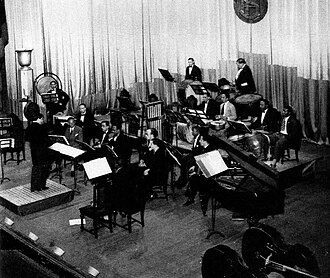
His passion for the new took him to Havana in 1932, where he conducted concerts featuring the works of Ives, Cowell, Ruggles, and Latin American composers Amadeo Roldán and Alejandro García Caturla. He viewed conducting as "the nearest approximation to music in motion," though his bold programming occasionally sparked controversy, most notably during a series of concerts at the Hollywood Bowl in 1933.
The Master Lexicographer
As his conducting career transitioned, Slonimsky leaned into his role as a diaskeuast—a term he used (derived from Greek) to describe himself as a reviser or interpolator. He became one of the most prolific musical writers of his time, blending rigorous factual accuracy with a sharp, often satirical wit.
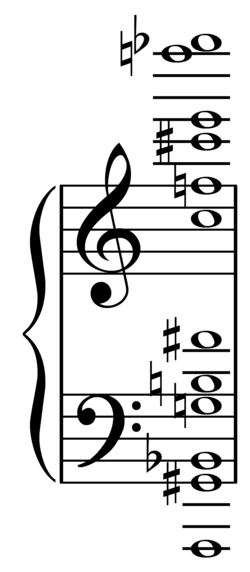
His most enduring legacy is the 1947 publication of the Thesaurus of Scales and Melodic Patterns. This sourcebook became a vital tool for composers and improvisers. While initially overlooked, it later became a cornerstone for jazz legends such as John Coltrane and Frank Zappa. Quincy Jones later recalled that Coltrane was frequently seen with a copy of Slonimsky's book.
Slonimsky also displayed a penchant for the humorous and the scathing. In 1953, he published the Lexicon of Musical Invective, a collection of the most vitriolic critiques ever written about great composers. His commitment to precision also led him to serve as the head editor of Baker's Biographical Dictionary of Musicians from 1958 until 1992.
Later Years and Legacy
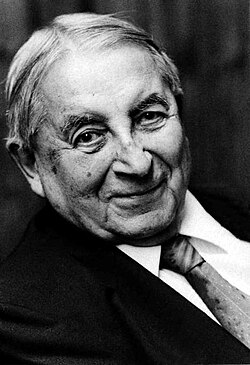
In his later years, Slonimsky moved to Los Angeles, where he taught at UCLA and became a beloved personality in the media, appearing on programs like Johnny Carson's Tonight Show. He formed an unlikely but deep friendship with the avant-garde rock musician Frank Zappa, performing his own compositions at a Zappa concert in 1981.
Even in his nineties, Slonimsky remained active. For his 98th birthday, he returned to his birthplace of Saint Petersburg for a music festival. He lived to the age of 101, passing away on December 25, 1995. His extensive archives are now preserved in the Library of Congress.
Key Facts
- Lifespan: 1894–1995 (died at age 101).
- Major Work: Author of the Thesaurus of Scales and Melodic Patterns, a key influence on jazz and modern composition.
- Conducting Milestones: Conducted world premieres of works by Charles Ives and Edgard Varèse.
- Editorial Role: Head editor of Baker's Biographical Dictionary of Musicians for over three decades.
- Diverse Talents: Accomplished as a pianist, composer, musicologist, and lexicographer.
| Work | Year | Description |
|---|---|---|
| Music Since 1900 | 1937 | A comprehensive chronology of modern music. |
| Music of Latin America | 1945 | The first thorough English coverage of the region's music. |
| Thesaurus of Scales and Melodic Patterns | 1947 | Influential sourcebook for jazz and classical composers. |
| Lexicon of Musical Invective | 1953 | A collection of scathing historical music critiques. |
| Perfect Pitch | 1988 | His autobiography detailing 20th-century musical life. |
Frequently Asked Questions
What is the Thesaurus of Scales and Melodic Patterns?
It is a comprehensive reference book published in 1947 that provides a vast array of scales and melodic structures. It became a primary resource for improvisers and composers, most notably influencing jazz musicians like John Coltrane.
Who were some of the composers Slonimsky championed?
Slonimsky was a major advocate for contemporary and avant-garde composers, including Charles Ives, Edgard Varèse, Henry Cowell, and various Latin American composers such as Amadeo Roldán.
What does Slonimsky mean by the term "diaskeuast"?
Derived from Greek, Slonimsky used this term to describe himself as a "reviser or interpolator," reflecting his passion for editing, correcting, and organizing musical knowledge in his lexicographical work.
Did Nicolas Slonimsky compose his own music?
Yes, he composed various works, including piano pieces like the Yellowstone Park Suite and Russian Nocturne, as well as chamber music and satirical songs.
What was his relationship with Frank Zappa?
Slonimsky and Zappa were friends who shared an interest in the avant-garde. Slonimsky even performed his own compositions at one of Zappa's concerts in Santa Monica in 1981.