Nicator: The Unique Songbirds of Sub-Saharan Africa
The nicators are a specialized group of songbirds endemic to Africa. Belonging to the genus Nicator and the family Nicatoridae, these birds have long fascinated ornithologists due to their distinct physical characteristics and a complex taxonomic history that has seen them shifted between various bird families over the decades.
Key Facts
- Endemic Range: Found exclusively in Sub-Saharan Africa.
- Species Count: The genus contains three distinct species.
- Physical Traits: Characterized by heavy hooked bills and olive-colored plumage.
- Taxonomic Status: Now widely recognized as a monogeneric family (Nicatoridae).
- Size: Range from 16 to 23 cm in length.
Taxonomic History and Classification
For many years, the systematic affinities—the evolutionary relationships—of the nicator were a mystery. Originally, they were classified as shrikes (Laniidae). By the 1920s, researcher James Chapin noted similarities to both bushshrikes (Malaconotidae) and bulbuls (Pycnonotidae). In 1943, Jean Théodore Delacour officially placed them with the bulbuls.
However, Storrs Olson later challenged this, arguing that nicators are more closely related to bushshrikes because they lack the ossification (hardening into bone) of the nostril found in bulbuls. Unique features such as their calls, nesting habits, and the position of their facial bristles—which are preorbital (located in front of the eye) rather than rictal (located at the corner of the mouth)—set them apart.
Recent DNA studies have confirmed that the genus is unique enough to be treated as its own monogeneric family, Nicatoridae. The name "Nicator" is derived from the Greek word Nikátōr, meaning "conqueror." Within this group, the western and eastern nicators are so similar that they are sometimes considered a single superspecies.
Species and Distribution
There are three recognized species of nicators, each occupying different regions of the African continent. They primarily inhabit various woodland and forest environments.
| Common Name | Scientific Name | Primary Distribution |
|---|---|---|
| Western nicator | Nicator chloris | Senegal to eastern Uganda and northern Angola |
| Eastern nicator | Nicator gularis | Somalia south to eastern South Africa |
| Yellow-throated nicator | Nicator vireo | Central Africa (Cameroon to Uganda) |
The western nicator maintains a mostly continuous range across West and Central Africa. In contrast, the eastern nicator has a discontinuous distribution across East Africa. The yellow-throated nicator is concentrated in the central regions of the continent.
Physical Description
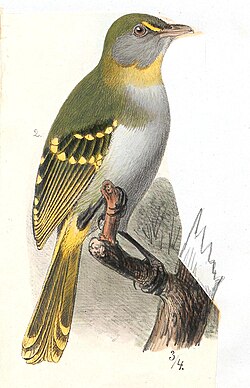
Nicators are shrike-like birds measuring between 16 and 23 cm (6.3–9.1 in) in length. Their plumage is generally olive on the wings, tail, and back, featuring distinctive yellow spotting on the wings and lighter grey or whitish undersides. One of their most prominent features is a heavy, hooked bill.
There is a significant difference in mass between species and genders. The eastern and western nicators are larger than the yellow-throated nicator. Furthermore, males are considerably heavier than females. For instance, a male western nicator weighs between 48 and 67 g (1.7–2.4 oz), while the female weighs between 32 and 51 g (1.1–1.8 oz). The yellow-throated nicator is the lightest of the group, ranging from 21 to 26 g (0.74–0.92 oz).
Frequently Asked Questions
What does the name "Nicator" mean?
The name is derived from the Greek word Nikátōr, which translates to "conqueror."
Why were nicators difficult to classify?
They share physical and behavioral traits with shrikes, bushshrikes, and bulbuls, but possess unique features—such as the position of their facial bristles and the lack of nostril ossification—that distinguish them from all three groups.
Where can nicators be found in the wild?
They are endemic to Sub-Saharan Africa, where they live in a variety of forest and woodland habitats.
How do the three species differ in size?
The western and eastern nicators are the larger species, while the yellow-throated nicator is significantly smaller and lighter.
Are the western and eastern nicators the same species?
While they are distinct species, they are closely related enough to be considered a superspecies and are occasionally treated as the same species by some authorities.