New Zealand historyMāori cultureAotearoaNew Zealand geographyNew Zealand economy

New Zealand: A Comprehensive Overview of Aotearoa

Exploring Aotearoa: A Comprehensive Guide to New Zealand New Zealand, known in Māori as Aotearoa, is a nation defined by its breathtaking landscapes, rich indigenous heritage, and a uniqu...

Exploring Aotearoa: A Comprehensive Guide to New Zealand

New Zealand, known in Māori as Aotearoa, is a nation defined by its breathtaking landscapes, rich indigenous heritage, and a unique blend of modern and traditional cultures. Located in the southwestern Pacific Ocean, this island nation offers everything from snow-capped mountains to subtropical peninsulas, making it one of the most geographically diverse countries in the world.

Islands of New Zealand as seen from satellite
The snow-capped Southern Alps dominate the South Island, while the North Island's Northland Peninsula stretches towards the subtropics.
: The snow-capped Southern Alps dominate the South Island, while the North Island's Northland Peninsula stretches towards the subtropics.

Key Facts

Black and white engraving depicting a crowd of people
A meeting of European and Māori residents of Hawke's Bay Province. Engraving, 1863.
  • Capital: Wellington
  • Largest City: Auckland
  • Official Languages: English, Māori, and NZ Sign Language
  • Population: Approximately 5.35 million (2026 estimate)
  • Currency: New Zealand dollar (NZD)
  • Government: Unitary parliamentary constitutional monarchy

History and Heritage

Residents of Dunedin celebrate the news of the Armistice of 11 November 1918.

The history of New Zealand is a profound narrative of exploration and settlement. The Māori people are descendants of Polynesians whose ancestors migrated from Taiwan to Melanesia between 3000 and 1000 BCE. After traveling east to the Society Islands around 1000 CE, a subsequent wave of exploration led to the discovery and settlement of New Zealand.

One set of arrows point from Taiwan to Melanesia to Fiji/Samoa and then to the Marquesas Islands. The population then spread, some going south to New Zealand and others going north to Hawai'i. A second set start in southern Asia and end in Melanesia.
The Māori people descend from Polynesians whose ancestors emigrated from Taiwan to Melanesia between 3000 and 1000 BCE and then travelled east, reaching the Society Islands c. 1000 CE. After a pause of 200 to 300 years, a new wave of exploration led to the discovery and settlement of New Zealand.[30][31][32]
: The Māori people descend from Polynesians whose ancestors emigrated from Taiwan to Melanesia between 3000 and 1000 BCE and then travelled east, reaching the Society Islands c. 1000 CE. After a pause of 200 to 300 years, a new wave of exploration led to the discovery and settlement of New Zealand.[30][31][32]

A pivotal moment in the nation's formal history was the signing of the Treaty of Waitangi on 6 February 1840, which established the relationship between the British Crown and Māori. Over the following century, New Zealand transitioned through various stages of independence, moving from responsible government in 1856 to becoming a Dominion in 1907, and eventually adopting the Statute of Westminster in 1947.

A torn sheet of paper
The Waitangi sheet from the Treaty of Waitangi
: The Waitangi sheet from the Treaty of Waitangi
Brown square paper with Dutch writing and a thick red, curved line
Detail from a 1666 map showing the western coastline of Nova Zeelandia (on this map, north is at the bottom)
: Detail from a 1666 map showing the western coastline of Nova Zeelandia (on this map, north is at the bottom)

Geography and Climate

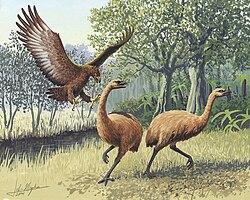
An artist's rendition of a Haast's eagle attacking two moa
The giant Haast's eagle died out when Māori hunted its main prey, the moa, to extinction.

New Zealand's geography is characterized by dramatic contrasts. The South Island is dominated by the Southern Alps, featuring Aoraki / Mount Cook, the nation's highest peak at 3,724 metres. In contrast, the North Island features more subtropical regions, such as the Northland Peninsula.

Aoraki / Mount Cook is the highest point in New Zealand, at 3,724 metres.
: Aoraki / Mount Cook is the highest point in New Zealand, at 3,724 metres.

The climate varies significantly depending on the region. While Auckland enjoys relatively mild temperatures, areas like Hokitika experience much higher annual rainfall. The nation's biodiversity is equally varied, hosting unique species such as the endemic, flightless kiwi.

Kiwi among sticks
The endemic flightless kiwi is a national icon.
: The endemic flightless kiwi is a national icon.
Blue water against a backdrop of snow-capped mountains
Milford Sound / Piopiotahi is one of New Zealand's most famous tourist destinations.[251]
: Milford Sound / Piopiotahi is one of New Zealand's most famous tourist destinations.[251]

Regional Climate Comparison

Average Temperature and Rainfall by City
Location Jan High (°C) Jan Low (°C) July High (°C) July Low (°C) Annual Rainfall (mm)
Auckland 23 15 8 6 1,212
Wellington 20 14 11 6 1,207
Hokitika 20 12 3 3 2,901
Christchurch 23 12 11 2 618
Alexandra 25 11 8 −2 359

Demographics and Culture

A map of New Zealand divided into regions and territorial authorities with labels
Map of regions (coloured) and territorial authorities (outlined) in New Zealand

New Zealand is a multicultural society. As of 2023, the ethnic composition includes 67.8% European, 19.6% Māori, 17.3% Asian, and 8.9% Pacific peoples. This diversity is reflected in the nation's vibrant arts, festivals, and culinary traditions, such as the hāngī—a traditional Māori method of cooking food using heated stones buried in a pit.

Raw meat and vegetables
Ingredients to be prepared for a hāngī
: Ingredients to be prepared for a hāngī

Cultural expression is central to the New Zealand identity. This is perhaps most visible in the haka, a ceremonial challenge characterized by vigorous movements and foot stamping, famously performed by the national rugby team, the All Blacks.

Rugby team wearing all black, facing the camera, knees bent, and facing toward a team wearing white
A haka performed by the national rugby union team ("All Blacks") before a game. The haka is a challenge with vigorous movements and stamping of the feet.
: A haka performed by the national rugby union team ("All Blacks") before a game. The haka is a challenge with vigorous movements and stamping of the feet.
Pasifika Festival celebrating Pasifika New Zealanders and their pan-cultural identity
: Pasifika Festival celebrating Pasifika New Zealander and their pan-cultural identity
Refer to caption
Portrait of Hinepare of Ngāti Kahungunu by Gottfried Lindauer, showing chin moko, pounamu hei-tiki and woven cloak
: Portrait of Hinepare of Ngāti Kahungunu by Gottfried Lindauer, showing chin moko, pounamu hei-tiki and woven cloak

Economy and Infrastructure

A squad of men kneel in the desert sand while performing a war dance
Māori Battalion haka in Egypt, 1941

The New Zealand economy is diverse, with significant contributions from agriculture, tourism, and technology. Historically, wool has been a major export, and the nation continues to be a key player in global trade. The infrastructure supports a modern economy, from major hubs like Auckland's waterfront to the national carrier, Air New Zealand.

Boats docked in blue-green water. Plate glass skyscrapers rising up in the background.
Waterfront along Auckland CBD, a major hub of economic activity
: Waterfront along Auckland CBD, a major hub of economic activity
A Romney ewe with her two lambs
Wool has historically been one of New Zealand's major exports.
: Wool has historically been one of New Zealand's major exports.
A mid-size jet airliner in flight. The plane livery is all-black and features a New Zealand silver fern mark.
A Boeing 787-9 Dreamliner of Air New Zealand, the flag carrier of New Zealand
: A Boeing 787-9 Dreamliner of Air New Zealand, the flag carrier of New Zealand

Government and Politics

A soldier in a green army uniform faces forward
Anzac Day service at the National War Memorial

New Zealand operates as a unitary parliamentary constitutional monarchy. The current Monarch is Charles III, represented by the Governor-General, Cindy Kiro. The political leadership is headed by Prime Minister Christopher Luxon, with the legislature residing in Parliament.

A block of buildings fronted by a large statue.
A statue of Richard Seddon, the "Beehive" (Executive Wing), and Parliament House (right), in Parliament Grounds, Wellington
: A statue of Richard Seddon, the "Beehive" (Executive Wing), and Parliament House (right), in Parliament Grounds, Wellington
Former New Zealand prime minister Jacinda Ardern with US president Joe Biden in the Oval Office, 2022
: Former New Zealand prime minister Jacinda Ardern with US president Joe Biden in the Oval Office, 2022

Frequently Asked Questions

New Zealand physicist Ernest Rutherford has been described as "the father of nuclear physics".
Stationary population pyramid broken down into 21 age ranges.
Population pyramid (2017)
Pedestrians crossing a wide street which is flanked by storefronts
Pedestrians on Queen Street in Auckland, an ethnically diverse city
Map of New Zealand showing the percentage of people in each census area unit who speak Māori. Areas of the North Island exhibit the highest Māori proficiency.
Speakers of Māori according to the 2013 census:[334] Less than 5% More than 5% More than 10% More than 20% More than 30% More than 40% More than 50%
The Wellington Cathedral of St Paul in Wellington.
Lorde is one of the most internationally successful New Zealand artists.
Hills with inset, round doors. Reflected in water.
The Hobbiton Movie Set, located near Matamata, was used for The Lord of the Rings film trilogy.[405]

What are the official languages of New Zealand?

New Zealand has three official languages: English, Māori, and New Zealand Sign Language.

What is the capital city of New Zealand?

The capital city of New Zealand is Wellington.

What is a "Kiwi" in the context of New Zealand?

While "kiwi" refers to the endemic flightless bird, it is also used as a colloquial demonym for New Zealanders.

How is the population of New Zealand distributed?

The population is concentrated in major urban centers, with Auckland being the largest city, followed by Christchurch, Wellington, and Hamilton.

What is the significance of the Treaty of Waitangi?

The Treaty of Waitangi, signed in 1840, is a foundational document that established the relationship between the British Crown and Māori, marking a key stage in the nation's independence.