Exploring the New York State College of Agriculture and Life Sciences at Cornell University
Nestled in Ithaca, New York, the New York State College of Agriculture and Life Sciences—commonly known as CALS or the "Ag School"—stands as a titan of agricultural education. As one of Cornell University's four statutory colleges, it holds the unique distinction of being the only agricultural college within the prestigious Ivy League. With a rich history spanning over 150 years, CALS combines the resources of a private Ivy League institution with the mission of a land-grant university to serve the state of New York and the world.
Today, CALS is a massive academic engine, serving as Cornell's second-largest undergraduate college and the third-largest of its kind in the United States. Through its partnership with The State University of New York, it administers essential cooperative extension programs, ensuring that scientific research reaches farmers, businesses, and communities across the state.
Key Facts
- Established: 1874
- Rankings: Ranked 1st in "Food and Nutrition" and "Agricultural Sciences" by Niche.com (2025).
- Enrollment: Approximately 3,390 undergraduates and 1,100 postgraduates.
- Unique Status: The only agricultural college in the Ivy League.
- Major Facilities: Includes the Agriculture Quadrangle and the NYSAES in Geneva, NY.
Academic Excellence and Diverse Programs
CALS offers a vast array of academic pathways designed to address modern challenges in science and society. Students can choose from more than 20 majors categorized into four primary pillars: Life Sciences, Applied Social Sciences, Environmental Sciences, and Agriculture and Food.
Undergraduate and Graduate Degrees
Undergraduate students pursue a Bachelor of Science degree across 22 different majors. These include specialized fields such as:
- Animal Science and Plant Sciences
- Biological Engineering and Environmental Engineering
- Viticulture & Enology (the study of grape growing and winemaking)
- Food Science and Nutritional Sciences
- Global Development and Communication
For those seeking a customized education, the college offers an Interdisciplinary degree option, allowing students to design a major that aligns with specific career goals. Graduate students can pursue advanced research through various degrees, including M.A.T., M.L.A., M.P.S., M.S., and PhD programs.
Research Facilities and the Agriculture Quadrangle
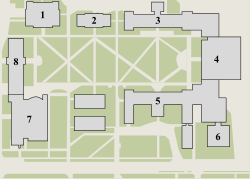
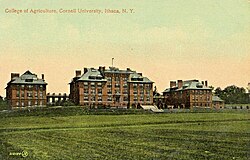
The physical heart of the college is the Agriculture Quadrangle (Ag Quad), a collection of state-owned buildings dedicated to the college's programs. This historic area features the art deco Albert R. Mann Library and the Plant Science Building. While some original structures like Stone Hall and Roberts Hall were demolished in 1988, they were replaced by modern facilities like Kennedy and Roberts Halls.
Statewide Research Impact
CALS extends its reach far beyond the Ithaca campus. The New York State Agricultural Experiment Station (NYSAES) in Geneva operates 20 buildings across 130 acres, supplemented by over 700 acres of test plots. Notable features include:
- Sutton Road Solar Farm: A 2-megawatt facility that offsets nearly 40% of the station's annual electricity needs.
- Specialized Laboratories: Research substations in Fredonia, Highland, and Riverhead.
- Dilmun Hill Student Farm: A student-run facility in Ithaca focused on sustainable agricultural practices.
Cutting-Edge Specialized Labs
Innovation at CALS spans from the soil to the digital realm. The Rich's Food Safety Lab focuses on training the next generation of food safety leaders, while the Social Media Lab investigates human interaction in digital communities. Interestingly, the Social Media Lab coined the term "the Butler Lie"—a reference to using polite, untrue excuses (like "Gotta go, boss is coming!") to avoid the social awkwardness of ending an instant message.
A Legacy of Innovation and History
The roots of CALS trace back to 1867, when George Chapman Caldwell became the first professor at Cornell. While the university's early leadership was initially hesitant about agricultural education, the arrival of Isaac P. Roberts in 1874 provided the necessary credibility. By 1888, the various departments were formally combined to create the Cornell College of Agriculture.
The college underwent a significant transformation in 1904 when Liberty Hyde Bailey helped secure state funding, leading to the establishment of the New York State College of Agriculture. In 1971, the name was expanded to include "Life Sciences" to reflect its growing academic breadth.
Notable Alumni
The impact of CALS is evident in the achievements of its graduates, who have excelled in diverse fields:
- Barbara McClintock: Nobel Laureate in Physiology and Medicine and plant geneticist.
- Robert C. Baker: Inventor of the chicken nugget and turkey hot dog.
- William F. Friedman: Geneticist who became a renowned WWII code breaker.
- Gregory Goodwin Pincus: Key figure in the development of hormonal contraception.
Summary of College Overview
| Category | Details |
|---|---|
| Type | Statutory College |
| Current Dean | Benjamin Z. Houlton |
| Total Budget (approx.) | $283 Million (excluding Geneva Station) |
| Admission Rate (2018) | 11.5% |
| Primary Location | Ithaca, New York |
Frequently Asked Questions
Is CALS part of the Ivy League?
Yes. While CALS is a statutory college receiving state funding, it is part of Cornell University, making it the only agricultural college in the Ivy League.
What makes the admission process competitive?
Admission is highly competitive; for example, the fall 2018 admission rate was 11.5%, placing it in the middle range of competitiveness relative to other Cornell colleges.
What is the purpose of the cooperative extension program?
Administered alongside the College of Human Ecology, the extension program fulfills Cornell's land-grant mission by disseminating scientific research and resources to the public and agricultural sectors across New York State.
Does the college offer research opportunities for students?
Yes, students can engage in research through various facilities, including the Dilmun Hill Student Farm, the Social Media Lab, and the Rich's Food Safety Lab.
How does the college support sustainability?
The college utilizes sustainable practices such as the student-run Dilmun Hill Student Farm and the Sutton Road Solar Farm, which provides significant renewable energy to the Geneva research station.