New Thought Movement: History, Key Figures, and Evolution
The New Thought movement emerged as a diverse collection of spiritual and philosophical beliefs centered on the power of the mind to influence physical and circumstantial reality. While it lacks a single, universally agreed-upon founder, the movement grew through the efforts of various pioneers who blended elements of mysticism, psychology, and spirituality to create a framework for self-empowerment and healing.
Key Facts
- Foundational Figures: Key early influencers include Charles Brodie Patterson, Emma Curtis Hopkins, and the Dresser family.
- The "Teacher of Teachers": Emma Curtis Hopkins is credited with mentoring many of the movement's most influential leaders.
- Major Organizations: The Unity Church remains the largest New Thought denomination today.
- Scientific Approach: The Chicago School of Psychology shifted the focus toward the Law of Suggestion and auto-suggestion.
- Global Reach: The movement expanded internationally, notably with the founding of Seicho-no-Ie in Japan.
The Origins and Early Pioneers
Identifying the exact origin of New Thought is complex. Charles Brodie Patterson, a Canadian expatriate in New York City, was recognized as a leader of the movement upon his death in the early 20th century. Other figures, such as Julius Dresser and his son Horatio, are also credited as founders. Horatio Dresser's 1919 work, A History of the New Thought Movement, highlighted his father's essential role in establishing the movement as a named entity.
Another significant branch began with Ursula Gestefeld, a former student of Mary Baker Eddy. After leaving Eddy's church, Gestefeld developed the "Science of Being." By 1904, groups following this philosophy formed the Church of New Thought, the first organization to use that specific name.
Emma Curtis Hopkins and the "Teacher of Teachers"
Emma Curtis Hopkins, a former student of Mary Baker Eddy, is often called the "mother of the movement." Known as the "Teacher of Teachers," she founded the Emma Hopkins College of Metaphysical Science, which educated a significant number of women. Hopkins was inspired by the medieval mystic Joachim of Fiore and viewed the Christian Trinity as consisting of God the Father, God the Son, and God the Mother-Spirit.
Her influence is evident in the numerous leaders and organizations that emerged from her tutelage:
- Annie Rix Militz: Founded the Home of Truth.
- Malinda E. Cramer and Nona L. Brooks: Co-founded Divine Science (along with Mrs. Bingham).
- Charles and Myrtle Fillmore: Established the Unity School of Christianity.
- Influential Authors: Her students included Dr. H. Emilie Cady (author of Lessons in Truth), poet Ella Wheeler Wilcox, and Elizabeth Towne.
Institutional Growth and Global Expansion
As the movement matured, several major denominations and organizations were established to institutionalize these beliefs. The Unity Church, formed by the Fillmores in 1891, has grown into the largest New Thought church globally. Divine Science also emerged in the late 19th century, while Ernest Holmes founded Religious Science and the United Centers for Spiritual Living in 1927.
The movement also found expression in other faiths and regions. Rabbi Alfred G. Moses conceived the Society for Jewish Science in the early 1900s, which was later institutionalized by Rabbi Morris Lichtenstein in 1922. Internationally, Masaharu Taniguchi founded Seicho-no-Ie in Japan in 1930, which remains the largest denomination outside the United States.
| Organization | Founder(s) | Established |
|---|---|---|
| Unity Church | Charles and Myrtle Fillmore | 1891 |
| Home of Truth | Annie Rix Militz | 1899 |
| Society for Jewish Science | Rabbi Alfred G. Moses / Rabbi Morris Lichtenstein | Early 1900s / 1922 |
| United Centers for Spiritual Living | Ernest Holmes | 1927 |
| Seicho-no-Ie | Masaharu Taniguchi | 1930 |
The Shift Toward Mental Science and Psychology
Parallel to the church-based growth, a more systematized approach to mental discipline emerged. Henry Wood was a key figure in this transition, writing Ideal Suggestion Through Mental Photography (1893) and New Thought Simplified. Wood framed New Thought as a practical mental science based on mental causation—the idea that disciplined thought and constructive affirmation can direct consciousness to achieve specific results.

This psychological approach was further institutionalized by the Chicago School of Psychology, founded by Herbert A. Parkyn in 1896. This was the first American institution dedicated to the systematic teaching of hypnotism and suggestion. The school taught that "mind cure" operated via the Law of Suggestion rather than supernatural forces. They emphasized auto-suggestion—the use of self-directed affirmations to reshape one's character and life circumstances.
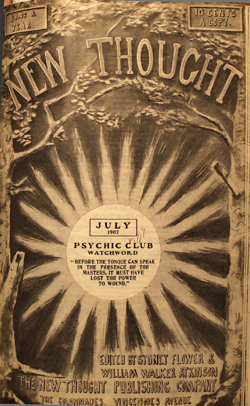
Among the school's most notable graduates was William Walker Atkinson. Atkinson translated clinical principles into concepts of "thought force" and "personal magnetism." Alongside Sydney B. Flower, he established New Thought magazine. Atkinson also wrote under various pseudonyms, including the 1908 work The Kybalion, attributed to the "Three Initiates," which summarized Hermetic philosophy.
Umbrella Organizations and Educational Schools
To coordinate the various branches of the movement, several umbrella organizations were formed. These include the International New Thought Alliance (dating back to 1899), the League for the Larger Life (1916–1950s), the Universal Foundation for Better Living (since 1974), and the Affiliated New Thought Network (formed in 1992).
Education remained a cornerstone of the movement. Beyond the Unity School of Christianity and the Emerson Theological Institute (est. 1992), Horatio Dresser operated the School of Applied Metaphysics at the turn of the century. Additionally, Frank B. Robinson utilized the U.S. Postal Service to spread New Thought teachings through a mail-order denomination called Psychiana.
Frequently Asked Questions
Who is considered the founder of the New Thought movement?
There is no single consensus. Charles Brodie Patterson, Julius Dresser, and Emma Curtis Hopkins are all frequently credited as founders or essential figures in the movement's inception.
What is the "Law of Suggestion"?
Promoted by the Chicago School of Psychology, the Law of Suggestion posits that mind cure and personal change occur through the systematic use of suggestion and auto-suggestion rather than through supernatural power.
Why is Emma Curtis Hopkins called the "Teacher of Teachers"?
She earned this title because she mentored many of the individuals who went on to found the most prominent organizations within the New Thought movement, including the founders of Unity and Divine Science.
What is the largest New Thought church today?
The Unity Church, founded by Charles and Myrtle Fillmore in 1891, is currently the largest New Thought church with thousands of members worldwide.
How did the movement spread internationally?
One of the most significant international expansions was the founding of Seicho-no-Ie by Masaharu Taniguchi in Japan in 1930, which eventually established missions globally, including in the United States.