New Jersey Elections: Legal Framework, Political Trends, and the County Line Controversy
Elections in New Jersey are governed by a complex interplay of constitutional mandates and state statutes. Authorized under Article II of the New Jersey State Constitution, the state holds elections for the governor, lieutenant governor, and members of the New Jersey Legislature. These processes are regulated by state law under Title 19 and overseen by the Division of Elections within the office of the New Jersey Secretary of State. Additionally, the New Jersey Election Law Enforcement Commission (ELEC) manages the critical areas of lobbying disclosure and campaign financing.
Due to its geographic position, New Jersey is split between the New York City and Philadelphia media markets—the largest and fourth-largest in the United States, respectively. This unique positioning makes statewide campaign advertising exceptionally expensive, resulting in some of the highest campaign budgets in the nation.
Key Facts
- Democratic Lean: Between 1860 and 2024, the state voted Democratic 57% of the time.
- Presidential Trends: George H. W. Bush (1988) was the last Republican presidential candidate to carry the state.
- Legislative Control: Democrats have controlled both chambers of the state legislature since 2004.
- Voter Status: Unaffiliated voters (those not registered with a specific party) represent a massive bloc, totaling 2.3 million as of July 2020.
- Constitutional Length: The 1947 state constitution is 26,159 words, slightly shorter than the U.S. average.
Constitutional Evolution and Voting Rights
The foundation of New Jersey's electoral system dates back to the first Constitution of 1776. Drafted during the Revolutionary War, this temporary framework was remarkably progressive for its time, granting suffrage (the right to vote) to women and Black men who met specific property requirements—specifically those worth fifty pounds in proclamation money. This included widows and spinsters, though married women were generally excluded due to common law property restrictions.
The current state constitution, adopted in 1947, reinforces the basic rights found in the U.S. Constitution while adding specific state-level provisions, including the regulation of casinos.
Political Trends and Party Strength
While New Jersey was once a Republican stronghold in the Northeast during much of the 20th century, it has shifted significantly. The state's Republicanism was historically moderate; as the national party moved further right, voters shifted toward the Democratic Party. This transition became permanent in 1992 when Bill Clinton became the first Democrat to win the state since 1964.
Today, New Jersey is considered part of the "blue wall" of Democratic states. This dominance is evident in the U.S. Senate races, where Democrats have held both seats since 1979, with the exception of brief periods involving Republican appointees. However, the governorship has remained more competitive, alternating between parties since 1961. Since 2018, the state has been led by Governor Phil Murphy and Lieutenant Governor Tahesha Way.
| Year | Democratic % | Republican % |
|---|---|---|
| 1961 | 50.4% | 48.7% |
| 1985 | 29.3% | 69.6% |
| 2001 | 56.4% | 41.7% |
| 2013 | 38.2% | 60.2% |
| 2021 | 51.2% | 48.0% |
| 2025 | 56.8% | 42.5% |
The "County Line" Controversy
One of the most unique and controversial aspects of New Jersey elections is the county line. This practice allows political parties to give preferential placement on primary ballots to their endorsed candidates, effectively grouping them together in a single column to signal party approval to voters. Non-endorsed candidates are isolated in separate columns, which often puts them at a significant disadvantage.
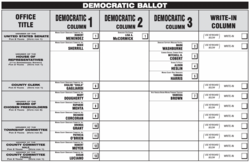
Critics argue that the county line empowers "party bosses" and allows them to manipulate voters. Because many local committee members are beholden to party chairs for employment or ballot positioning, the selection process for the line often lacks transparency and secret ballots.
Legal Challenges and the 2024 Injunction
The practice has faced severe legal scrutiny. In 2024, U.S. Senate candidate Andy Kim, along with other candidates, filed a lawsuit (Kim v. Hanlon) arguing that preferential ballot placement is unconstitutional. In March 2024, Federal District Judge Zahid Quraishi issued a preliminary injunction against the Democratic county line, ordering that ballots for the 2024 primary be printed with candidates organized by office in a randomized order.
While the injunction specifically restrained the Democratic primary—as that was where the plaintiffs sought relief—the court noted that the reasoning could apply to the entire ballot system. This legal shift aims to reduce the influence of party insiders and provide a more neutral playing field for primary candidates.
Frequently Asked Questions
What is the "county line" in New Jersey elections?
The county line is a ballot design practice where endorsed candidates are placed in a prominent, grouped column, while non-endorsed candidates are placed in separate columns, giving endorsed candidates a significant visibility advantage.
Who are unaffiliated voters in New Jersey?
Unaffiliated voters are registered citizens who do not specify a political party affiliation. As of July 2020, there were 2.3 million such voters, a number larger than the registered Republican population in the state.
How has New Jersey's presidential voting trend changed?
New Jersey was historically a Republican-leaning state in the Northeast until the late 20th century. Since 1992, it has consistently voted for Democratic presidential candidates, becoming part of the "blue wall."
What was the outcome of the Kim v. Hanlon lawsuit?
The court issued a preliminary injunction in March 2024 that stopped the use of the Democratic county line for the 2024 primary, requiring a randomized office-block layout instead.
Who oversees the execution of elections in New Jersey?
The Division of Elections, which is part of the office of the New Jersey Secretary of State, is responsible for overseeing the execution of elections under state law.