Néstor Kirchner: The Political Legacy of Argentina's 54th President
Néstor Carlos Kirchner Ostoić was a pivotal figure in early 21st-century South American politics. Serving as the 54th President of Argentina from 2003 to 2007, he led the nation through a period of significant economic and social transition following a deep crisis. A lawyer by profession and a member of the Justicialist Party, Kirchner's influence extended far beyond his presidential term, shaping the political landscape of Argentina for over a decade.
Before ascending to the presidency, Kirchner built his political foundation in the province of Santa Cruz. He served as the Intendant of Río Gallegos from 1987 to 1991 and subsequently as the 89th Governor of Santa Cruz from 1991 until his inauguration as president in 2003.
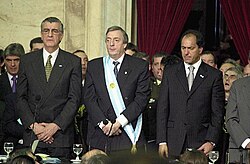
Key Facts
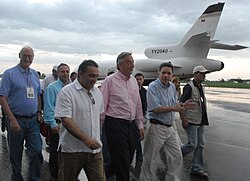
- Presidency: Served as President of Argentina from May 25, 2003, to December 10, 2007.
- Political Affiliation: Member of the Justicialist Party and the Front for Victory.
- Human Rights: Championed the overturning of amnesty laws related to the "Dirty War."
- Regional Leadership: Served as the first Secretary General of UNASUR.
- Family: Married to Cristina Fernández de Kirchner, who succeeded him as president.
The Path to the Presidency
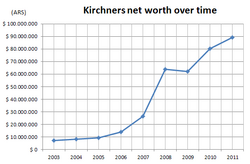
Kirchner's rise to national power culminated in the 2003 presidential election. Running on a ticket with Vice President Daniel Scioli, he emerged as a symbol of change during a time of national instability.
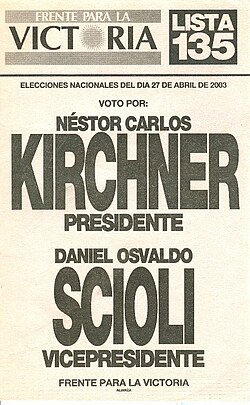
His victory marked a shift in the Justicialist Party's direction, moving away from the previous administration of Eduardo Duhalde. Upon taking office, Kirchner focused on a diverse cabinet and a strong message of national renewal.
Presidential Governance and Policy
Economic and Judicial Reform
During his presidency, Kirchner worked closely with Roberto Lavagna, his Minister of Economy for much of his term, to stabilize the Argentine economy. His administration sought a "new financial architecture" on the global stage to better support developing nations.
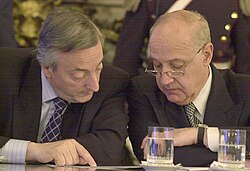
In the judicial sphere, Kirchner's tenure was marked by efforts to reform the appointment of judges and a complex relationship with the Supreme Court, which saw the resignation of several justices during his term.
Human Rights and Military Relations
One of the most defining aspects of Kirchner's presidency was his commitment to human rights. He actively supported the scrapping of amnesty laws that had protected military officials from prosecution for crimes committed during the National Reorganization Process (the military dictatorship).
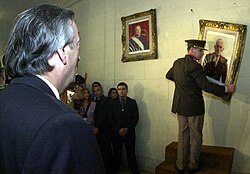
His administration oversaw the removal of military portraits from the National Military College, symbolizing a break from the era of state-sponsored violence and a commitment to truth and justice.
Foreign Policy and Regional Integration
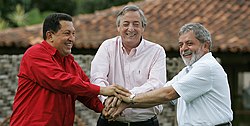
Kirchner pursued a policy of regional integration, strengthening ties with other South American leaders. He maintained close relationships with Presidents Hugo Chávez of Venezuela and Luiz Inácio Lula da Silva of Brazil, aiming to create a more cohesive Latin American political axis.
Post-Presidency and Later Years
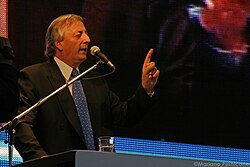
After leaving the presidency in 2007, Néstor Kirchner took on the role of First Gentleman as his wife, Cristina Fernández de Kirchner, assumed the presidency. He remained a powerful political force, serving as the President of the Justicialist Party and as a National Deputy for Buenos Aires.
In 2010, he was appointed the first Secretary General of UNASUR (Union of South American Nations), where he worked to mediate regional conflicts, including restoring bilateral relations between Colombia and Venezuela.
Death and Legacy
Néstor Kirchner died suddenly on October 27, 2010, at the age of 60 in El Calafate, Santa Cruz. His passing was met with widespread national mourning and a complex political reaction.
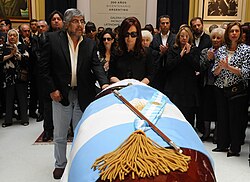
He was interred in the Mausoleum of Néstor Kirchner in Río Gallegos, a structure built by Lázaro Báez. His legacy remains a subject of intense debate in Argentina, characterized by his contributions to human rights and regional diplomacy, as well as allegations of embezzlement and unjust enrichment that surfaced during and after his career.
![The Mausoleum of Néstor Kirchner in Río Gallegos, Santa Cruz, was built by Lázaro Báez.[147]](/images/dc/a0/dca0735a6799d4a4bb502864175a6f4d780e51b1e8d84d6e6ee71ffbf02b25f8.jpg)
Summary of Political Career
| Position | Jurisdiction/Organization | Term Period |
|---|---|---|
| Intendant | Río Gallegos | 1987–1991 |
| Governor | Santa Cruz | 1991–2003 |
| President | Argentina | 2003–2007 |
| Secretary General | UNASUR | 2010 |
| National Deputy | Buenos Aires | 2009–2010 |
Frequently Asked Questions
Who succeeded Néstor Kirchner as President of Argentina?
Néstor Kirchner was succeeded by his wife, Cristina Fernández de Kirchner, who took office on December 10, 2007.
What was Kirchner's stance on human rights?
Kirchner was a strong advocate for human rights, notably pushing for the repeal of amnesty laws to allow the prosecution of military officials involved in the "Dirty War" crimes.
What was the role of the Front for Victory?
The Front for Victory was the political coalition associated with Néstor and Cristina Kirchner, used to consolidate their power and implement their political agenda between 2003 and 2010.
What international honors did Néstor Kirchner receive?
He received several high distinctions, including the Grand Collar of the Order of the Southern Cross (Brazil), the Knight Grand Cross of the Order of the Netherlands Lion (Netherlands), and the Grand Collar of the Order of the Liberator (Venezuela).
Where is Néstor Kirchner buried?
He is buried in the Mausoleum of Néstor Kirchner located in his hometown of Río Gallegos, Santa Cruz.