The Neolithic Revolution: How Humanity Transformed the World
The transition from wandering hunter-gatherers to settled farmers is perhaps the most profound turning point in human history. Known as the Neolithic (from the Greek words for "new stone"), this era represents the final division of the Stone Age. Spanning roughly from 10,000 BC to 2,000 BC, the Neolithic period introduced a "package" of revolutionary developments that fundamentally altered the human experience: the birth of agriculture, the domestication of animals, and the establishment of permanent settlements.
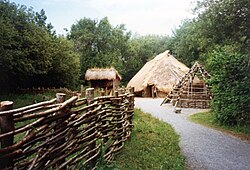
The Dawn of the New Stone Age
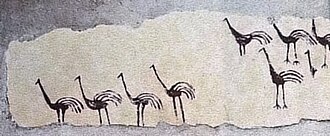
The Neolithic period did not emerge as a single, global event. Instead, it was a series of independent developments occurring in different parts of the world at different times. This process, often called the Neolithic Revolution, saw humans move away from the Mesolithic (Middle Stone Age) lifestyle toward a more stable, sedentary existence.
In West Asia and Mesopotamia, the shift began approximately 12,000 years ago. This transition was likely driven by climatic changes associated with the Younger Dryas—a period of cooling around 10,000 BC—which may have forced populations to rely more heavily on the cultivation of wild cereals to ensure food security.
![Approximate centers of origin of agriculture in the Neolithic Revolution and its spread in prehistory: the Fertile Crescent (12,000 BP), the Yangtze river and Yellow River basins (9,000 BP) and the New Guinea Highlands (9,000–6,000 BP), Central Mexico (5,000–4,000 BP), Northern South America (5,000–4,000 BP), sub-Saharan Africa (5,000–4,000 BP, exact location unknown), eastern North America (4,000–3,000 BP).[9]](/images/fb/ce/fbcedea371c23b9724cced0b0232407ecee2b3adc9d74a886cd702223c5f2a11.webp)
The Origins in the Levant
Following the ASPRO chronology, the Neolithic in the Levant is thought to have begun around 10,200 BC, arising from the Natufian culture. The Natufians were a "proto-Neolithic" people who had already begun living a sedentary lifestyle and depending heavily on wild cereals. As they transitioned into the Pre-Pottery Neolithic A (PPNA), the pioneering use of these cereals evolved into true farming.
Regional Developments Across the Globe
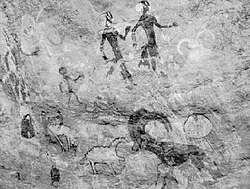
As the Neolithic progressed, distinct cultural complexes emerged across every continent, each with its own unique tools, art, and social structures.
The Near East and Mesopotamia
The Fertile Crescent was a primary cradle of civilization. During the PPNA phase, some of the world's first towns appeared. Jericho, located in the Levant, emerged around 9000 BC, featuring a massive stone tower and a surrounding stone wall that may have protected a population of up to 3,000 people. Later, the Halaf culture appeared in Syria and Northern Mesopotamia around 6400 BC.
![The Urfa Man c. 9000 BC.[16][17][18] Şanlıurfa Archaeology and Mosaic Museum.](/images/74/44/7444841e89b568ed55b9debd50c0ccd6634812f5d116d9afd39a79a07bce0cd6.jpg)
Europe and the Spread of Farming
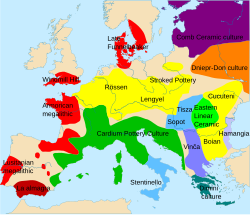
In Southeast Europe, agrarian societies were established by the 7th millennium BC, with sites like Vashtëmi in Albania dating to 6500 BC. Recent archaeogenetic research suggests that the spread of agriculture into Europe was not merely a cultural exchange but was driven by the migration of early farmers from Anatolia approximately 9,000 years ago.
As these traditions moved north and west, they gave rise to various cultures, such as the Linearbandkeramik (Linear Pottery culture). While many Neolithic societies were organized around farming, evidence from sites like the Talheim Death Pit suggests that systematic violence and warfare became more common during this period than in the preceding Paleolithic era.
Asia and the Americas
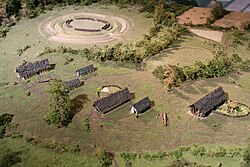
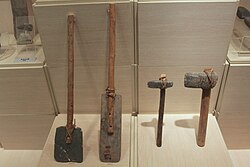
In East Asia, significant agricultural developments occurred in China, with rice residues dating back to 8200–7800 BC. In South Korea, a site in Munam-ri has been identified as a potential early farmland dating between 3600 and 3000 BC. In South India, the Neolithic period (3000–1400 BC) is characterized by the presence of Ash mounds.
In the Americas, similar shifts toward crop domestication and sedentary life occurred. In Mesoamerica, this happened around 4500 BC, while in South America, evidence suggests it may have begun as early as 11,000–10,000 BC. In the southwestern United States, the Formative stage saw the rise of large villages supported by the farming of maize, beans, and squash.
Cultural and Material Life
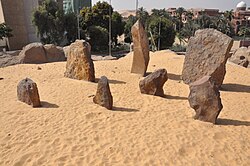
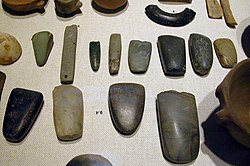
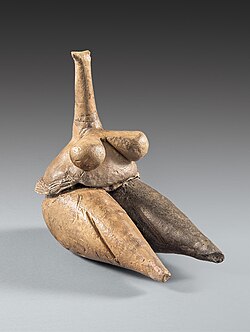
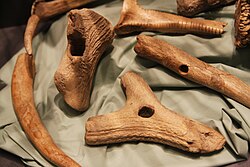
The Neolithic was a period of immense creativity. Humans began producing sophisticated lithic technology (stone tools), pottery, and art. Anthropomorphic figurines—statues representing the human form—have been found across the globe, from the Balkans to Iran, often serving ritualistic or symbolic purposes.
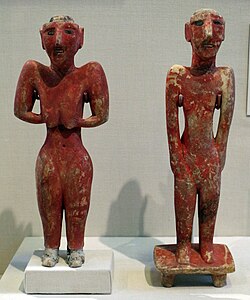
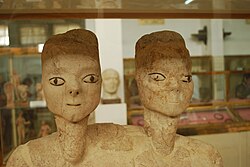
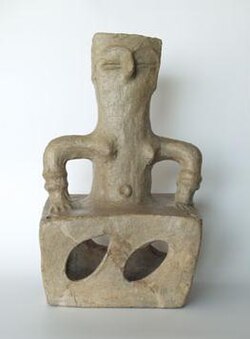
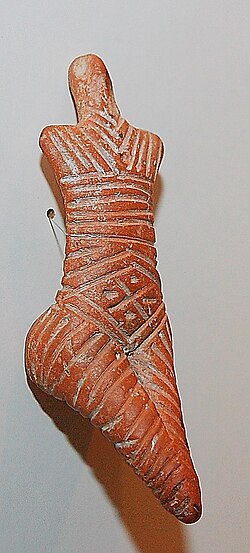
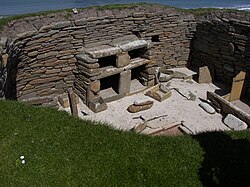
Settlement patterns also evolved. While some lived in fortified villages, others built permanent homes with sophisticated furnishings. In Scotland, the site of Skara Brae provides evidence of early home interiors, including stone shelves.
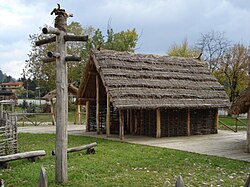
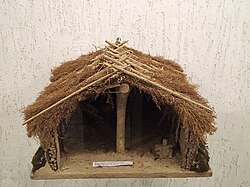
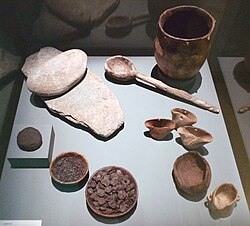
Dietary habits shifted toward processed foods. Archaeological excavations have recovered millstones, charred bread, grains, and even clay cooking pots, illustrating the transition to a grain-based diet.
Key Facts
![The neolithization of Northwestern Africa corresponded to the arrival of European migration circa 5500 BC (■), and a wave of Levantine migration circa 5000 BC (■), with some local admixture (■).[42]](/images/b0/3b/b03bd89d576625648659a11b8c8229ee40332a4ea84acdc2fc5a24b2a3c0df48.png)
- Timeframe: Approximately 10,000 BC to 2,000 BC.
- Core Developments: Agriculture, animal domestication, and permanent settlement.
- Terminology: The term "Neolithic" was coined by John Lubbock in 1865.
- Transition: The period was followed by the Chalcolithic (Copper Age).
- Global Nature: Farming emerged independently in multiple regions, including the Fertile Crescent, East Asia, and the Americas.
Summary of Major Neolithic Sites
| Site/Culture Name | Location | Approximate Date (BC) | Significance |
|---|---|---|---|
| Tell Qaramel | Syria | 10,700–9,400 | Early settlement with temples |
| Jericho | Palestine | 9,500 | One of the world's first towns |
| Aşıklı Höyük | Turkey | 8,200–7,400 | Aceramic Neolithic settlement |
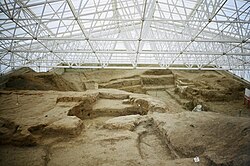
| Çatalhöyük | Turkey | 7,500–5,700 | Major Neolithic urban center |
| Skara Brae | Scotland | 3,500–3,100 | Evidence of advanced home furnishings |
| Hemudu Culture | China | 5,000–4,500 | Large-scale rice plantations |
Frequently Asked Questions
What does the term "Neolithic" actually mean?
The term comes from the Greek words néos (new) and líthos (stone), literally meaning "New Stone Age."
How did the Neolithic differ from the Paleolithic?
The Paleolithic was characterized by nomadic hunter-gatherer lifestyles. The Neolithic was defined by the "Neolithic Revolution," which introduced farming, animal domestication, and permanent settlements.
Was the Neolithic Revolution a single event?
No. It was a series of independent developments that occurred in different parts of the world—such as the Fertile Crescent, East Asia, and the Americas—at different times.
What followed the Neolithic period?
In many regions, the Neolithic was followed by the Chalcolithic, or Copper Age, which was marked by the development of early metallurgy.
Did Neolithic people live in peace?
While many lived in stable communities, archaeological evidence (such as fortified settlements and weapon-traumatized bones) suggests that systematic violence and warfare were more common during the Neolithic than in the preceding Paleolithic period.