Nemestrinidae: The Fascinating World of Tangle-Veined Flies
In the diverse world of insects, few families possess names as evocative as the Nemestrinidae. Commonly known as tangle-veined flies, these members of the order Diptera (true flies) are characterized by their unique wing patterns and complex life cycles. While they may appear as simple visitors to garden flowers, they play a sophisticated role in their ecosystems as both pollinators and biological regulators.
Belonging to the superfamily Nemestrinoidea, these flies are closely related to the Acroceridae family. They represent a specialized lineage of Brachycera—a suborder of flies that includes many of the more advanced fly groups we recognize today.
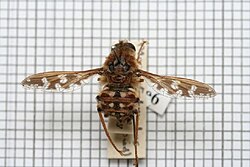
Biological Classification and Diversity
The Nemestrinidae family is relatively small in terms of total species count but possesses a wide global reach. Currently, there are approximately 300 species distributed across 34 different genera. While they can be found worldwide, they exhibit a distinct preference for the Southern Hemisphere, where their diversity is most pronounced. In contrast, the Nearctic region (North America) is home to only six species across three genera.
Taxonomic Hierarchy
To understand where these flies fit in the tree of life, we can look at their scientific classification:
- Kingdom: Animalia
- Phylum: Arthropoda
- Class: Insecta
- Order: Diptera
- Suborder: Brachycera
- Superfamily: Nemestrinoidea
- Family: Nemestrinidae
Life Cycle and Ecological Impact
The life cycle of the tangle-veined fly is defined by its role as an endoparasitoid—an organism that lives inside a host, eventually killing it. The specific host depends on the subfamily to which the fly belongs:
- Trichopsideinae: The larvae of this subfamily act as parasitoids of grasshoppers.
- Hirmoneurinae: The larvae of this subfamily target scarab beetles.
Because of their relationship with grasshoppers, certain species within the Nemestrinidae family are considered important tools for the natural control of grasshopper populations, helping to maintain ecological balance.
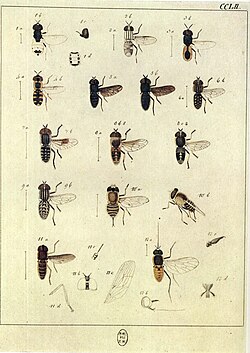
Fossil History and Evolutionary Timeline
The evolutionary history of Nemestrinidae is extensive, with a temporal range stretching from the Callovian epoch of the Jurassic period to the present day. Fossil evidence provides a window into their ancient past, with significant remains discovered in Russia, Kazakhstan, Mongolia, Western Europe, and North America.
The oldest described fossils have been identified in the Middle-Upper Jurassic Karabastau Formation of Kazakhstan and the Daohugou Bed of China. Additionally, undescribed remains have been noted from the Upper Liassic of Germany, suggesting these flies have been a stable part of terrestrial ecosystems for millions of years.
Key Facts
- Common Name: Tangle-veined flies.
- Global Presence: Distributed worldwide, but most diverse in the Southern Hemisphere.
- Species Count: Approximately 300 species in 34 genera.
- Ecological Role: Larvae are endoparasitoids of grasshoppers and scarab beetles.
- Ancient Lineage: Fossils date back to the Middle-Upper Jurassic.
Summary of Nemestrinidae Characteristics
| Feature | Details |
|---|---|
| Order | Diptera |
| Superfamily | Nemestrinoidea |
| Larval Hosts | Grasshoppers and Scarab Beetles |
| Primary Habitat | Flowers (Adults) |
| Temporal Range | Callovian to Present |
Frequently Asked Questions
What does "tangle-veined" mean?
The name refers to the complex, intricate pattern of veins found in the wings of these flies, which distinguishes them from many other dipteran families.
Are tangle-veined flies harmful to humans?
There is no evidence in the provided text suggesting that Nemestrinidae are harmful to humans; adults are typically observed visiting flowers.
How do they help the environment?
They serve as natural biological controls. By acting as parasitoids of grasshoppers, they help regulate insect populations that might otherwise overconsume vegetation.
Where are they most likely to be found?
While they are found globally, you are most likely to encounter a high diversity of these species in the Southern Hemisphere.
Which subfamilies are known?
The family includes the subfamilies Archinemestriinae, Hirmoneurinae, Nemestrininae, and Trichopsideinae.