Nebraska Demographics: Population Trends, Ethnicity, and Social Profiles
Nebraska has experienced steady growth since its early settlement, evolving from a small frontier population into a diverse Midwestern state. With a population that has climbed from just under 29,000 in 1860 to over 2 million by 2025 estimates, the state reflects a blend of deep-rooted European ancestry and a growing international community.
Key Facts
- Estimated Population (2025): 2,018,006 people.
- Median Household Income: $76,376.
- Education: 92.6% of the population holds a high school diploma; 35.4% hold a bachelor's degree or higher.
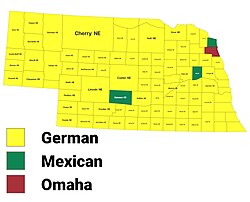
- Primary Ancestry: German Americans are the largest ancestry group in most of the state.
- Diversity: Nebraska is the largest U.S. home to Yazidi refugees and Yazidi Americans, particularly in Lincoln.
- Median Age: 37.4 years.
Population Growth and Housing
The trajectory of Nebraska's population shows explosive growth in the late 19th century, followed by a period of stabilization and gradual increase. By the 2020 census, the population reached 1,961,504, with current estimates for 2024 placing the number at 2,005,465.
As of the 2024 American Community Survey, there are approximately 824,012 households with an average of 2.38 persons per household. The state maintains a population density of 26.11 inhabitants per square mile. Housing is distributed across the state with 880,521 units, averaging 11.46 units per square mile.
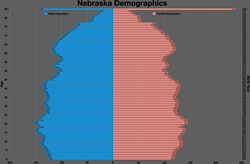
Racial and Ethnic Composition
Nebraska's racial landscape has shifted toward greater diversity over the last several decades. While the state remains predominantly White, there has been a notable increase in the Hispanic or Latino population and the Asian community.
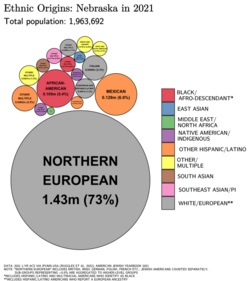
According to 2024 estimates, the racial makeup of the state is 86.5% White (including 75.1% Non-Hispanic White), 5.7% African American, 3.1% Asian, 1.8% Native American, and 2.7% from two or more races. Hispanic or Latino people of any race now make up 13.6% of the population.
Ancestry and Cultural Heritage
European heritage remains a cornerstone of Nebraska's identity. The largest ancestry groups include German (36.1%), Irish (13.1%), English (7.8%), Czech (4.7%), Swedish (4.3%), and Polish (3.5%). Notably, Nebraska holds the nation's largest Czech American and non-Mormon Danish American populations as a percentage of the total population, and the largest Polish American population in the Great Plains.
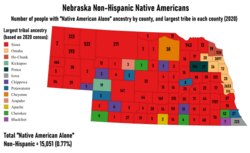
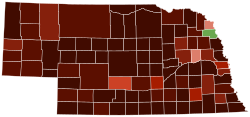
Geographically, this diversity is concentrated in specific areas. Thurston County, consisting of the Omaha and Winnebago reservations, has a Native American majority, while Butler County is one of only two counties in the U.S. with a Czech-American plurality.
Immigration and Refugee Communities
In recent years, Nebraska has become a significant hub for refugees. In 2016, it welcomed more refugees per capita than any other state. The city of Lincoln is specifically recognized as the largest home to Yazidi Americans in the United States. Top countries of origin for immigrants include Mexico, India, China, Guatemala, and El Salvador.
Socioeconomic Indicators
Nebraska's economy is reflected in a median household income of $76,376, though economic challenges persist for some, with approximately 10.9% of the population living at or below the poverty line. The state's employment rate is estimated at 65.9%.
Language diversity is also increasing. While English is spoken by 86.0% of the population, Spanish is the second most reported language at 9.3%, followed by Indo-European (2.1%) and Asian and Pacific Islander languages (1.6%).
Birth Trends
Data from 2011 indicates that 31.0% of the population younger than age one were minorities. Recent birth data shows a continuing trend: in 2024, Hispanic births accounted for 22.6% of the total, while White births decreased to 64.0%.
Religious Affiliation
The population of Nebraska is predominantly Christian. According to a 2023–24 Pew Research Center study, 74% of Nebraskans identify as Christian, while 21% are religiously unaffiliated. The largest denominations by number of adherents include the Roman Catholic Church, the Lutheran Church–Missouri Synod, the Evangelical Lutheran Church in America, and the United Methodist Church.
| Category | Data / Value | Source/Year |
|---|---|---|
| Estimated Population | 2,018,006 | 2025 Est. |
| Median Household Income | $76,376 | 2024 ACS |
| Hispanic or Latino Population | 13.6% | 2024 Est. |
| Poverty Rate | 10.9% | 2024 ACS |
| High School Graduation Rate | 92.6% | 2024 ACS |
| Christian Affiliation | 74% | 2023-24 Pew |
Frequently Asked Questions
What is the most common ancestry in Nebraska?
German Americans are the largest ancestry group in most of the state, particularly within the eastern counties.
How has the Hispanic population changed in Nebraska?
The Hispanic or Latino population has grown significantly, from 1.79% in 1980 to an estimated 13.6% in 2024.
Which county in Nebraska has a Native American majority?
Thurston County, which is composed entirely of the Omaha and Winnebago reservations, has a Native American majority.
What are the primary languages spoken in Nebraska?
The most reported languages are English (86.0%) and Spanish (9.3%), followed by Indo-European and Asian/Pacific Islander languages.
What is the religious makeup of the state?
Nebraska is predominantly Christian (approximately 74%), with the Roman Catholic Church being the largest single denomination by number of adherents.