NCADE: The Network Centric Airborne Defense Element Interceptor
The Network Centric Airborne Defense Element (NCADE) was an ambitious anti-ballistic missile system developed by Raytheon for the Missile Defense Agency. Designed to intercept threats during their most vulnerable stage, the NCADE focused on boost phase interception, aiming to neutralize ballistic missiles shortly after launch.
Key Facts
- Developer: Raytheon, with propulsion components from Aerojet.
- Primary Goal: Boost phase interception of ballistic missiles.
- Base Technology: Heavily derived from the AIM-120 AMRAAM.
- Kill Mechanism: Hit-to-kill vehicle (kinetic impact) rather than a fragmentation warhead.
- Launch Platform: Boeing F-15C Golden Eagle equipped with AESA radar.
- Current Status: Discontinued.
Technical Design and Propulsion
The NCADE system was engineered as a boost phase interceptor, meaning it was designed to strike a missile while its engines were still firing. To achieve this, Raytheon utilized the existing framework of the AIM-120 AMRAAM (Advanced Medium-Range Air-to-Air Missile) but implemented critical modifications to the payload.
Instead of the standard AMRAAM fragmentation warhead, the NCADE employed a hit-to-kill vehicle. This approach relies on the sheer kinetic energy of a direct collision to destroy the target. This vehicle was powered by monopropellant rocket engines from Aerojet, utilizing hydroxylammonium nitrate.
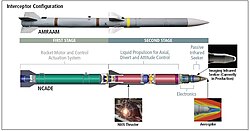
Thruster Performance
In April 2008, Aerojet successfully conducted a full-duration test firing of an axial thruster intended for the NCADE's second stage. This specific thruster demonstrated the ability to provide over 660 N of thrust for a duration exceeding 25 seconds, ensuring the interceptor could maneuver precisely during the final phase of engagement.
Testing and Operational Integration
The development of NCADE involved integrating advanced seekers into existing missile airframes. On December 3, 2007, tests were conducted at the White Sands Missile Range using AIM-9X missiles equipped with NCADE infrared seekers. These missiles were launched from an F-16 operated by the Air National Guard Air Force Reserve Command Test Center.
During this test, the system targeted an Orion target rocket. One modified AIM-9X successfully intercepted the target, while a second missile followed an intercept trajectory and observed the impact.
For full operational deployment, the intended launch vehicle was the Boeing F-15C Golden Eagle. The aircraft would have utilized an AESA (Active Electronically Scanned Array) radar, a sophisticated radar system capable of tracking multiple targets with high precision and speed.
System Summary
| Feature | Detail |
|---|---|
| Primary Contractor | Raytheon |
| Propulsion Provider | Aerojet |
| Base Missile | AIM-120 AMRAAM |
| Intercept Method | Hit-to-kill (Kinetic) |
| Propellant | Hydroxylammonium nitrate-based monopropellant |
| Carrier Aircraft | Boeing F-15C Golden Eagle |
Frequently Asked Questions
What was the primary purpose of the NCADE?
The NCADE was designed as an anti-ballistic missile system specifically for boost phase interception, aiming to destroy missiles shortly after they were launched.
How did NCADE differ from a standard AMRAAM?
While based on the AIM-120 AMRAAM, the NCADE replaced the traditional fragmentation warhead with a hit-to-kill vehicle powered by Aerojet monopropellant rocket engines.
Which aircraft was intended to launch the NCADE?
The Boeing F-15C Golden Eagle, equipped with an AESA radar, was the designated launch vehicle for the system.
Was the NCADE system ever fully deployed?
No. According to the Missile Defense Advocacy Alliance, the NCADE project is listed as discontinued.
What happened during the December 2007 test?
Two AIM-9X missiles with NCADE infrared seekers were launched from an F-16; one successfully intercepted an Orion target rocket while the other observed the intercept.