National Police of France
The National Police (Police nationale) serves as the primary civil law enforcement agency in France. Operating under the motto Pro patria vigilant ("They are watching for their country"), the force is tasked with maintaining order and safety across the nation's urban centers. While the National Police hold primary jurisdiction in cities and large towns, they operate alongside the National Gendarmerie, which focuses on rural areas, smaller towns, and border regions.
Managed by the Ministry of the Interior, the agency is a massive operation overseeing a vast jurisdictional area of 551,695 square kilometers and a population of approximately 67.2 million people.
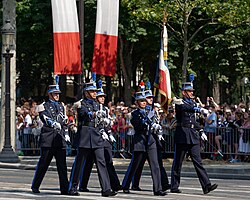
Key Facts
- Established: April 23, 1941 (unified from existing units).
- Workforce: 154,547 employees as of 2021.
- Annual Budget: €12.64 billion (2021).
- Parent Agency: Ministry of the Interior.
- Primary Jurisdiction: Urban areas, cities, and large towns.
- Elite Unit: RAID (Research, Assistance, Intervention, Deterrence).
History and Evolution
The modern National Police was established on August 14, 1941, via a decree signed by Philippe Pétain under the Vichy regime. This move unified the Sûreté nationale (which had absorbed the Sûreté générale in 1934) and municipal police units from towns with more than 10,000 inhabitants, as well as the police services of the Paris Police Prefecture.
Following the Liberation of France, the force was dissolved on November 16, 1944, by the Provisional Government. However, it was revived on July 9, 1966, through Law no. 66-492, which once again unified the Sûreté Nationale and the Préfecture de Police into the current organizational structure.
Organizational Structure
The National Police is organized into several central directorates and sub-directorates to manage diverse law enforcement needs. A key administrative body is the Central Directorate for Recruitment and Training (DCRFPN), formed in 2010 from the merger of the administration and training directorates.
Specialized Units and the Paris Prefecture
The Paris Police Prefecture manages a unique jurisdictional area, having absorbed the 'petit couronne' region (Seine-Saint-Denis, Hauts-de-Seine, and Val-de-Marne) in 2009. This is managed via the Proximity Security Directorate of the Parisian Agglomeration (DSPAP).
For high-risk scenarios, the RAID (Research, Assistance, Intervention, Deterrence) serves as the elite counter-terror unit. Based in Bièvres, RAID coordinates nationwide deployments and oversees the National Police Intervention Force (FIPN). In Paris, the primary reaction unit is the Brigade anticommando (BRI-BAC). Between 2016 and 2019, the tactical intervention units known as GIPN were absorbed into RAID as territorial detachments.
Agency Overview Summary
| Category | Detail |
|---|---|
| Total Employees | 154,547 |
| Annual Budget | €12.64 billion |
| Vehicle Fleet | 31,263 |
| Headquarters | Paris, France |
| Responsible Minister | Minister of the Interior |
Equipment and Weaponry
The National Police has undergone significant standardization of its arsenal over the decades. Following the use of various revolvers and semi-automatics before WWII, the force standardized on the RR 51 pistol and MAT-49 submachine guns in 1951. During the Algeria War in the 1950s, CRS units were upgraded to the 9×19mm MAC Mle 1950.
In 2003, the agency entered a major contract for approximately 250,000 SIG Sauer Pro SP 2022 pistols, replacing the PAMAS G1. While originally intended for service until 2022, additional purchases in 2018 suggest extended use.
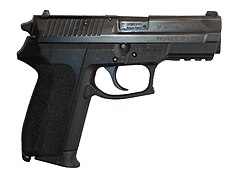
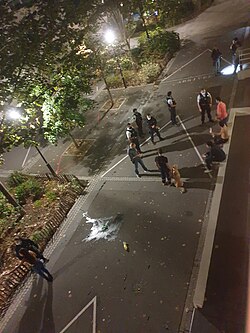
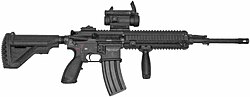
For tactical operations, the police utilize Ruger Mini-14 semi-automatic rifles, Remington 870 shotguns, and H&K UMP submachine guns. Elite units such as RAID and SDAT have adopted the HK416F, a short-barreled rifle version of the French Army's current assault rifle.
Personnel and Requirements
To join the National Police, candidates must meet strict criteria, including being a French national, having a clean criminal record, and possessing a Bachelor's degree or equivalent. Applicants must be no older than 35 on January 1st of the competition year and demonstrate good physical and moral standing. The selection process consists of a three-stage entrance exam.
The rank structure is hierarchical, ranging from Gardien de la paix (Keeper of the Peace) at the entry level to high-ranking officials such as the Commissaire général and the Directeur général.
Safety and Controversy
Data from the Ministry of the Interior indicates a decline in officer fatalities in the line of duty, with 36 deaths recorded in the 2010s compared to 88 in the 1980s.
Conversely, the agency has faced criticism regarding the use of force. The collective "Désarmons-les" has tracked 437 deaths caused by law enforcement since 2012, noting a disproportionate impact on Black and Arab populations, which some analysts attribute to institutionalized racism.
Frequently Asked Questions
What is the difference between the National Police and the National Gendarmerie?
The National Police are civil law enforcement primarily responsible for cities and large towns, while the National Gendarmerie is a military force with jurisdiction over rural areas, small towns, and borders.
What is RAID?
RAID (Research, Assistance, Intervention, Deterrence) is the elite counter-terrorism and tactical intervention unit of the National Police, serving as the counterpart to the Gendarmerie's GIGN.
What is the standard sidearm used by French police officers?
The current standard sidearm is the SIG Sauer Pro SP 2022, which was adopted in a large-scale contract in 2003.
Who oversees the National Police?
The National Police is overseen by the General Directorate of the National Police and falls under the jurisdiction of the French Ministry of the Interior.
What are the requirements to become a police officer in France?
Candidates must be French citizens, under 35 years old, hold a Bachelor's degree or equivalent, have a clean criminal record, and pass a three-stage entrance examination.