National Fire Service: The Wartime Evolution of British Firefighting
During the height of the Second World War, the United Kingdom faced an unprecedented threat from aerial bombing and coastal shelling. To combat these emergencies, the government transformed a fragmented system of local brigades into a unified national entity: the National Fire Service (NFS). Established in August 1941, the NFS represented a pivotal shift in how the nation managed emergency response during a time of total war.
The Formation of the NFS
Before the creation of the NFS, firefighting responsibilities were scattered across approximately 1,600 local authority fire brigades and the national Auxiliary Fire Service (AFS). In some regions, the lines between law enforcement and firefighting were blurred; for instance, the Liverpool City Police operated as a Police Fire Brigade. This overlap continued until a Royal Commission highlighted the necessity of separating police and fire services.
Following the recommendations of the commission and the legislative framework provided by the Fire Brigade Act 1938, the Home Office amalgamated these various bodies into the NFS in August 1941 to ensure a coordinated national response to wartime disasters.
Organization and Personnel
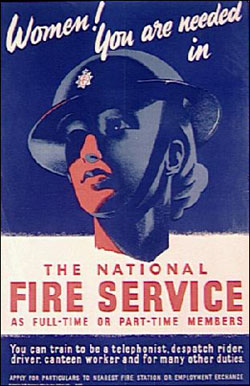
At its peak, the NFS was a massive operation employing 370,000 personnel. This workforce included 80,000 women, who were primarily tasked with essential administrative duties. The service was led by Sir Aylmer Firebrace, the former Chief Officer of the London Fire Brigade, who served as the Chief of the Fire Staff and Inspector-in-Chief until his retirement on February 28, 1947.
The NFS adopted a strict hierarchical structure to maintain order across the country. The service was divided into approximately forty Fire Forces, which were further broken down into Divisions. Each Division consisted of two Columns, and every Column was composed of five Companies.
Uniforms and Daily Life
The NFS transitioned from the peakless sailor-style caps used by many pre-war brigades, such as the London Fire Brigade, to the peaked cap worn by the AFS. This peaked cap became the standard and was retained by fire services even after the war. The standard uniform consisted of a traditional dark blue double-breasted tunic.
Life in the NFS involved long periods of waiting between emergency calls. During these intervals, many personnel utilized their pre-war factory skills to perform voluntary manufacturing work in workshops located within or adjacent to the fire stations, contributing to the wider war effort.
Risks and Sacrifices
Service in the NFS was fraught with danger. Personnel were frequently deployed to the aftermath of German bombing raids and coastal shelling from France, often entering hazardous zones while attacks were still ongoing. These risks led to inevitable casualties. One notable example is a 19-year-old volunteer who died in the line of duty and was posthumously awarded the Certificate for Gallantry; he is buried in the Hamilton Road Cemetery in Deal, Kent.
The Transition Back to Local Control
The NFS remained the primary firefighting authority until 1948. Under the Fire Services Act 1947, the service was disbanded, and control reverted to local authorities. However, the landscape had changed; instead of the 1,600 fragmented brigades that existed before the war, the new system was streamlined, with only one brigade per county and county borough.
Key Facts
- Established: August 1941 via the amalgamation of the AFS and local brigades.
- Peak Strength: 370,000 personnel, including 80,000 women.
- Leadership: Led by Sir Aylmer Firebrace until February 1947.
- Structure: Organized into Fire Forces, Divisions, Columns, and Companies.
- Legislation: Created under the Fire Brigade Act 1938 and dissolved by the Fire Services Act 1947.
| Period | Organizational Status | Governing Legislation | Control Level |
|---|---|---|---|
| Pre-August 1941 | Fragmented (AFS & Local Brigades) | Fire Brigade Act 1938 | Local/Auxiliary |
| 1941 – 1948 | Unified National Fire Service | Fire Brigade Act 1938 | National (Home Office) |
| Post-1948 | Streamlined Local Brigades | Fire Services Act 1947 | County/County Borough |
Frequently Asked Questions
What was the National Fire Service?
The National Fire Service (NFS) was a unified British firefighting organization created in August 1941 by merging the Auxiliary Fire Service (AFS) and approximately 1,600 local fire brigades to better handle wartime emergencies.
What role did women play in the NFS?
Approximately 80,000 women served in the NFS, where they were primarily employed to handle administrative duties.
Who led the NFS during the war?
Sir Aylmer Firebrace, the former Chief Officer of the London Fire Brigade, served as the Chief of the Fire Staff and Inspector-in-Chief until February 28, 1947.
How did the NFS change the firefighting uniform?
The NFS replaced the pre-war sailor-style peakless caps with the peaked cap from the AFS. This peaked cap continued to be used by fire services after the war ended.
What happened to the NFS after the war?
In 1948, following the Fire Services Act 1947, the NFS was split and control returned to local authorities, though the number of brigades was reduced to one per county and county borough.