NASA Exceptional Service Medal: Honoring Excellence in Space Exploration
In the high-stakes world of aerospace engineering and space flight, extraordinary achievements require more than just technical skill; they demand sustained initiative and creative problem-solving. The NASA Exceptional Service Medal stands as a prestigious recognition for U.S. government employees who have demonstrated such remarkable dedication to the advancement of space-related endeavors.
This award is not merely for routine excellence but is reserved for those whose performance has led to substantial improvements in critical fields such as aeronautics, administration, and space flight support. By honoring these individuals, NASA acknowledges the human ingenuity that drives the agency's most ambitious programs forward.
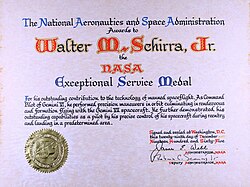
: Certificate that accompanies the medal, given to Wally Schirra in 1964.
Key Facts
- Established: July 29, 1959.
- Purpose: Recognizes significant sustained performance and unusual initiative in NASA programs.
- Eligibility: Awarded to U.S. government employees.
- Precedence: Ranked higher than the NASA Outstanding Leadership Medal but lower than the NASA Exceptional Service Ribbon.
- Historical Origin: Inherited from the National Advisory Committee on Aeronautics (NACA).
History and Evolution of the Award
The roots of the Exceptional Service Medal stretch back to NASA's predecessor, the National Advisory Committee on Aeronautics (NACA). Because the award was inherited from the NACA, early versions of the medal featured the original NACA emblem. As the agency transitioned into the modern National Aeronautics and Space Administration, the design was updated to feature the official NASA seal.
Award Precedence and Hierarchy
Within the hierarchy of NASA honors, the Exceptional Service Medal holds a specific position. It is positioned immediately after the NASA Exceptional Service Ribbon in terms of precedence, and it sits above the NASA Outstanding Leadership Medal. It is part of a broader ecosystem of achievement awards that include specialized honors for scientific, engineering, technological, and administrative accomplishments.
Notable Recipients and Legacy
The roster of individuals who have received the NASA Exceptional Service Medal includes some of the most iconic names in the history of space exploration. From legendary astronauts to pioneering engineers, the recipients represent the pinnacle of aerospace achievement.
Among the distinguished honorees are:
- Neil Armstrong: Awarded in 1966.
- Buzz Aldrin: Awarded in 1969.
- Peggy Whitson: A multi-time recipient (1993, 2003, 2006, and 2008).
- Eileen Collins: Awarded in 1998.
- Charles Bolden: A three-time recipient.
- John W. Young: Awarded in 1965 and 1966.
The medal is also awarded to individuals who have made significant contributions to cybersecurity, such as Brandon T. Bailey in 2019, and international figures like Christer Fuglesang (2010) and Julie Payette (2010), highlighting the global impact of NASA's collaborative endeavors.
Summary of NASA Exceptional Service Medal
| Category | Details |
|---|---|
| Type | Medal |
| Country | United States |
| Presented by | National Aeronautics and Space Administration (NASA) |
| Established | July 29, 1959 |
| Primary Criteria | Sustained performance, unusual initiative, or creative ability |
Frequently Asked Questions
Who is eligible to receive the NASA Exceptional Service Medal?
The medal is specifically granted to U.S. government employees who demonstrate significant sustained performance and creative ability that improves NASA programs.
What is the difference between the NACA and NASA versions of the medal?
The original medal was inherited from the National Advisory Committee on Aeronautics (NACA) and featured the NACA emblem; the modern NASA version features the NASA seal.
How does this medal rank among other NASA awards?
The Exceptional Service Medal is ranked higher than the NASA Outstanding Leadership Medal, but it follows the NASA Exceptional Service Ribbon in precedence.
Can an individual receive this medal more than once?
Yes. Several notable recipients, such as Peggy Whitson and Charles Bolden, have received the award multiple times for their ongoing contributions.
What specific fields does the award recognize?
The award recognizes improvements in engineering, aeronautics, space flight, administration, support, or other space-related endeavors.