NACF: The Backbone of South Korean Agriculture and Cooperative Banking
The National Agricultural Cooperative Federation (NACF), commonly known in South Korea as Nonghyup, serves as a vital pillar for the nation's rural economy. Established on August 15, 1961, the federation was created to elevate the social and economic standing of its members while fostering balanced national economic development. Today, it operates as a massive cooperative federation, managing everything from large-scale agricultural marketing to sophisticated banking services.
The NACF's identity is deeply rooted in its symbolism. Its official logo features a 'V' shape representing a 'bud' and 'rice'—signifying the eternal development of Korean agriculture—while the 'O' shape symbolizes smoothness, prosperity, and cooperation.
Key Facts
- Founded: August 15, 1961
- Headquarters: Seoul, South Korea
- Primary Industries: Banking, agricultural marketing, supply, livestock, and extension services
- Core Structure: A federation of democratically controlled, autonomous member cooperatives
- Major Subsidiaries: Nonghyup Bank and NH Investment & Securities
Organizational Structure and Membership
The NACF operates through a unique cooperative model. Unlike government-funded entities, the federation is funded by institutional subscriptions from its member cooperatives. These cooperatives are autonomous business groups that are democratically controlled by their members. The governance follows a democratic chain: members elect their local cooperative presidents, who in turn elect the chairman of the NACF.
Membership is divided into two distinct categories:
- Member Farmers: The genuine owners and primary stakeholders of the cooperative.
- Associate Members: Non-farmers who have invested capital into the cooperative. While they can access certain services, such as tax-free bank accounts, they have limited influence over the organization compared to member farmers.
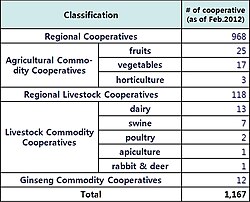
As of December 2011, the federation supported 2,446,836 member farmers and 15,262,611 associate members. The network is vast, comprising 3,306 cooperatives and 1,167 head branches.
Core Operational Pillars
To maximize efficiency, the NACF restructured its operations in 2012 into a federation supported by specialized holding companies. Its work is divided into three essential functional areas:
1. Extension and Support Services
This unit focuses on the human element of farming. It provides education and training for members, promotes farmers' rights, and invests in the development of new agricultural technologies and products to ensure the industry remains modern and competitive.
2. Marketing and Supply
The marketing and supply units aim to increase farming household income by expanding sales channels and reducing operational costs. By managing the production, distribution, processing, and consumption of agricultural and livestock products, the NACF allows farmers to focus primarily on their cultivation efforts.
3. Cooperative Banking and Insurance
The financial arm acts as a facilitator for the entire network. Through subsidiaries like Nonghyup Bank, the federation provides essential loan and deposit services. In 2011, the scale of this operation was immense, with total deposits reaching KRW 209 trillion and total loans amounting to KRW 146 trillion.
Economic Impact and Challenges
The NACF plays a critical role in the South Korean economy, particularly as the agricultural sector faces pressures from international trade. The implementation of Free Trade Agreements (FTAs) with the European Union and the United States has introduced new complexities to the domestic market. While the agricultural sector saw a production increase of 7.1% in 2011, reaching KRW 44.62 trillion, economic forecasts have occasionally suggested potential decreases in production due to these shifting trade landscapes.
| Metric | Value (KRW) |
|---|---|
| Total Revenue | 36.289 trillion |
| Operating Income | 964 billion |
| Net Income | 703 billion |
| Total Assets | 305 trillion |
Frequently Asked Questions
What is the difference between a member farmer and an associate member?
Member farmers are the primary stakeholders and owners of the cooperative. Associate members are non-farmers who have invested capital; they enjoy certain benefits like tax-free accounts but have significantly less influence over the cooperative's governance.
How is the NACF governed?
The NACF is governed democratically. Member cooperatives elect their own presidents, and these presidents then elect the chairperson of the NACF federation.
What industries does the NACF operate in?
The federation operates across three main sectors: banking and insurance, agricultural and livestock marketing and supply, and agricultural extension services (education and technology support).
What are the main subsidiaries of the NACF?
Key subsidiaries include Nonghyup Bank, Nonghyup Life Insurance, NH Investment & Securities, and various marketing and logistics companies like Nonghyup Logistics Service, Inc.
Why did the NACF restructure in 2012?
The restructuring was designed to increase effectiveness and competitiveness by establishing specialized financial and marketing holding companies to manage different business units more efficiently.