N250 Aircraft: The Evolution from Indonesian Innovation to the R80
The N250 represents a bold chapter in aviation history, marking Indonesia's ambitious effort to enter the global regional aircraft market. Developed by PT IPTN (now known as PT Dirgantara Indonesia or Indonesian Aerospace), the N250 was designed as a modern commuter plane intended to bridge the gap in regional connectivity.
First introduced at the Indonesian Air Show in 1986 and later revealed at the 1989 Paris Air Show, the aircraft's design evolved from an initial propfan concept to a turboprop configuration. On July 12, 1990, IPTN officially selected the Allison GMA 2100 turboprop engine to power the aircraft.
Global Production Ambitions
By the mid-1990s, the N250 had garnered significant international interest. Great Britain and several U.S. states expressed interest in hosting final assembly lines. After evaluating 26 contender cities, including Phoenix, Arizona, and Portland, Oregon, IPTN narrowed the U.S. candidates down to Macon, Georgia, and Mobile, Alabama.
On May 19, 1995, Mobile was selected as the U.S. assembly site. This operation was to be managed by the American Regional Aircraft Industry (AMRAI), with IPTN holding a 40-percent stake. The production strategy was aggressive: one aircraft per week from the Bandung factory in West Java and up to two aircraft per week from the Mobile facility.
The completed aircraft made high-profile appearances at the Indonesian Air Show '96, the 1997 Paris Air Show, and the 1998 Asian Aerospace show.
Prototypes and Technical Performance
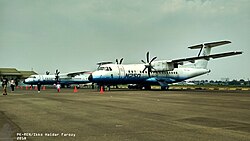
The first prototype, serial number PA-1, was rolled out on November 10, 1994, in Bandung. This 50-passenger aircraft took its maiden flight on August 10, 1995. During testing, the PA-1 demonstrated impressive cruise speeds: 727.8 km/h (452.2 mph) at an altitude of 7,600 meters (25,000 ft) and 744.5 km/h (462.6 mph) at 5,200 meters (17,000 ft).
A second, stretched variant designated as the N250-100 was developed to accommodate 64–68 passengers. Although planned for May 1996, the PA-2 prototype did not fly until December 19, 1996. Plans for third and fourth prototypes were set for July and September 1996, respectively.
The Impact of the Asian Financial Crisis
The momentum of the N250 program was halted by the Asian financial crisis. While IPTN was halfway through its 1,400-hour flight test program, the International Monetary Fund (IMF) mandated that the Indonesian government cease support for the project as part of a US$43 billion bailout plan.
This financial intervention forced IPTN to postpone certification from March 1999 to late 2000, and eventually indefinitely, as the company sought a risk-sharing partner to sustain the program.
The Transition to the R80
Efforts to revive the program were led by former Indonesian president B. J. Habibie with the approval of President Susilo Bambang Yudhoyono. An initial revival concept, the N250R, proposed reducing engine capacity and removing the fly-by-wire system (a system that replaces manual flight controls with an electronic interface) to lower costs and increase competitiveness.
In August 2012, PT Regio Aviasi Industri (RAI)—led by the sons of B. J. Habibie—and Erry Firmansyah of PT Eagle Cap agreed to finance a new iteration of the aircraft, renamed the R80.
The R80 project gained traction with a September 2013 order from Nam Air for 50 aircraft, with an option for 50 more. In February 2018, RAI signed a memorandum of understanding with Leonardo Aerostructures to fund and complete development, targeting the production of 400 aircraft over 20 years. The R80, designed for 80–90 seats, was priced at USD$25 million, with a target for European Aviation Safety Agency (EASA) type certification by 2025.
Ilham Akbar Habibie noted that the R80 would compete against the ATR 72 and Bombardier Dash 8, filling the void left by the Fokker 50 after Fokker's 1996 bankruptcy.
| Feature | N250 (Original) | R80 (Successor) |
|---|---|---|
| Developer | PT IPTN | PT Regio Aviasi Industri (RAI) |
| Passenger Capacity | 50 (PA-1) / 64-68 (N250-100) | 80-90 |
| Engine Type | Allison GMA 2100 Turboprop | Updated Turboprop |
| Key Technology | Fly-by-wire | Cost-optimized design |
| Status | Terminated (IMF bailout) | In development / Certification target 2025 |
Key Facts
- First Flight: The PA-1 prototype first flew on August 10, 1995.
- Top Speed: Reached 744.5 km/h at 17,000 feet.
- Production Hub: Mobile, Alabama, was selected as the U.S. assembly site.
- Financial Halt: The program was stopped due to an IMF-mandated bailout during the Asian financial crisis.
- Modern Successor: The R80 is the evolved version, targeting a price of USD$25 million.
- Preservation: The PA-1 prototype is currently housed at the Dirgantara Mandala Museum in Yogyakarta.
Frequently Asked Questions
Why was the N250 program cancelled?
The program was halted because the International Monetary Fund (IMF) required the Indonesian government to end its financial support as a condition of a US$43 billion bailout during the Asian financial crisis.
What is the difference between the N250 and the R80?
The R80 is a successor to the N250 with a larger capacity (80-90 seats compared to 50-68) and design changes intended to reduce production costs and improve international price competitiveness.
Who were the main competitors of the N250 and R80?
The primary competitors are the ATR 72 and the Bombardier Dash 8. The Fokker 50 was also a competitor until Fokker went bankrupt in 1996.
Where can the original N250 prototype be seen today?
The PA-1 prototype is on display as part of the 60th collection at the Dirgantara Mandala Museum in Yogyakarta, Indonesia.
What was the planned production rate for the N250?
The plan was to produce one aircraft per week at the Bandung factory and up to two aircraft per week at the assembly site in Mobile, Alabama.