Museum Services and Outdoor Art Exhibits
Beyond its permanent galleries, the museum offers a diverse array of services and public installations designed to foster a deeper connection between the community and the world of art. From specialized educational groups to an expansive outdoor sculpture collection, the institute serves as both a resource for scholars and a public gallery for all.
Museum Services and Community Engagement
To support the growth of private art collecting and the acquisition of significant works, the museum has established affinity groups. These groups are aligned with the museum's seven curatorial areas and provide members with access to specialized lectures, symposia, and curated travel opportunities.
The museum also maintains a dynamic exhibition schedule, frequently hosting traveling collections from other institutions. Many of these displays are made possible through funding from local business partners, and some exhibitions include public tours led by the featured artists themselves.
Supporting the local creative community, the museum houses the Minnesota Artists Exhibition Program. This is an artist-controlled initiative specifically dedicated to exhibiting the work of artists residing in Minnesota.
For researchers and art enthusiasts, the Museum Library is open to the public, boasting a collection of more than 60,000 volumes focused on art and art history.
Outdoor Art Installations
The museum's exterior grounds serve as an open-air gallery, featuring a variety of international works and historical monuments.
The 24th Street Entrance
Visitors entering via 24th Street are greeted by a pair of Chinese lions, gifted by Ella Pillsbury Crosby in 1998. Because 18th-century statues were too difficult to export, these pieces were newly carved in China following the traditional 18th-century style.
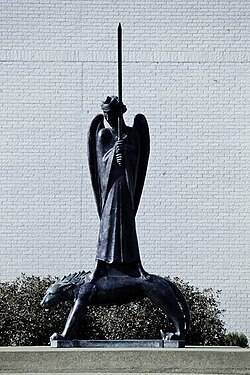
Also located near this entrance is The Fighter of the Spirit, a bronze statue by Ernst Barlach. The work depicts a winged man holding a sword vertically while standing atop a snarling beast. Originally commissioned by the University of Kiel for the Holy Spirit Church, the statue was later condemned as degenerate art by the National Socialist party. It was vandalized, cut into four pieces, and hidden on a farm to avoid being melted down. After resurfacing in 1946, it was repaired and placed at the Church of St. Nicholas. The museum acquired one of two copies made at that time in 1959; the other resides at the Gethsemane Church in Berlin.
The Chinese Garden and Target Park
Visible from the café, the Chinese Garden—a gift from Ruth and Bruce Dayton—features Taihu stones. In Buddhist and Taoist traditions, these unique stones are said to represent the mountains of the immortals.
Located behind the museum, Target Park hosts several contemporary installations, including:
- An untitled bronze work (c. 1968) by Pietro Consagra.
- Samba (1993), crafted from African granite by Richard Erdman.
- L'arbre de vie, a 20th-century stainless steel and pigment piece designed by Jean Willy Mestach and manufactured by Michael Chowen.
- Labyrinth (1993), a granite and steel pavilion by John Willenbecher. This structure features wide lines cut into the steel roof, allowing visitors to view the labyrinth by looking upward.
Centennial Commemoration
To mark its 100th anniversary, the institute acquired Eros Bendato Screpolato (1999) by Polish artist Igor Mitoraj. This bronze piece is part of Mitoraj's "bandaged heads" series. Similar works by the artist are displayed in other public spaces, such as Market Square in Kraków, Poland, and the Citygarden in St. Louis, Missouri.
Key Facts
- Library Size: Over 60,000 volumes on art and art history, open to the public.
- Local Support: The Minnesota Artists Exhibition Program is artist-controlled and focuses on local talent.
- Historical Resilience: "The Fighter of the Spirit" survived Nazi condemnation and destruction before being restored.
- Global Influence: Outdoor exhibits include works from Poland, China, and various contemporary international artists.
| Artwork/Installation | Artist/Donor | Material/Style | Notable Feature |
|---|---|---|---|
| Chinese Lions | Ella Pillsbury Crosby | 18th-century style | Gifted in 1998 |
| The Fighter of the Spirit | Ernst Barlach | Bronze | Survived as "degenerate art" |
| Chinese Garden | Ruth and Bruce Dayton | Taihu stones | Represents immortal mountains |
| Labyrinth | John Willenbecher | Granite and Steel | Viewable from inside looking up |
| Eros Bendato Screpolato | Igor Mitoraj | Bronze | Part of "bandaged heads" series |
Frequently Asked Questions
What are the museum's affinity groups?
Affinity groups are organizations aligned with the museum's seven curatorial areas. They are designed to encourage private art collecting and provide members with educational opportunities such as lectures, symposia, and travel.
Who can access the Museum Library?
The Museum Library, which contains more than 60,000 volumes on art and art history, is open to the general public.
What is the significance of the Taihu stones in the Chinese Garden?
Taihu stones are symbolic elements in the garden that are said to represent the mountains of the Buddhist and Taoist immortals.
What happened to "The Fighter of the Spirit" during the National Socialist era?
The statue was condemned as degenerate art, vandalized, and cut into four pieces to be melted down. It was saved when the pieces were hidden on a farm until 1946.
What is unique about the Labyrinth pavilion in Target Park?
The Labyrinth pavilion features wide lines cut into its steel roof, which allows visitors standing inside the structure to view the labyrinth by looking up.