Museu Nacional d'Art de Catalunya
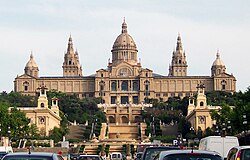
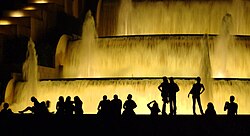
Perched atop the scenic Montjuïc hill in Barcelona, the Museu Nacional d'Art de Catalunya (MNAC) stands as one of Spain's most significant cultural institutions. Housed in the imposing Palau Nacional, the museum serves as a comprehensive chronicle of Catalan visual art, spanning from the early Middle Ages to the mid-20th century. Whether you are drawn to the spiritual intensity of Romanesque frescoes or the avant-garde spirit of 20th-century design, MNAC offers an unparalleled journey through the artistic identity of Catalonia.
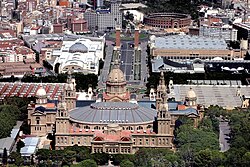
The museum is located at the end of Avinguda de la Reina Maria Cristina, near Plaça d'Espanya, making it a focal point for both art historians and casual visitors exploring the city's architectural grandeur.
Key Facts
- Established: 1934 (Officially inaugurated in its current form on December 16, 2004).
- Location: Palau Nacional, Montjuïc, Barcelona.
- Collection Size: Approximately 290,000 works.
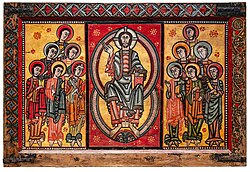
- Specialization: World-renowned for Romanesque church paintings and Catalan Modernisme.
- Architecture: Housed in the Italian-style Palau Nacional, built for the 1929 International Exposition.
A History of Preservation and Growth
The roots of MNAC stretch back to the 19th-century Renaixença (Catalan renaissance), a cultural movement dedicated to reviving and conserving the region's artistic heritage. This effort began with the creation of the Barcelona Provincial Museum of Antiquities in 1880 and the Municipal Fine Art Museum in 1891.
In 1934, under the direction of Joaquim Folch i Torres, a project was launched to consolidate these collections within the Palau Nacional. However, the Spanish Civil War (1936–1939) disrupted these plans, forcing many artworks to be evacuated to Paris, Olot, and Darnius for safety. Following the war, the collections were split: Romanesque, Gothic, and Baroque works returned to the Palau in 1942, while modern art was housed in the Arsenal building in Parc de la Ciutadella until 2004.
A massive renovation led by architects Gae Aulenti, Enric Steegmann, and Josep Benedito began in 1990. This process saw the reopening of the Oval Hall for the 1992 Summer Olympics and a phased installation of collections that culminated in the museum's official 2004 inauguration.
The Collections
![Saint George and the Princess (anon) [ca; es; fr]](/images/7c/7c/7c7cd639ccf29019c218cbfe5884e1c0c25fa9055994eeeb8add6e387f612cc6.jpg)
Romanesque Art
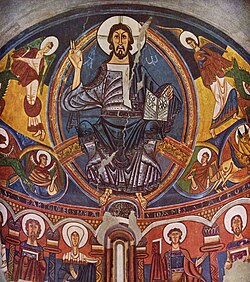
The Romanesque collection is widely considered the most important of its kind globally. Dating from the 11th to 13th centuries, these murals originally adorned rural churches in the Pyrenees and "Old Catalonia" (Catalunya Vella). Many were recovered following a landmark 1907 expedition by the Institut d'Estudis Catalans.
Gothic, Renaissance, and Baroque Art
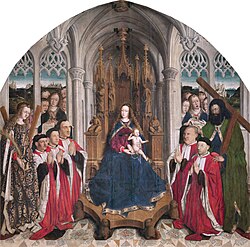
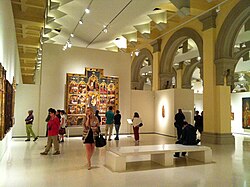
The Gothic section showcases a blend of Italian, Catalan, and Aragonese influences. Key highlights include the Triptych of Sant Vicenç d'Estopanyà and works by the influential Serra brothers. The collection also features significant sculpture from the 14th and 15th centuries, including the International Gothic style represented by Pere Oller and Pere Joan.
Modern Art: Modernisme and Noucentisme
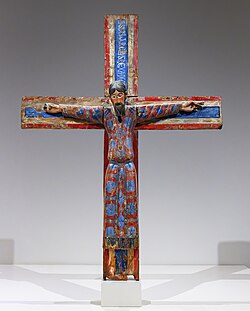
The modern collection tracks the evolution of Catalan art from the early 19th century to the 1940s. It is particularly famous for Modernisme (the Catalan version of Art Nouveau) and Noucentisme (a return to classical order and Mediterranean values). Notable artists include Ramon Casas, Joaquim Mir, and the acclaimed Antoni Tàpies.
Specialized Collections and Bequests
- Thyssen-Bornemisza Collection: A permanent loan of 72 paintings and 8 sculptures, primarily religious themes, landscapes, and portraits.
- Cabinet of Drawings and Prints: Over 50,000 drawings and 70,000 engravings, including a massive body of work by Marià Fortuny.
- Numismatic Cabinet of Catalonia: Established in 1932, it houses over 134,000 coins and medals, including high-quality works by Eusebi Arnau.

Museum Infrastructure and Resources
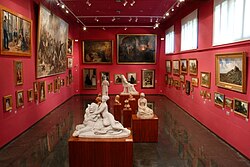
Beyond the galleries, MNAC is a hub for research and education. The museum maintains a comprehensive library and archive, featuring rare incunabula (books printed before 1501) such as the 1493 Nuremberg Chronicle. The institution also operates a specialized Conservation-Restoration Center to ensure the longevity of its vast holdings.
| Category | Details |
|---|---|
| Current Director | Pepe Serra |
| Primary Building | Palau Nacional |
| Key Art Movements | Romanesque, Gothic, Modernisme, Noucentisme |
| Total Works | ~290,000 |
| Parking | On site (no charge) |
Frequently Asked Questions

What is the most famous part of the MNAC collection?
The museum is most renowned for its Romanesque collection, which features an unmatched assembly of murals and paintings from 11th to 13th-century rural churches in the Pyrenees.
Where is the museum located?
It is located in the Palau Nacional on Montjuïc hill in Barcelona, Spain, near Plaça d'Espanya.
What are Modernisme and Noucentisme?
Modernisme is a Catalan artistic movement related to Art Nouveau, characterized by organic forms and ornamentation. Noucentisme was a subsequent movement that emphasized a return to classical order, harmony, and Mediterranean identity.
Is the Thyssen-Bornemisza collection part of MNAC?
Yes, a specific selection of 72 paintings and 8 sculptures from the Thyssen-Bornemisza Foundation is exhibited permanently at the museum via a loan agreement.
When was the museum officially inaugurated?
While the building has housed art since 1934, the Museu Nacional d'Art de Catalunya was officially inaugurated on December 16, 2004, following a major renovation.