Murray Chotiner: The Political Strategist and Presidential Adviser
Murray Chotiner was a formidable political operative and lawyer whose relationship with Richard Nixon spanned over two decades. Known for his aggressive tactics and strategic mind, Chotiner played a complex role within the Nixon administration, oscillating between official government appointments and private legal practice while remaining a trusted, if sometimes controversial, confidant to the President.
The Struggle for Influence at the RNC
Following Richard Nixon's election in November 1968, Chotiner sought the chairmanship of the Republican National Committee (RNC). However, he faced significant opposition from White House Chief of Staff H.R. Haldeman and Attorney General John Mitchell, who viewed him as a rival. To keep him outside the immediate White House circle, they proposed making him the RNC executive director—a role designed to hold the actual power while the chairman served as a figurehead.
The transition was fraught with tension. Chotiner initially occupied an office at the RNC under the nominal guise of managing inauguration tickets. This arrangement disturbed RNC chairman Ray Bliss. The situation remained unresolved for a month after the inauguration until Chotiner took unilateral action, informing Bliss that he was taking control. This led to Bliss's immediate resignation.
Despite this, Chotiner's tenure at the RNC was short-lived. Rogers Morton, the incoming chairman, refused to serve as a figurehead or allow Chotiner any role within the organization. Consequently, Chotiner was informed by John Sears that he had no place at the RNC.
Government Appointments and Special Counsel Duties
Because Chotiner had sold his home and closed his California practice, the administration sought a suitable position for him. On April 10, 1969, he was appointed General Counsel to Theodore R. Gates, the acting Special Representative for Trade Negotiations. To facilitate this, Nixon had issued Executive Order 11463, designating the role as a Schedule C (political) appointment and increasing its salary.
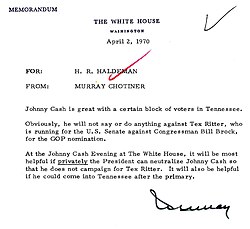
By January 13, 1970, Chotiner was appointed as a special counsel to the President, reporting directly to Haldeman. His primary responsibility was serving as the internal White House liaison for political campaigns across 31 states. He was known for his aggressive campaign advice; for example, during a seminar for Young Republican leaders, he suggested that opponents of Senator Edward Kennedy repeatedly mention the Chappaquiddick incident while simultaneously claiming it was not a campaign issue.
Chotiner also coordinated Vice President Spiro Agnew's campaigns against "radic lib" (radical liberal) candidates, contributing to the defeat of Senator Charles Goodell by James L. Buckley. He credited his twenty-year history with Nixon as the reason he could operate with significant autonomy.
Private Practice and Political Lobbying
In March 1971, Chotiner resigned from the White House to return to private law. During this period, he represented Jimmy Hoffa, the former Teamsters president. Chotiner lobbied Haldeman regarding Hoffa's release, and Nixon granted Hoffa clemency in November 1971.
Chotiner also engaged in high-stakes lobbying for milk producers seeking increased price supports from the United States Department of Agriculture. He negotiated a $2 million campaign contribution from Associated Milk Producers to the Committee for the Re-Election of the President (CRP). To avoid suspicion, these funds were funneled through shell organizations created by Bob Bennett and John Dean.
Intelligence Gathering and the 1972 Election
During the 1972 campaign, Chotiner headed the Ballot Security Task Force. More notably, at the direction of John Mitchell, he hired journalists Seymour Friedin and later Lucianne Goldberg to embed themselves with Democratic presidential candidates. Code-named "Chapman's Friend," these operatives sent reports back to Chotiner, who forwarded them to Mitchell and Haldeman. They were paid $1,000 per week plus expenses, reimbursed by the CRP via Chotiner's law office account.
The Watergate Era and Final Years
Despite his proximity to the administration, Chotiner was not part of the inner circle consisting of Haldeman and John Ehrlichman. He famously dismissed the Watergate break-in as a "stupid, useless, inane experiment" inspired by television shows like Mission Impossible. While the Manchester Union Leader accused him of organizing the break-in, Chotiner successfully sued for libel, resulting in a substantial settlement and a front-page apology.
As the scandal deepened, Chotiner advised Nixon to fire Special Prosecutor Archibald Cox, an action that contributed to the events known as the Saturday Night Massacre. Despite the turmoil, Chotiner remained loyal, believing Nixon was a genius and that the President would move past the scandal by early 1974.
Key Facts
- Role: Served as Special Counsel to the President and General Counsel for Trade Negotiations.
- Political Strategy: Acted as the White House liaison for Republican organizations in 31 states.
- Controversies: Managed the "Chapman's Friend" intelligence operation and negotiated a $2 million contribution from milk producers to the CRP.
- Legal Actions: Successfully sued the Manchester Union Leader for libel regarding Watergate accusations.
- Key Advice: Urged President Nixon to fire Special Prosecutor Archibald Cox.
| Period | Position/Role | Key Focus |
|---|---|---|
| 1969 | General Counsel (Trade Negotiations) | Political appointment under Theodore R. Gates |
| 1970–1971 | Special Counsel to the President | Political campaigns and state liaison |
| 1971–1974 | Private Law Practice | Representation of Jimmy Hoffa and milk producers |
| 1972 | Head of Ballot Security Task Force | Nixon re-election campaign intelligence |
Frequently Asked Questions
What was Chotiner's relationship with H.R. Haldeman?
Their relationship was strained; Haldeman viewed Chotiner as a rival and actively worked to keep him out of the White House, describing Chotiner's eventual appointment as a "mixed blessing."
How did Chotiner assist Jimmy Hoffa?
Chotiner represented Hoffa in private practice and wrote to H.R. Haldeman to push for Hoffa's release, which preceded President Nixon granting him clemency in November 1971.
What was the "Chapman's Friend" operation?
It was a covert intelligence operation where Chotiner hired journalists to spy on Democratic presidential candidates and report their findings back to the Nixon campaign leadership.
Did Murray Chotiner organize the Watergate break-in?
No. Although the Manchester Union Leader accused him of doing so, Chotiner won a libel lawsuit against the newspaper, which issued a full retraction and apology.
What role did Chotiner play in the Saturday Night Massacre?
Chotiner advised President Nixon to fire Special Prosecutor Archibald Cox, arguing that Cox would use anyone and everyone to get what he wanted.