Morocco Electricity and Renewable Energy Transition
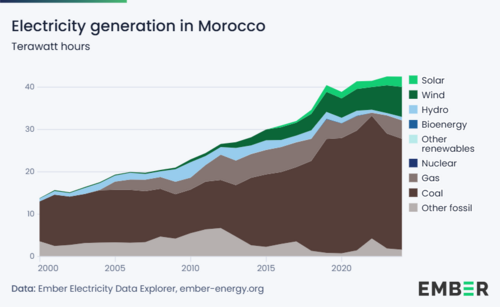
Morocco is currently undergoing a significant transformation of its energy landscape. Historically dependent on state-managed infrastructure and imported fossil fuels, the kingdom is now pivoting toward a diversified energy mix. Driven by a growing population and rapid economic development, the nation's electricity demand has surged, leading to a strategic shift toward private sector involvement and a massive investment in sustainable resources.
The sector was traditionally managed by the Office National de l'Electricité (ONE), a state-owned entity reorganized in 1995 to improve profitability. By 2014, annual electricity consumption had reached 33.5 terawatt-hours. To combat power shortages and reduce public spending, the government has integrated private sector generation, with the state's share of production expected to decline to 40 percent by 2020, although ONE remains solely responsible for the transmission and distribution of power.
Key Facts
- Renewable Target: Morocco aims for 52% of its energy to come from renewable sources by 2030.
- Solar Leadership: The Noor Solar complex in Ouarzazate is one of the world's largest solar power plants.
- Wind Capacity: The country targets a 2-GW production capacity through the Moroccan Integrated Wind Energy Project.
- Hydropower: Morocco possesses an installed hydropower capacity of 1,770 MW.
- Private Sector: Jorf Lasfar became the first privately operated power station in 1997.
Traditional Power Generation
In 2003, Morocco's installed generating capacity stood at 4.8 GW. The energy mix has historically relied on coal, with the largest stations located at Mohammedia and Jorf Lasfar. Since closing the Jerada coal mine in 2000, Morocco has imported most of its coal from South Africa and Poland.
Efforts to expand capacity include the Jorf Lasfar plant, which was expanded to 1,400 MW in 2001 by a U.S.-Swiss consortium. Additionally, a 350–400-MW combined-cycle power plant—a system that uses both gas and steam turbines to produce electricity—began operation in Tahaddart in 2005, owned jointly by ONE (48%), Endesa (32%), and Siemens (20%).
The Shift to Renewable Energy
Lacking significant fossil fuel deposits, Morocco has leveraged its abundant solar, wind, and hydro resources. A 2004 development plan sought to electrify 80 percent of rural areas by 2008 and increase renewable energy's share from 0.24 percent in 2003 to 10 percent by 2011. This was further bolstered by the 2010 "renewable energy law" (Law 13-09), positioning Morocco as a leader in the Independent Power Producer (IPP) model for large-scale utilities in North Africa.
Wind Power
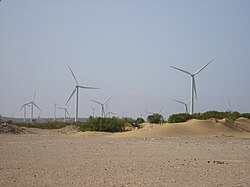
Through the Moroccan Integrated Wind Energy Project launched in 2010, the country is pursuing a 2-GW capacity goal. As of 2016, eight operational wind farms—including Torres, Amogdoul, Lafarge, Akhfennir, Laayue, Tangier I, Cimar, and Haouma—provided a total capacity of 487 MW.
Solar Power
Morocco's solar ambitions are managed by the Moroccan Agency for Sustainable Energy (MASEN). A $9 billion initiative announced in 2009 aimed to produce 2,000 MW of electricity by 2020, accounting for 38 percent of installed generation. This effort utilizes both Photovoltaic (PV) technology and Concentrated Solar Power (CSP), which uses mirrors to focus sunlight to create heat that drives a steam turbine.
The flagship Noor Solar project in Ouarzazate consists of three phases (Noor I, II, and III). Noor I, inaugurated in 2016, uses 500,000 parabolic mirrors to generate up to 160 MW. Together with Noor PV 1 and Noor Midelt phase 1, the total complex was scheduled to reach 582 MW of capacity by 2018, enough to power 1.1 million homes.
Hydropower and Biomass
With four perennial rivers and numerous dams, Morocco has an installed hydropower capacity of 1,770 MW. The country also possesses vast biomass potential—estimated at 12,568 GWh/year for solid bioenergy and 13,055 GWh/year for biogas and biofuels—though less than 1% of this is currently utilized due to high investment costs and technical knowledge gaps.
Nuclear Energy and Desalination
Morocco has explored nuclear energy primarily for desalination and research. In 2001, an agreement with the United States led to the construction of a 2-MW research reactor east of Rabat, developed in partnership with General Atomics.
Energy Infrastructure Summary
| Energy Source | Key Project/Entity | Capacity/Target | Status/Note |
|---|---|---|---|
| Coal | Jorf Lasfar | 1,400 MW | Privately operated since 1997 |
| Wind | Integrated Wind Project | 2 GW (Goal) | 487 MW operational (2016) |
| Solar | Noor Solar Complex | 582 MW (Complex) | Includes CSP and PV technology |
| Hydro | National Dams | 1,770 MW | Installed capacity |
| Nuclear | Research Reactor | 2 MW | Research and desalination focus |
Frequently Asked Questions
What is the long-term goal for renewable energy in Morocco?
Morocco aims to have 52% of its energy generated from renewable sources by the year 2030.
What is the difference between the solar technologies used in the Noor project?
The project uses both Photovoltaic (PV) cells, which convert sunlight directly into electricity, and Concentrated Solar Power (CSP), which uses mirrors to concentrate solar thermal energy to produce steam and drive turbines.
Who is responsible for the distribution of electricity in Morocco?
The state-owned Office National de l'Electricité (ONE) remains solely responsible for the transmission and distribution of electricity across the country.
Why has Morocco not fully utilized its biomass energy potential?
Despite having significant potential in solid bioenergy and biogas, less than 1% is utilized due to insufficient production process knowledge and high investment costs.
Does Morocco produce its own coal?
No, Morocco stopped domestic coal production in 2000 when the Jerada coal mine was closed; it now imports coal primarily from South Africa and Poland.