Montreal Stock Exchange: A History of Canadian Finance
The evolution of the Montreal Stock Exchange mirrors the broader economic trajectory of Canada. From its humble beginnings in a coffee house to its transformation into a global leader in derivatives trading, the institution has stood at the center of Canada's financial shifts for nearly two centuries.
The Early Years and Rapid Growth (1832–1920s)
Canada's first foray into organized trading began in 1832 as an informal stock exchange operating out of the Exchange Coffee House in Montreal. However, it wasn't until 1874 that the formal Montreal Stock Exchange was established. This creation was driven by Lorn MacDougall, his brothers Hartland St. Clair and George Campbell MacDougall, James Burnett, and Frank Bond. Lorn MacDougall served as the first Chairman of the Governing Committee until his retirement in 1883.
By 1910, Montreal was the undisputed financial heart of Canada. The exchange handled approximately $2.1 million in trades, dwarfing the Toronto Stock Exchange's $900,000. This era of prosperity fueled the rise of industrial giants such as Dominion Textile and Montreal Light, Heat & Power.
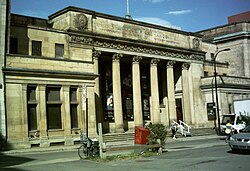
The city's financial dominance was physically manifested on Saint Jacques Street, where many major financial institutions headquartered. In 1903, the exchange commissioned architect George B. Post—who also designed New York's Exchange Building—to create a dedicated facility on St. Francois-Xavier Street.
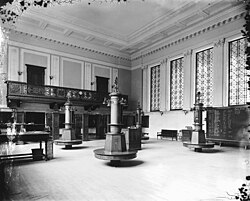
The interior of this historic building reflected the prestige of the era's financial elite.
Market Expansion and the Great Depression
World War I served as a catalyst for economic independence, reducing Canada's reliance on the London market. Throughout the 1920s, the Montreal market grew strongly, with trading volumes reaching $3.5 million. To accommodate speculative and junior stocks, the "Montreal Curb Market" was established in 1926. This served as a stepping stone for smaller companies; if they grew successfully, they could apply for transfer to the main Exchange. In 1953, this entity was renamed the Canadian Stock Exchange.
The 1929 financial crisis hit Montreal with particular severity. By 1934, a combination of factors allowed the Toronto Stock Exchange to surpass Montreal in influence. While Montreal eventually recovered its economic standing, a decade of political instability in the mid-1970s ultimately shifted Canada's financial metropolis status to Toronto.
Political Turmoil and the Shift to the Montreal Exchange
During the late 1960s, the exchange became a target for political unrest. The separatist group Front de libération du Québec viewed the institution as a symbol of Anglo-Canadian power. On February 13, 1969, the group detonated a bomb at the exchange, which injured 27 people and destroyed the northeast wall.
In 1982, the institution rebranded as the Montreal Exchange. This change reflected a strategic shift in focus toward financial instruments other than stocks, specifically options (contracts giving the right to buy or sell an asset) and futures (contracts to buy or sell an asset at a predetermined future date).

Modernization and Global Integration
The turn of the millennium brought a massive restructuring of Canadian capital markets. In 1999, the exchanges in Vancouver, Alberta, Toronto, and Montreal agreed to specialize. The Montreal Exchange became the Canadian Derivatives Exchange for a ten-year period. Equity trading for large companies moved to the Toronto Stock Exchange (TSX), while smaller companies moved to the Canadian Venture Exchange (now the TSX Venture Exchange).
Technologically, the Montreal Exchange was a pioneer. By the end of 2001, it became the first traditional North American exchange to fully migrate from an open outcry system (where traders shout bids and offers) to a fully automated trading system. It also transitioned from a specialist model to a competing market-making model for equity options.
The exchange expanded its international footprint in 2004 by providing electronic trading systems and support for the Boston Options Exchange (BOX) via the Sola Trading platform. By September 2009, the Montreal Exchange held a stake of over 51% in BOX.
Corporate Mergers and Acquisitions
On May 1, 2008, the TSX Group completed the acquisition of Montreal Exchange Inc. for C$1.31 billion, renaming the parent corporation TMX Group Inc.
In 2011, a complex series of events unfolded. The London Stock Exchange (LSE) proposed a merger with TMX Group to create a global entity called LTMX Group plc, which would have been the second-largest exchange in the world. However, on June 13, 2011, the Maple Group—a consortium of leading Canadian banks and financial institutions—launched a hostile bid of $3.7 billion CAD to block the LSE takeover.
Key Facts
- Founded: Formally established in 1874; informal roots dating back to 1832.
- Peak Dominance: In 1910, Montreal's trade volume ($2.1M) significantly exceeded Toronto's ($900K).
- Technological First: First traditional North American exchange to fully automate trading (2001).
- Specialization: Transitioned to focus primarily on derivatives (options and futures) starting in 1999.
- Acquisition: Acquired by TSX Group in 2008 for C$1.31 billion.
| Era/Year | Entity Name | Primary Focus/Event |
|---|---|---|
| 1832 | Exchange Coffee House | Informal stock trading |
| 1874 | Montreal Stock Exchange | Formalized equity trading |
| 1926 | Montreal Curb Market | Speculative and junior stocks |
| 1982 | Montreal Exchange | Shift toward options and futures |
| 1999 | Montreal Exchange | Designated Canadian Derivatives Exchange |
| 2008 | TMX Group Inc. | Acquisition by TSX Group |
Frequently Asked Questions
Why did the Montreal Stock Exchange change its name in 1982?
The name was changed to the Montreal Exchange to reflect that the trading floor was increasingly focused on financial instruments other than stocks, specifically options and futures.
What was the "Montreal Curb Market"?
Created in 1926, it was a market for speculative and junior stocks. Companies that grew successfully in the Curb Market could eventually apply to transfer to the main Exchange. It was later renamed the Canadian Stock Exchange in 1953.
How did the Montreal Exchange lead in technology?
At the end of 2001, it became the first traditional exchange in North America to completely replace the open outcry trading environment with a fully automated electronic system.
What happened during the 2011 merger attempt?
The London Stock Exchange attempted to merge with TMX Group to create LTMX Group plc. This was met with a hostile $3.7 billion CAD bid from the Maple Group, a consortium of Canadian financial institutions seeking to keep the exchange under Canadian control.
Who designed the original Montreal Stock Exchange building?
The building on St. Francois-Xavier Street was designed by architect George B. Post, who was commissioned in 1903 and had also designed the Exchange Building in New York.