Monoisotopic Elements: The Science of Single Stable Isotopes
In the vast landscape of the periodic table, most elements exist as a mixture of different isotopes—variants of the same element that differ in their number of neutrons. However, a select group of elements known as monoisotopic elements stands apart. A monoisotopic element is defined as an element that possesses one and only one stable isotope, also referred to as a nuclide.
There are 26 such elements in existence. While theoretical physics suggests that all nuclides with atomic numbers above 40 or 66 (depending on the specific definition used) are technically unstable, they are experimentally defined as stable if their half-lives are so long that decay has never been observed, either directly or through the measurement of decay products.
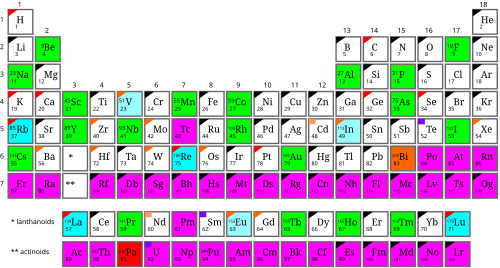
Key Facts
- There are 26 monoisotopic elements.
- Most monoisotopic elements have an odd number of protons (odd Z) and an even number of neutrons.
- Beryllium is the only monoisotopic element with an even atomic number.
- Nuclear pairing energy generally prevents nuclei with odd numbers of both protons and neutrons from being stable.
- Tantalum-180m is observationally stable, though it is not beta-stable.
The Role of Nuclear Pairing Energy
The stability of these elements is largely governed by nuclear pairing energy, a phenomenon where nucleons (protons and neutrons) tend to form pairs to achieve a lower, more stable energy state. Because of this energy gain, a nucleus containing an odd number of both protons and neutrons is typically unstable and will not be beta-stable (resistant to beta decay).
There are only four light exceptions to this rule: hydrogen-2, lithium-6, boron-10, and nitrogen-14. Outside of these, the general trend holds, with one notable exception in the heavier elements: tantalum-180m. While tantalum-180m is not beta-stable, it remains observationally stable.
The Unique Case of Beryllium
Beryllium represents the sole exception to the odd-proton rule among monoisotopic elements, as it has an even atomic number of 4. Its only stable, primordial isotope is beryllium-9, which consists of 4 protons and 5 neutrons.
The reason beryllium lacks other stable isotopes is due to specific nuclear instabilities. Beryllium-8, which has an equal number of protons and neutrons (4 of each), is unstable because it rapidly splits into two exceptionally well-bound helium-4 nuclei. On the other hand, an isotope with 4 protons and 6 neutrons is prevented from stability by a significant mismatch in the proton-to-neutron ratio (approximately 0.67), which is too high for such a light element.
Interestingly, beryllium-10 possesses a half-life of 1.387 million years. While this is too short for the isotope to be primordial (existing since the formation of the solar system), it demonstrates a relative stability for a light isotope with such a neutron imbalance.
Summary of Monoisotopic Characteristics
| Feature | General Rule | Notable Exception(s) |
|---|---|---|
| Number of Stable Isotopes | Exactly one | None |
| Proton Count (Z) | Odd | Beryllium (Even Z=4) |
| Neutron Count | Even | Beryllium-9 (Odd) |
| Beta-Stability | Stable | Tantalum-180m (Observationally stable) |
Frequently Asked Questions
What exactly is a monoisotopic element?
A monoisotopic element is a chemical element that has only one stable isotope (nuclide) found in nature.
How many monoisotopic elements are there?
There are 26 elements that fit this classification.
Why is beryllium-8 not stable?
Beryllium-8 is unstable because it tends to split into two helium-4 nuclei, which are exceptionally well-bound and more stable.
What is the significance of nuclear pairing energy?
Nuclear pairing energy is the energy gain that occurs when protons or neutrons pair up. This generally means that nuclei with an odd number of both protons and neutrons are unstable, unless they are among the four lightest cases.
Is tantalum-180m truly stable?
Tantalum-180m is considered observationally stable, meaning its decay has not been observed, although it is not technically beta-stable.