Monaca History: From Early Settlements to Industrial Evolution
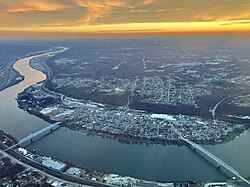
The story of Monaca, Pennsylvania, is a rich tapestry of religious experimentation, early American industry, and strategic geographical importance. From its origins as a land grant in the late 18th century to its current role in the petrochemical industry, Monaca has evolved through several distinct identities, reflecting the broader shifts in American social and economic history.
The land was originally granted by the Commonwealth of Pennsylvania on September 5, 1787, to Colonel Ephraim Blaine, a Revolutionary War veteran and former commissary-general of the Northern Department. This initial tract was known as "Appetite." By 1813, the land passed to Francis Helvidi, a Polish nobleman in exile. While Helvidi attempted to establish a sheep-farming venture, the effort failed, leading to the property's sale to George Rapp, leader of the Harmony Society, in 1821.
The Rise of Phillipsburg and the New Philadelphia Society
The transition from rural land to a structured town began in 1822 when Stephen Phillips and John Graham purchased the property. They established extensive boat yards on the Ohio River, and the settlement became known as Phillipsburg. Their shipyards were prolific, producing steamboats such as the William Penn, which transported the Harmonites to their final home at Economy.
In 1832, the trajectory of the town shifted when Bernhard Müller, known as Count de Leon, led a group of approximately 250 seceders from the Harmony Society to the area. These German immigrants formed a communal religious society called the New Philadelphia Society (or New Philadelphian Congregation). They renamed the community "Löwenburg" (Lion City) and constructed a hotel, a church, and various other buildings.
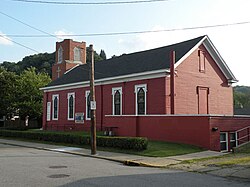
Despite their ambitions, financial difficulties and litigation forced Müller's group to sell their communal land in 1833. While some members remained in Monaca, others followed Müller to the Germantown Colony in Louisiana. Later, in the early 1840s, a speaker named William Keil attracted some remaining members, eventually leading a group to settle in Missouri and later Oregon. Despite these departures, a core population remained, and the area was officially incorporated as the Borough of Phillipsburg in 1840.
Health, Education, and the Transition to Monaca
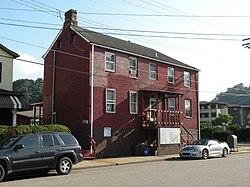
The mid-19th century saw Phillipsburg become a center for specialized services. In 1848, Dr. Edward Acker founded the Watercure Sanatorium, the first hospital in Beaver County. This facility utilized hydropathy—the use of water for healing—and was so prominent that when the first post office opened in 1856, the town was referred to as "Water Cure."
Following the sanatorium's era, the buildings were used by Reverend William G. Taylor for the Soldiers' Orphans Home starting in 1865, though the facility was destroyed by fire in 1876. Education also found a temporary home here; Thiel College was founded in Monaca in 1866 before relocating to Greenville in 1871.
In 1892, the borough officially changed its name from Phillipsburg to Monaca. This was done to honor Monacatootha (also known as Scarouady), an Oneida warrior chief and representative of the Iroquois Confederacy. Monacatootha, whose name means "Great Arrow," was a key diplomatic figure who had met with George Washington and was a staunch ally of the English against the French.
Industrialization and the Modern Era
As the 20th century progressed, Monaca transformed into a manufacturing hub. The town became known for producing a wide array of industrial goods, including drawn steel, wire, tubing, glass, tile, and enameled porcelain ware. This industrial legacy continues today with the presence of Stölzle Glass USA.
In recent decades, Monaca has faced both challenges and significant economic shifts. In 2003, the town was the center of a major hepatitis A outbreak linked to tainted green onions at a local Chi-Chi's restaurant, affecting at least 640 people. However, the town's economic landscape shifted again in 2012 when Royal Dutch Shell announced plans for a multi-billion-dollar ethane cracker complex. This facility, the Shell Pennsylvania Petrochemicals Complex, utilizes natural gas from the Marcellus shale via hydraulic fracturing (a process of injecting liquid at high pressure into subterranean rocks to extract gas) to produce ethylene.
Key Facts
- Original Name: First known as "Appetite," then Phillipsburg, and briefly "Löwenburg."
- Founding Figure: Colonel Ephraim Blaine received the original land patent in 1787.
- Religious Influence: Home to the New Philadelphia Society, a communal group led by Count de Leon.
- Medical Milestone: The Watercure Sanatorium (1848) was Beaver County's first hospital.
- Name Origin: Renamed Monaca in 1892 after the Oneida chief Monacatootha.
- Modern Industry: Site of the Shell Pennsylvania Petrochemicals Complex, the first of its kind in the NE U.S. using shale gas.
| Period | Key Identity/Name | Primary Activity/Event |
|---|---|---|
| Late 18th C. | Appetite | Land grant to Col. Ephraim Blaine |
| 1822–1832 | Phillipsburg | Establishment of steamboat yards |
| 1832–1833 | Löwenburg | Communal settlement by New Philadelphia Society |
| 1848–1860s | Water Cure | Hydropathy and the first county hospital |
| 1892–Present | Monaca | Industrial manufacturing and petrochemicals |
Frequently Asked Questions
Why was the town originally called Phillipsburg?
It was named after Stephen Phillips, who, along with John Graham, purchased the land in 1822 to establish extensive steamboat yards on the Ohio River.
Who was Monacatootha?
Monacatootha, also known as Scarouady or "Great Arrow," was an Oneida warrior chief and Iroquois Confederacy representative who supervised affairs among the Delawares and Shawnees and was an ally of the English.
What was the Watercure Sanatorium?
Founded in 1848 by Dr. Edward Acker, it was the first hospital in Beaver County and specialized in hydropathy, which is the use of water to treat ailments.
What is the significance of the Shell Pennsylvania Petrochemicals Complex?
It is the first unit of its kind built in the northeastern United States to use natural gas obtained from hydraulic fracturing of the Marcellus shale as feedstock to produce ethylene.
What happened to the New Philadelphia Society?
Led by Bernhard Müller (Count de Leon), the communal society sold its land in 1833 due to financial problems and litigation; some members stayed in Monaca, while others moved to Louisiana.