Modi'in: From Ancient Maccabean Roots to Modern Urban Planning
The region of Modi'in serves as a profound intersection of ancient heritage and contemporary urban development. Known primarily as the birthplace of a historic Jewish rebellion, the area has evolved from a series of strategic ancient settlements into a highly planned modern municipality. By examining the archaeological layers of the landscape, we can trace a timeline that spans from the Chalcolithic period to the present day.
Ancient Modi'in and the Maccabean Legacy
In classical antiquity, the town of Modi'in (Ancient Greek: Mōdeeim) was the epicenter of a pivotal movement in Jewish history. It was the home of the Maccabees, Jewish rebel warriors who led a revolt against Seleucid rule and the forced Hellenisation—the spread of Greek culture and language—of the Jewish population. This successful uprising led to the rededication of the Second Temple, an event commemorated annually during the holiday of Hanukkah.
Following the expulsion of the Seleucids, the Maccabees established the Hasmonean dynasty, which governed Judea throughout the 2nd and 1st centuries BCE. Later, during the Byzantine era under Emperor Justinian, the town in this region was referred to as Moditha.
Archaeological excavations have revealed a fortified Jewish homestead dating from the Hellenistic period through the Bar Kokhba revolt (132–135 CE). Notable finds include a rock-hewn hiding complex accessed via a mikveh (a ritual bath used for purification) and a numismatic collection of 16 silver tetradrachms and didrachms (shekels and half-shekels) minted in Tyre during the Seleucid era.
While the Talmud describes an ancient Modi'in, its exact location remains a subject of scholarly debate. Potential sites include Suba, al-Midya, Khirbet el-Burj, and Umm el-Umdan.
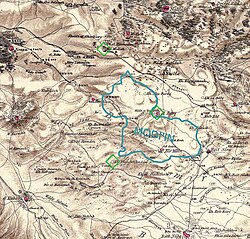
Key Archaeological Sites
Umm el-Umdan
Located on a hilltop near the southern Moriah neighbourhood of Maccabim Reut, Umm el-Umdan features six settlement strata spanning the Persian, Hellenistic, Roman, Byzantine, and Early Muslim periods. The most significant findings are from a rural settlement active from the Hasmonean through the Early Roman periods. This site contains a synagogue dating from the late 2nd to early 1st century BCE, which remained in use until the Bar Kokhba revolt, alongside a 1st-century CE mikveh.
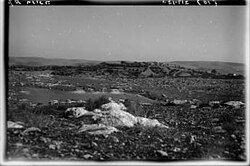
Titura (Horbat Tittora)
Horbat Tittora exhibits a long history of human presence, with evidence stretching from the Chalcolithic to the Ottoman period. Habitation was continuous from the Iron Age II (First Temple period) through the Byzantine period, with subsequent traces from the Early Muslim, Mamluk, and Ottoman eras.
Excavations at Titura also uncovered a Crusader castle. Findings from the castle's courtyard, which served as a kitchen, include various kitchenware and bronze and silver jewelry likely lost by the medieval female staff.
Preservation and Modern Development
The rapid construction of the modern city initially threatened many archaeological vestiges. However, the intervention of private citizens helped save sites like Titura and Umm el-Umdan. Today, these authorities manage the preservation of these sites, and the Hasmonean antiquities are integrated into local Hanukkah rituals.
The modern municipality of Modi'in-Maccabim-Re'ut was formed through a series of developments in the late 20th century. The town of Maccabim was started in 1985 by the International Maccabi World Union, followed by Re'ut in 1987, founded by an association of Israeli army officers. These two were merged into Maccabim-Re'ut in 1990.
The cornerstone of the main city of Modi'in was laid in 1993, and it opened for residency in 1996. Designed as a planned city, it emphasizes environmental sustainability and urban growth, with 50% of the city limits dedicated to large greenspaces. In 2003, the Israeli Ministry of Interior unified Modi'in and Maccabim-Re'ut into a single city.
The current municipal boundaries encompass several depopulated Palestinian villages following the 1948 Arab–Israeli War, including Ajanjul, Barfiliya, Bayt Shanna, Bir Ma'in, Al-Burj, Innaba, Khirbat al-Buwayra, Kharruba, and Al-Kunayyisa. Additionally, reports from ARIJ indicate that land for the construction of Maccabim was confiscated from the villages of Beit Sira (1,499 dunams) and Saffa (471 dunams).
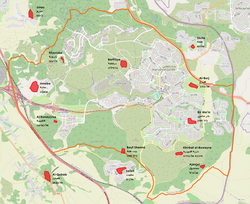
Summary of Modi'in's Historical Eras
| Period | Key Features / Sites | Significant Events/Findings |
|---|---|---|
| Ancient/Hellenistic | Ancient Modi'in | Maccabean Revolt; Hasmonean Dynasty |
| Roman/Byzantine | Moditha / Umm el-Umdan | Bar Kokhba revolt; Synagogue and Mikveh |
| Medieval | Titura | Crusader castle and kitchenware |
| Modern (1985-Present) | Modi'in-Maccabim-Re'ut | Planned urban development; 50% greenspace |
Frequently Asked Questions
Who were the Maccabees?
The Maccabees were a group of Jewish rebel warriors from ancient Modi'in who led a successful revolt against the Seleucid Empire to stop the Hellenisation of the Jewish people and reclaim their religious freedom.
What is the significance of the mikveh found in the area?
A mikveh is a ritual bath used for spiritual purification. The discovery of these structures at sites like Umm el-Umdan and the fortified homestead indicates the religious practices of the Jewish populations living there during the Hasmonean and Roman periods.
How is the modern city of Modi'in designed?
Modi'in was built as a planned city with a strong focus on urban planning and environmental considerations, notably allocating 50% of its area to greenspaces to accommodate future growth.
What happened to the ancient sites during the city's construction?
Some archaeological remains were lost due to a lack of initial interest during construction. However, citizen efforts successfully preserved key sites such as Titura and Umm el-Umdan, which are now under official preservation.
Which Palestinian villages are within the modern municipal boundaries?
The boundaries include several depopulated villages: Ajanjul, Barfiliya, Bayt Shanna, Bir Ma'in, Al-Burj, Innaba, Khirbat al-Buwayra, Kharruba, and Al-Kunayyisa.