Missouri Botanical Garden: A Legacy of Botanical Research and Horticulture
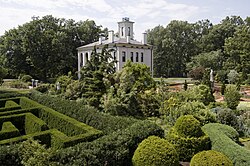
Located at 4344 Shaw Boulevard in St. Louis, Missouri, the Missouri Botanical Garden stands as a premier center for plant research, conservation, and public education. Often referred to as Shaw's Garden after its founder, the institution blends Late Victorian architectural charm with cutting-edge scientific facilities, making it a cornerstone of botanical study in North America.
Beyond its aesthetic beauty, the garden is a powerhouse of scientific data. Its herbarium—a collection of preserved plant specimens—is the second largest in North America, housing over 7.5 million specimens. This collection is identified by the Index Herbariorum code MO, a standard used globally when citing these specific specimens in scientific literature.
Key Facts
- Founded: Opened in 1859 by philanthropist Henry Shaw.
- Scientific Standing: Home to the second largest herbarium in North America.
- Historic Status: Listed on the National Register of Historic Places (1971) and designated a National Historic Landmark (1976).
- Major Attractions: The Climatron geodesic dome and the Seiwa-en Japanese Garden.
- Global Impact: Co-creator of The Plant List, a comprehensive internet encyclopedia of botanical nomenclature.
History and Heritage
The garden's development began around 1850 under the vision of Henry Shaw, a British immigrant who arrived in St. Louis in 1819. Construction officially commenced in 1855, and the gates opened to the public in 1859. Upon his death in 1889, Shaw donated the conservatory to the city.
The site also holds significant historical weight regarding the Underground Railroad. In 2024, the Tower Grove House was added to the Network to Freedom. Records indicate that in 1855, four individuals enslaved by Shaw escaped from the house with the assistance of Mary Meachum, though some were captured shortly after crossing the Mississippi River.
Architectural Evolution: The Climatron
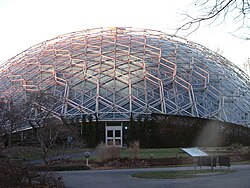
In 1959, the garden transitioned into the modern era with the construction of the Climatron. This geodesic greenhouse, which opened in 1960, was one of the first of its kind. Designed by architect and engineer Thomas C. Howard, it replaced the former Palm House to simulate a lowland rainforest environment for approximately 1,500 plants.
World-Class Research and Libraries
The garden is not merely a public park but a critical hub for systematic botany (the study of plant diversification) and plant taxonomy (the science of naming and classifying plants). The Peter H. Raven Library supports this mission, providing 85% coverage of all literature ever published in these fields.
| Collection | Period | Donor | Size (Items) |
|---|---|---|---|
| Sturtevant Pre-Linnaean | 1474–1753 | Edward Lewis Sturtevant | 1,000 |
| Linnaean | N/A | Carl Linnaeus | 900 |
| Post-1753 Rare Book | Post-1753 | Charles Darwin, George Engelmann | 3,000 |
| Folio | N/A | N/A | 1,000 |
| Steere | N/A | William C. Steere | 3,000 |
Diverse Gardens and Cultural Spaces
The Missouri Botanical Garden features a wide array of themed landscapes that reflect global botanical diversity and cultural heritage.
International and Specialized Gardens
- Seiwa-en Japanese Garden: The largest Japanese garden in North America, featuring a 4-acre central lake and a "wet strolling" design.
- Grigg Nanjing Friendship Chinese Garden: A gift from the sister city of Nanjing, featuring a moon gate, lotus gate, and scholar's rocks from Lake Tai.
- Strassenfest German Garden: Showcases flora native to Central Europe and honors botanist George Engelmann.
- Biblical Garden: Contains plants mentioned in the Bible, such as date palms, figs, and olives.
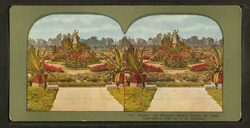
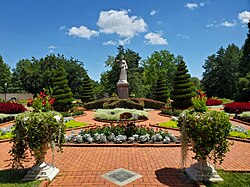
Other notable areas include the Gladney Rose Garden, known for its circular design and arbors, and the Kresko Victorian Garden, which maintains a highly manicured aesthetic.
Cultural Festivals and Events
The garden serves as a community hub, hosting the Japanese Festival (featuring sumo wrestling and taiko drumming) and Chinese Culture Days. Annual highlights include the Whitaker Music Festival summer concerts, the Garden Glow holiday light show, and the October Fest-of-Ale.
Conservation and Global Projects
The institution extends its reach far beyond St. Louis through several specialized initiatives:
- The Plant List: A collaborative internet encyclopedia with the Royal Botanic Gardens, Kew, documenting over one million scientific plant names.
- Living Earth Collaborative: A partnership with the St. Louis Zoo and Washington University to preserve natural environments for plants, animals, and microbes.
- Shaw Nature Reserve: A 2,400-acre reserve in Gray Summit, Missouri, originally established in 1925 to protect plants from city pollution.
- Sophia M. Sachs Butterfly House: A facility in Chesterfield featuring an 8,000-square-foot indoor conservatory.
- EarthWays Center: An educational group focusing on renewable energy and sustainability.
The Henry Shaw Medal
Since 1893, the garden has awarded the Henry Shaw Medal to individuals and organizations that have made significant contributions to horticulture, botanical research, or conservation. Notable recipients have included the National Geographic Society and various world-renowned botanists.
Frequently Asked Questions
What is the significance of the Climatron?
The Climatron is a pioneering geodesic-domed greenhouse that simulates a lowland rainforest climate, housing approximately 1,500 plant species.
How large is the Missouri Botanical Garden's herbarium?
It is the second largest in North America, containing more than 7.5 million plant specimens.
What is the Seiwa-en Japanese Garden?
It is the largest Japanese garden in North America, characterized by a 4-acre central lake and traditional strolling paths.
What is the purpose of the Shaw Nature Reserve?
Established in 1925, it was originally intended to store plants away from urban pollution; it now serves as a 2,400-acre site for public enjoyment, research, and education.
What is The Plant List?
It is a comprehensive internet encyclopedia of botanical nomenclature created by the Missouri Botanical Garden and the Royal Botanic Gardens, Kew.