Minnesota: The North Star State
Known affectionately as the Land of 10,000 Lakes and the North Star State, Minnesota is a region of striking natural beauty and significant economic influence. From the bustling urban centers of the Twin Cities to the serene wilderness of the Boundary Waters, Minnesota blends a rich indigenous and colonial history with a modern, diverse population.
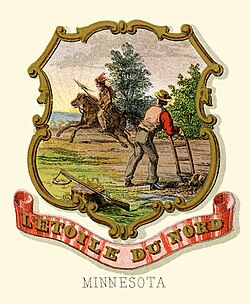
The state's identity is deeply tied to its geography, characterized by vast waterways and a climate that swings from humid summers to frigid winters. Its motto, L'Étoile du Nord (The Star of the North), reflects its position as a beacon in the upper Midwest of the United States.
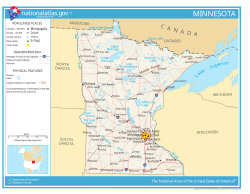
Key Facts
- Capital: Saint Paul
- Largest City: Minneapolis
- Statehood: Admitted May 11, 1858 (32nd state)
- Total Area: 86,936 square miles (12th largest in the US)
- Population: Approximately 5,830,405 (2025 estimate)
- Highest Point: Eagle Mountain (2,300 ft)
- Lowest Point: Lake Superior (600 ft)
Geography and Natural Environment
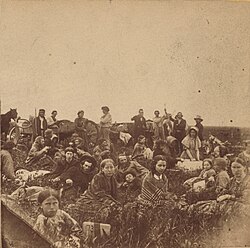
Minnesota's landscape is defined by its abundance of water, with 7,310 square miles of the state consisting of water bodies. The terrain varies from the rugged, rocky shores of Lake Superior to the glacial lakes and prairies of the south.
Geology and Landforms
The state's geological history is evident in its diverse formations. In Jay Cooke State Park, visitors can see the tilted beds of the Middle Precambrian Thomson Formation, while Palisade Head on Lake Superior showcases ancient Precambrian rhyolitic lava flows.
![Tilted beds of the Middle Precambrian Thomson Formation in Jay Cooke State Park[58]](/images/0c/26/0c26648ec6e1e5c2c121e7c7d5a980d70a1ffb58d6b827ec0af3e590ae3c6e54.jpg)
![Palisade Head on Lake Superior was formed from a Precambrian rhyolitic lava flow.[58]](/images/8b/a9/8ba99496ec91be71385932bb6c8bcf1c4682b0a6de904131145bf65dd2ccbbd1.jpg)
Climate
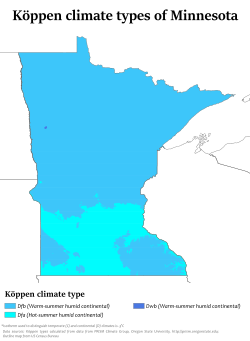
Minnesota experiences a wide range of temperatures. Cities like International Falls often see extreme winter lows, while southern cities like Mankato experience warmer summers. The state is categorized by various Köppen climate types, which dictate the flora and fauna found across the region.
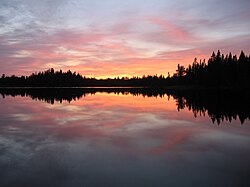
The wilderness areas, such as the Boundary Waters Canoe Area, provide critical protected habitats and recreational opportunities for those seeking the quiet of the north woods.
Demographics and Society
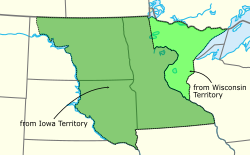
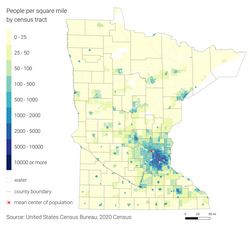
Minnesota has seen steady population growth since its territory days. From a population of just over 6,000 in 1850, it has grown to over 5.8 million by 2025. The state is characterized by a diverse ethnic makeup, with significant communities of White, Black, Asian, and Native American residents.
Urban Centers and Infrastructure
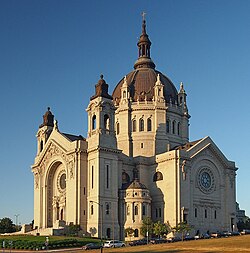
The Minneapolis–Saint Paul metropolitan area serves as the state's primary urban hub. Minneapolis is the largest city, while Saint Paul serves as the capital. The region is known for its architectural landmarks, including the IDS Tower—the state's tallest building—and the French Renaissance style Cathedral of St. Paul.
![The IDS Tower, designed by Philip Johnson, is the state's tallest building,[116] reflecting César Pelli's Art Deco-style Wells Fargo Center.](/images/a3/da/a3dace27a266ebebd0589daa85eed73b7d4985750834072082c0958ca723f00c.jpg)
Cultural Diversity and Immigration
Minnesota is home to vibrant immigrant communities. Notable populations include people from Mexico, Somalia, and Hmong people, contributing to a rich tapestry of languages and traditions. English is the most spoken language (88.9%), followed by Spanish, Somali, and Hmong.
Economy and Industry
The economy of Minnesota is robust, with a strong emphasis on healthcare, education, and corporate headquarters. The state boasts a high median household income, ranking 13th in the United States as of 2023.
Major Employers
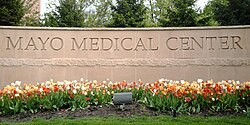
Healthcare is a dominant sector, led by the world-renowned Mayo Clinic in Rochester. Other major employers include the State of Minnesota, Target Corporation, and UnitedHealth Group.
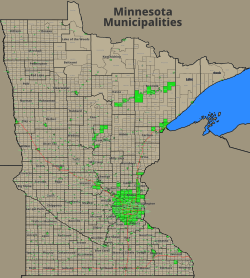
| Rank | City | County | Population |
|---|---|---|---|
| 1 | Minneapolis | Hennepin | 425,336 |
| 2 | Saint Paul | Ramsey | 307,193 |
| 3 | Rochester | Olmsted | 121,465 |
| 4 | Bloomington | Hennepin | 89,298 |
| 5 | Duluth | St. Louis | 86,372 |
Government and Law
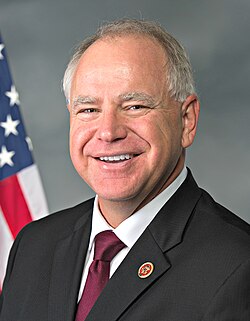
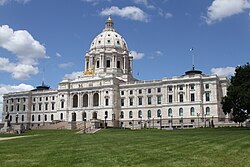
Minnesota operates under a representative democracy. The executive branch is led by Governor Tim Walz and Lieutenant Governor Peggy Flanagan. The legislative branch consists of a Senate and a House of Representatives, while the judiciary is headed by the Minnesota Supreme Court.
Tribal Sovereignty
The state recognizes several tribal communities, including four Dakota Mdewakanton communities (such as the Prairie Island Indian Community) and seven Anishinaabe reservations (including the Red Lake Band of Chippewa).
Frequently Asked Questions
![First Avenue nightclub, the heart of Minnesota's music community.[60]](/images/35/a9/35a9ddf3e3ba61c0cd9bc3004daba8cfbf4d2fc3353cfbb73362473c72ef3f68.jpg)


![Fishing on Bde Maka Ska in Minneapolis[207]](/images/94/f7/94f71d231b536c76438bd156dc84ee1caf8e751bc93f83c2f53bdd2cb28a4c6a.jpg)
What are the nicknames of Minnesota?
Minnesota is commonly known as the North Star State, the Gopher State, the Land of 10,000 Lakes, and the Land of Sky Blue Waters.
Who is the current Governor of Minnesota?
The current Governor of Minnesota is Tim Walz.
What is the largest city in Minnesota?
Minneapolis is the largest city in the state, followed by the capital, Saint Paul.
What are the most spoken languages in Minnesota?
English is the primary language spoken by 88.9% of the population, with Spanish, Somali, and Hmong also being widely spoken.
Which organization is the largest employer in the state?
The Mayo Clinic is the largest employer in Minnesota, with 57,159 employees.