Minigolf History: From Early 20th Century Roots to Global Sport
Miniature golf, often known as minigolf, is a leisure activity that blends skill, geometry, and whimsical design. While it may seem like a modern pastime, its origins date back to the early 20th century, evolving from simple artificial carpets to complex, themed courses that span the globe. From the rooftops of New York City to the public parks of Sweden, the game has undergone several transformations in both design and purpose.
The Early Era and the American Boom
The first documented mention of a geometrically shaped minigolf course appeared on June 8, 1912, in The Illustrated London News, which introduced a course called the Gofstacle. Shortly after, the industry moved toward commercial mass production. In 1916, the Thistle Dhu ("This'll Do") course launched in Pinehurst, North Carolina, followed by Garnet Carter's 1927 Tom Thumb patent from Lookout Mountain, Tennessee.
A major breakthrough occurred in 1922 when Thomas McCullough Fairbairn developed a specialized artificial green. By mixing cottonseed hulls, sand, oil, and dye, Fairbairn made the game accessible in diverse environments. This innovation sparked a massive boom in the late 1920s; New York City alone hosted over 150 rooftop courses, with tens of thousands more appearing across the United States.
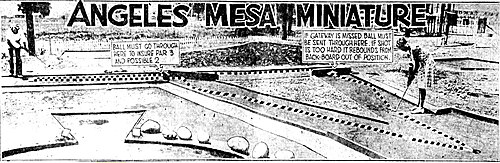
However, this golden age was cut short by the Great Depression of the late 1930s. Most American courses were demolished during this economic downturn. One of the few remaining relics is the Parkside Whispering Pines Miniature Golf Course near Rochester, New York, which earned a place on the National Register of Historic Places in 2002.
European Expansion and Standardization
While the American market fluctuated, minigolf found a steady foothold in Europe. In 1926, a man named Schröder built one of the first mainland European courses in Hamburg, Germany, after being inspired by his travels in the U.S.
In 1931, Edwin O. Norrman and Eskil Norman founded "Norman och Norrmans Miniatyrgolf" in Sweden. They began installing standardized courses in public parks, helping the game spread rapidly across the region. Interestingly, Swedish courses initially used tennis field sand within wooden frames, whereas American courses utilized patented felt. Felt eventually became the standard in Scandinavia and the United Kingdom by the mid-1960s because it allows rainwater to soak through, preventing the pooling that occurs on concrete or fibre-cement surfaces.
Sweden also led the way in formalizing the sport. The Swedish Minigolf Federation (Svenska Bangolfförbundet), founded in 1937, is the oldest minigolf sport organization in the world, with national championships held annually since 1939.
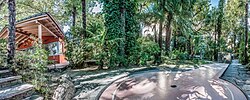
Global Milestones
- 1951: Sandvig Minigolf in Bornholm, Denmark, is built, becoming the oldest course in the world.
- 1954: The course in Ascona, Switzerland, opens as the second oldest course following the norms of Paul Bongni.
- 1930: Canada's first course opens at the Maples Inn in Pointe-Claire, Quebec.
The Evolution of Competitive Play and Design
Competitive minigolf peaked early in the U.S. with the 1930 National Tom Thumb Open, which featured a $10,000 purse and players from 30 states. While competitive play declined in America after the Depression, it thrived in Europe.
The game's aesthetic shifted in 1938 when Joseph and Robert Taylor began building courses in Binghamton, New York. Moving away from simple curves and pipes, the Taylors introduced landscaping and iconic obstacles like windmills, castles, and wishing wells. Their company, Taylor Brothers, eventually supplied prefabricated courses to the U.S. Military for G.I.s during the Korean and Vietnam Wars.
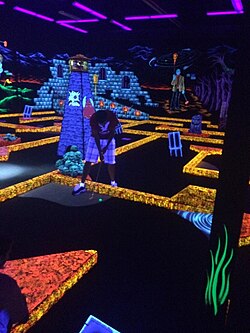
In the 1950s, Don Clayton introduced the Putt-Putt brand, which emphasized skill and practice over luck, typically utilizing 2-par holes. Simultaneously, Lomma Golf, Inc. (founded by Al and Ralph Lomma) revived "wacky" animated hazards, such as revolving statuary and spinning windmill blades, requiring precise timing from the player.
Key Facts
- Oldest Organization: The Swedish Minigolf Federation (est. 1937).
- Oldest Course: Sandvig Minigolf in Bornholm, Denmark (est. 1951).
- Surface Materials: Felt is preferred in wet climates (UK/Scandinavia) as it prevents water pooling.
- Industry Milestone: NAPCOMS was the first association to unite operators and manufacturers in 1961.
- Celebration: National Miniature Golf Day is celebrated in the U.S. on the second Saturday of May.
| Era/Period | Key Development | Primary Influence/Figure |
|---|---|---|
| Early 1900s | First documented courses (Gofstacle) | The Illustrated London News |
| 1920s | Artificial greens and rooftop boom | Thomas McCullough Fairbairn |
| 1930s | European standardization | Norman och Norrmans (Sweden) |
| 1940s-50s | Themed obstacles and prefabricated courses | Taylor Brothers |
| 1950s | Skill-based play and animated hazards | Don Clayton (Putt-Putt) / Lomma Golf |
Frequently Asked Questions
What is the oldest minigolf course in the world?
The Sandvig Minigolf in Bornholm, Denmark, built in 1951, is recognized as the oldest course in the world.
Why is felt used as a surface material in the UK and Scandinavia?
Felt is used because it allows rainwater to soak through into the ground, whereas concrete or fibre-cement surfaces cause water to pool, which stops the ball from rolling.
How did the Great Depression affect minigolf in the United States?
The Depression led to the closure and demolition of nearly all minigolf courses in the U.S. by the end of the 1930s, ending the initial early-century boom.
What is the difference between Taylor Brothers courses and Putt-Putt?
Taylor Brothers focused on landscaping and themed obstacles like castles and windmills, while Putt-Putt emphasized skill improvement and mastery through 2-par holes with ramps and angled blocks.
When is National Miniature Golf Day celebrated?
In the United States, National Miniature Golf Day is held annually on the second Saturday of May.