Microsoft RoundTable: The Evolution of 360-Degree Videoconferencing
In the early days of digital collaboration, capturing the dynamics of a physical meeting room was a significant challenge. Traditional cameras offered a narrow field of view, often leaving participants at the end of the table out of frame. The Microsoft RoundTable emerged as a solution to this problem, introducing a panoramic approach to video communication that ensured every person in the room was visible.
Designed to integrate with Microsoft Office Communications Server 2007 and Microsoft Office Live Meeting, the RoundTable device utilized a 360-degree camera to provide remote participants with a complete view of the conference table. This immersive perspective bridged the gap between remote and in-person attendees by maintaining the visual context of the meeting environment.
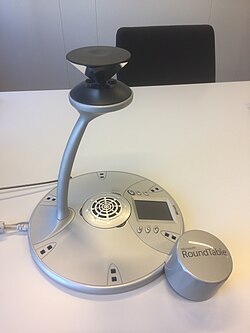
Key Facts
- Launch Year: 2007.
- Core Feature: 360-degree panoramic video capture.
- Intelligence: Active speaker detection for real-time high-resolution tracking.
- Connectivity: Plug-and-play USB functionality and PSTN speakerphone capabilities.
- Legacy: Licensed to Polycom in 2009, leading to the CX series.
Technology and Development
The foundation of the RoundTable was laid at Microsoft Research, where Ross Cutler and a team of researchers developed the core technology. To bring this innovation to market, Ross Cutler and Senthil Velayutham established the RoundTable product group under the Microsoft Greenhouse initiative, with leadership from General Manager Jeff Finan.
From a technical standpoint, the device operated on a hybrid system. The main processor ran on the Windows CE operating system, while supporting Digital Signal Processor (DSP) chipsets—specialized microprocessors optimized for the mathematical operations required for audio and video processing—ran on separate operating systems.
Transition to Polycom
In 2009, Microsoft licensed the RoundTable technology to Polycom. This resulted in the release of the Polycom CX5000, which offered an identical feature set to the original Microsoft device but under Polycom branding.
Polycom expanded upon this design by introducing the CX5100 and CX5500 models, both of which upgraded the visual experience to 1080p high-definition resolution. While the CX5100 remained a USB-only device, the CX5500 offered greater versatility; it functioned as a 360-degree camera when connected to a PC running the Skype for Business client, but could also independently handle audio VoIP (Voice over Internet Protocol) calls.

Comparison of RoundTable and Polycom CX Series
| Model | Manufacturer/Brand | Key Feature | Connectivity/Capability |
|---|---|---|---|
| RoundTable | Microsoft | 360-degree Panoramic Video | USB / PSTN Speakerphone |
| CX5000 | Polycom | Identical to RoundTable | USB / PSTN Speakerphone |
| CX5100 | Polycom | 1080p Resolution | USB Only |
| CX5500 | Polycom | 1080p Resolution | USB / Independent VoIP Audio |
Frequently Asked Questions
What was the primary purpose of the Microsoft RoundTable?
The Microsoft RoundTable was designed to provide a 360-degree panoramic view of all participants sitting around a conference table, ensuring remote attendees could see everyone in the room.
How did the device handle multiple speakers?
The device used active speaker detection technology to track the flow of conversation in real time, automatically switching to a high-resolution video feed of whoever was currently speaking.
Who developed the original technology for the RoundTable?
The core technology was invented by Ross Cutler and other researchers at Microsoft Research before being commercialized through the Microsoft Greenhouse program.
What is the difference between the Polycom CX5100 and CX5500?
Both support 1080p video, but the CX5100 is a USB-only device, whereas the CX5500 can make audio VoIP calls even when it is not plugged into a PC.
Which operating systems powered the RoundTable?
The main processor utilized Windows CE, while the supporting DSP chipsets utilized other specialized operating systems.