Microsoft LifeCam VX Series
The VX series marked Microsoft's first venture into the webcam market, introducing a line of hardware designed to bring video communication to the desktop. Debuting on June 13, 2006, and hitting shelves in August of the same year, the series began with two flagship models: the VX-3000 and the VX-6000.
One of the most distinctive features of the early VX series was its deep integration with Windows Live Messenger. These devices included a dedicated Windows Live Call button, allowing users to initiate video calls instantly with a single press.
Design and Connectivity
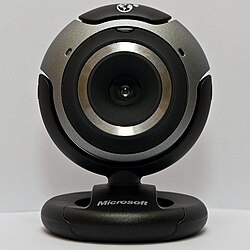
Engineered specifically for desktop environments, the VX series utilized a Universal Attachment Base, a round base design that allowed the camera to be securely mounted to a desktop monitor. To ensure compatibility and ease of use, every model in the series interfaced via a standard USB connection.
Model Evolution and Specifications
Over the years, Microsoft expanded the VX lineup to cater to different user needs, ranging from basic 0.3 MP sensors to high-resolution interpolated models. While many models shared a standard 640 x 480 video resolution, the series saw significant variations in sensor quality and physical design.
High-End and Specialized Models
The VX-6000 stood out with a wide-angle lens and a resolution of 1280 x 1024 (interpolated to 5.0 MP), though it lacked the automatic face tracking found in the VX-3000. The VX-7000 pushed the boundaries further with a 2.0 MP sensor and a resolution of 1600 x 1200 (interpolated to 7.6 MP).
Entry-Level and Lifestyle Variants
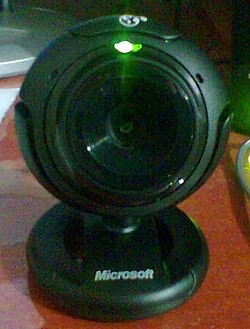
Later additions like the VX-500 and VX-700 offered more basic 0.3 MP sensors. Microsoft also experimented with aesthetics; the VX-5000 featured a flexible stand and came in Fire Red, Cool Blue, and Lucky Green, while the VX-5500 offered swappable plastic front covers in white, blue, and red.
Key Facts
- Launch Date: The series debuted on June 13, 2006.
- Connectivity: All models use a USB interface.
- Software Integration: Early models featured a physical button for Windows Live Messenger calls.
- Mounting: Most models utilized the Universal Attachment Base for monitor mounting.
- Highest Resolution: The VX-7000 reached 1600 x 1200 (7.6 MP interpolated).
Technical Specifications Summary
| Model | Released | Video Resolution | Image Sensor | Microphone | Key Feature |
|---|---|---|---|---|---|
| VX-3000 | 2006 June | 640 x 480 | 1.3 MP | Yes | Face tracking, Pan/Tilt/Zoom |
| VX-6000 | 2006 June | 1280 x 1024 | 1.3 MP (5MP Interp.) | Yes | Wide-angle lens |
| VX-7000 | 2007 Sept | 1600 x 1200 | 2.0 MP (7.6MP Interp.) | Yes | High resolution |
| VX-5000 | 2008 May | 640 x 480 | 1.3 MP | Yes | Flexible Stand, Color variants |
| VX-500 | 2008 May | 640 x 480 | 0.3 MP | No | Basic model |
| VX-2000 | 2009 May | 640 x 480 | 1.3 MP | Yes | Standard 1.3 MP |
| VX-800 | 2009-2011 | 640 x 480 | 0.3 MP | Yes | Regional releases |
Frequently Asked Questions
Which VX series model had the highest resolution?
The VX-7000 offered the highest resolution at 1600 x 1200, with an interpolated resolution of 7.6 MP.
Did all LifeCam VX models have built-in microphones?
No, the VX-500 model did not include a built-in microphone.
What was the purpose of the Universal Attachment Base?
The Universal Attachment Base was a round base designed to allow the webcam to be easily attached to a desktop monitor.
Which model featured automatic face tracking?
The VX-3000 included automatic face tracking software, a feature that was notably absent from the VX-6000.
How did the VX series integrate with software?
The series integrated with Windows Live Messenger via a physical Windows Live Call button used to start video calls quickly.