Micrometre: Measuring the Invisible World
In the vast scale of the universe, some of the most critical structures—from the bacteria that drive our ecosystems to the cells that compose our bodies—are far too small to be seen with the naked eye. To measure these dimensions, scientists use the micrometre, a unit of length that bridges the gap between the visible world and the atomic scale.
A micrometre (spelled micrometer in the United States) is a unit of length within the International System of Units (SI). It is defined as one millionth of a metre, or one thousandth of a millimetre (0.001 mm). In the scientific community, it is frequently referred to as a micron.
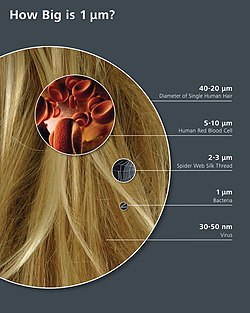
Key Facts
- Definition: 1 micrometre (μm) = 10-6 metres.
- Common Name: Often called a micron.
- Scale: One thousand times larger than a nanometre and one thousand times smaller than a millimetre.
- Primary Uses: Measuring biological cells, bacteria, infrared radiation wavelengths, and wool fibre diameters.
- Human Reference: A single human hair typically ranges from 17 to 181 μm in diameter.
Technical Specifications and Conversions
The micrometre utilizes the SI standard prefix "micro-," which denotes a factor of 10-6. While it is a standard metric unit, it can be converted into other systems for different applications.
| Unit System | Equivalent Value |
|---|---|
| SI Base Unit (Metre) | 10-6 m |
| Millimetre | 0.001 mm |
| Imperial / US (Inch) | 3.9370 × 10⁻⁴ in |
| Natural Units | 1.8897 × 10⁻¹⁶ ℓP |
Real-World Examples of Scale
To better visualize the size of a micrometre, it is helpful to look at common objects and biological structures categorized by their size range.
Objects between 1 μm and 10 μm
- Bacteria: Typical bacteria range from 1 to 10 μm in length.
- Spider Silk: A strand of spider web silk is generally 3 to 8 μm wide.
- Human Sperm: The head of a typical human spermatozoon is approximately 5 μm long.
- Red Blood Cells: These typically have a diameter of 6 to 8 μm.
- Fungal Hyphae: These structures are roughly 10 μm in size.
- Atmospheric Droplets: Water droplets in fog, mist, or clouds are about 10 μm.
Objects between 10 μm and 100 μm
- Plastic Wrap: Cling wrap typically measures between 10 and 12 μm in thickness.
- Wool Fibres: These range from 10 to 55 μm in width.
- Human Hair: The diameter of a human hair varies from 17 to 181 μm.
- Paper: Standard paper thickness ranges from 70 to 180 μm.
Standardization and Symbolism
The symbol for the micrometre is μm, combining the Greek lowercase letter mu (μ) with the symbol for metre (m). Historically, the term "micron" and the symbol "μ" were accepted as standalone terms in 1879. However, the International System of Units revoked this in 1967 to ensure consistency with the official adoption of the prefix "micro-."
In American English, the term "micron" is often preferred to avoid confusion with the micrometer, which is a physical measuring device. While they are spelled the same (homographs), they are distinguished in speech by pronunciation: the measuring device is stressed on the second syllable, while the unit of length is stressed on the first.
Regarding digital representation, the Unicode standard recognizes both the micro sign (U+00B5) and the Greek small letter mu (U+03BC). While the Greek letter is preferred, both are widely used for compatibility. In the era of mechanical typewriters, the symbol was often approximated as "/um" or simply "um" when the Greek character was unavailable.
Frequently Asked Questions
What is the difference between a micrometre and a micron?
There is no difference in value; they are two names for the same unit of length. "Micrometre" is the official SI name, while "micron" is a common alternative term.
How does a micrometre compare to a nanometre?
A nanometre is one thousand times smaller than a micrometre. Therefore, 1 micrometre is equal to 1,000 nanometres.
Why is the term "micron" used in the United States?
In the US, "micron" helps distinguish the unit of measurement from the "micrometer," which refers to a specific tool used for measuring small distances.
What are some common uses for the micrometre in science?
It is widely used to measure the size of bacteria and biological cells, the wavelengths of infrared radiation, and the diameter of textile fibres, such as wool.