Miami-Dade County Government Structure and Administration
The government of Miami-Dade County operates under a complex legal framework defined by the Constitution of Florida, Florida state law, and the Home Rule Charter of Miami-Dade County. Since its establishment in 1957, the county has utilized a unique two-tier system of governance to manage its vast and diverse population.
This system divides the region into 34 incorporated municipalities—each with its own local government providing services like zoning and police protection—and a large unincorporated area. For the approximately 44% of the 2,751,796 residents (as of 2017) who live in these unincorporated zones, the county serves as both the upper- and lower-tier government.
These residents are part of the Unincorporated Municipal Services Area (UMSA). To fund city-equivalent services such as fire, water, sewer, and police, UMSA residents pay a specific UMSA tax. Residents living within incorporated city limits are exempt from this particular tax.
Key Facts
- Governance Model: A two-tier system consisting of 34 incorporated municipalities and one large unincorporated area.
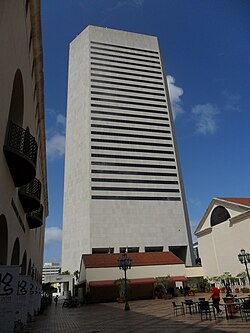
- Administrative Hub: The Stephen P. Clark Government Center (SPCC) in downtown Miami.
- Legislative Body: A 13-member Board of County Commissioners elected from single-member districts.
- Term Limits: Commissioners are limited to two consecutive four-year terms.
- Independent Offices: Since 2018, the tax collector, property appraiser, supervisor of elections, and sheriff are independent elected offices.
Organization and Executive Leadership
The county is led by an independently elected executive mayor and the Miami-Dade Board of County Commissioners (BCC). While the mayor handles executive functions, the BCC holds broad regional powers to establish policies for countywide services and provides municipal-level services for those in unincorporated areas.
The Board of County Commissioners
The BCC consists of 13 commissioners, each representing one of the county's 13 districts. These officials are elected in non-partisan, single-district elections for four-year staggered terms. The commissioners elect a chairperson, who then appoints the leadership for all standing committees.
As of November 2025, the board's composition includes seven Republicans and six Democrats.

| District | Commissioner | Party | First Elected |
|---|---|---|---|
| 1st | Oliver Gilbert | Democratic | 2020 |
| 2nd | Marleine Bastien | Democratic | 2022 |
| 3rd | Keon Hardemon | Democratic | 2020 |
| 4th | Micky Steinberg | Democratic | 2022 |
| 5th | Vicki Lopez | Republican | 2025 (Appointed) |
| 6th | Natalie Milian Orbis | Republican | 2022 |
| 7th | Raquel A. Regalado | Republican | 2020 |
| 8th | Danielle Cohen Higgins | Democratic | 2020 (Appointed) |
| 9th | Kionne McGhee | Democratic | 2020 |
| 10th | Anthony Rodriguez | Republican | 2022 |
| 11th | Roberto J. Gonzalez | Republican | 2022 (Appointed) |
| 12th | Juan Carlos Bermudez | Republican | 2022 |
| 13th | René García | Republican | 2020 |
Constitutional Officers
Beyond the mayor and commission, several constitutional officers are required by Florida law and the county charter. These officials manage critical legal and financial functions for the region:
- Mayor: Daniella Levine Cava (Democrat), serving as the independently elected county executive.
- Sheriff: Rosie Cordero-Stutz (Republican), vested with wide-ranging powers as a county officer and part of the state judicial branch.
- State Attorney: Katherine Fernandez Rundle (Democrat), the chief prosecutor for state circuit and county courts.
- Clerk of the Circuit Court: Juan Fernandez-Barquin (Republican), who also serves as the county auditor, recorder, and ex-officio comptroller.
- Public Defender: Carlos J. Martinez (Democrat), providing legal representation for residents in court.
- Property Appraiser: Tomás Regalado (Republican).
- Supervisor of Elections: Alina Garcia (Republican).
- Tax Collector: Dariel Fernandez (Republican), who also manages the county DMV.
County Departments and Public Services
Miami-Dade County operates a vast array of departments to maintain metropolitan infrastructure and quality of life. Notable services include:
- Transportation: Miami-Dade Transit operates Florida's largest system, including Metrorail, Metromover, and Metrobus. The Department of Transportation and Public Works (DTPW) and PortMiami further support regional logistics.
- Public Safety: Managed by the Miami-Dade Fire Rescue Department (MDFR) and the Miami-Dade Sheriff's Office (MDSO).
- Environment and Recreation: The Parks, Recreation and Open Spaces Department is the third largest county park system in the U.S., managing 270 parks across 13,573 acres.
- Health and Human Services: Including the Jackson Health System (Public Health Trust) and the Department of Community Action and Human Services.
- Culture and Infrastructure: The Miami-Dade Public Library System, the Vizcaya Trust (Vizcaya Museum and Gardens), and the Miami-Dade Aviation Department (Miami International Airport).
Frequently Asked Questions
What is the UMSA tax?
The Unincorporated Municipal Services Area (UMSA) tax is a fee paid by residents living in unincorporated areas of the county. It is equivalent to a city tax and funds essential municipal services like police, fire, and zoning that would otherwise be provided by a city government.
How are Miami-Dade County Commissioners elected?
Commissioners are elected in non-partisan, single-district elections. Residents vote only for the candidate running in their specific district. They serve four-year staggered terms.
What are the term limits for County Commissioners?
Following a 2012 amendment to the county charter, commissioners are limited to serving two consecutive four-year terms.
Who manages the county's transit system?
Miami-Dade Transit oversees the region's transportation network, which is the largest in Florida and includes the Metrorail, Metromover, and Metrobus systems.
Which offices became independent elected positions in 2018?
A state constitutional amendment passed in 2018 made the positions of sheriff, property appraiser, tax collector, and supervisor of elections independent elected offices.