Mexico City Metro: A History of Urban Transformation and Engineering
By the mid-20th century, Mexico City faced a critical transportation crisis. The downtown core, which concentrated 40% of the city's daily trips, was paralyzed by congestion. With 65 of the city's 91 bus and electric lines serving the center, alongside 150,000 personal vehicles during peak hours, average travel speeds often dropped below walking pace.
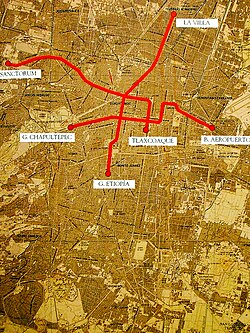
The solution came through the vision of engineer Bernardo Quintana and his company, Ingenieros Civiles y Asociados (ICA). His studies laid the groundwork for a rapid transit network, which became official on April 29, 1967, with the creation of the Sistema de Transporte Colectivo (STC). To ensure technical excellence, Mexico partnered with France's SOFRETU (the engineering branch of RATP), which influenced the initial planning and the adoption of tyre/rail technology.
Key Facts
- Inauguration: Daily operations began on September 4, 1969, with a trip between Zaragoza and Insurgentes.
- Construction Speed: During the first stage, tracks were laid at a rate of at least one kilometer per month.
- Resilience: The system's rectangular structural design allowed it to survive the magnitude 8.0 earthquake of 1985 without structural damage.
- Archaeology: Over 20,000 archaeological artifacts have been discovered during the construction of the network.
- Longest Line: Line 12 is the longest in the system, spanning 24.31 kilometers.
The Evolution of the Network
First Stage (1967–1972)
The initial phase focused on Lines 1, 2, and 3. This massive undertaking employed between 1,200 and 4,000 specialists and 48,000 workers. By June 10, 1972, the network spanned 41.41 kilometers with 48 stations, providing vital access to key areas including the General Hospital of Mexico.
Second and Third Stages (1977–1985)
Expansion resumed under President José López Portillo with the creation of the Comisión Ejecutiva del Metro. This era saw the extension of Line 3 and the introduction of Lines 4 and 5. Line 4 was notable for being the first elevated track due to the lower density of buildings in its path.
Between 1983 and 1985, the network grew by 35.29 kilometers, adding Lines 6 and 7. Line 7 was constructed as a deep-bore tunnel because its route followed the Sierra de las Cruces mountain range, placing it outside the ancient lake zone.
The 1985 Earthquake
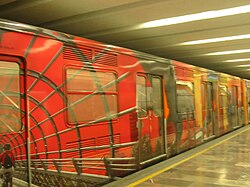
On September 19, 1985, a magnitude 8.0 earthquake devastated the city. While surface transportation was crippled, the STC Metro remained structurally sound due to its rectangular support structures. Although service was temporarily suspended to prevent electrocution and several stations in the historic center closed to allow for surface rescue operations, the system proved to be a safe haven during the crisis.
Fourth through Seventh Stages (1985–2014)
Subsequent expansions introduced Line 9 and the first líneas alimentadoras (feeder lines). Line A, opened in 1991, marked the first time the Metro entered the State of Mexico. Unlike previous lines, Line A used metro férreo (steel-rail) technology and overhead lines to reduce maintenance costs.
The most recent major addition, Line 12, became fully operational on October 30, 2012. Serving southern Mexico City, it introduced several modernizations: the prohibition of hawkers, the mandatory use of the Tarjeta DF smart card, and the use of steel railway tracks.

Archaeology, Architecture, and Culture
Underground Discoveries
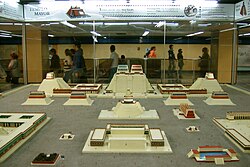
The excavation of the Metro has served as a massive archaeological survey. Over 20,000 finds have been recovered, including an Aztec idol, mammoth bones (displayed at Talismán station), and an altar to the god Ehécatl at Pino Suárez station—the latter recognized as the smallest archaeological site in Mexico.
Design and Artistic Influence
The system's aesthetic was shaped by renowned architects such as Luis Barragán and Félix Candela, whose work is visible in the San Lázaro, Candelaria, and Merced stations. Beyond architecture, the Metro has permeated Mexican culture, inspiring songs like "Metro Balderas" and serving as a filming location for the movie Total Recall.
System Summary
| Stage | Period | Key Developments | Technology/Notes |
|---|---|---|---|
| First | 1967–1972 | Lines 1, 2, 3 | Pneumatic traction (tyre/rail) |
| Second | 1977–1982 | Lines 4, 5 | First elevated tracks (Line 4) |
| Third | 1983–1985 | Lines 6, 7 | Deep-bore tunnels (Line 7) |
| Fourth | 1985–1987 | Line 9 | Mixed deep-bore and elevated |
| Fifth | 1988–1994 | Line 8, Line A | Introduction of steel-rail (Line A) |
| Sixth | 1994–2000 | Line B | Pneumatic traction feeder line |
| Seventh | 2008–2014 | Line 12 | Steel-rail; Smart card access |
Frequently Asked Questions
Why did the Metro survive the 1985 earthquake?
The system was built using rectangular structures rather than arches, which provided superior resistance to the seismic forces of the magnitude 8.0 earthquake.
What is the difference between pneumatic traction and metro férreo?
Pneumatic traction uses rubber tyres on rails for a smoother, quieter ride, while metro férreo refers to traditional steel railway tracks, which are often more cost-effective to maintain.
Which is the longest line in the Mexico City Metro?
Line 12 is the longest line in the entire system, with a total length of 24.31 kilometers.
What archaeological finds can be seen in the stations?
Notable displays include mammoth bones at Talismán station and an altar to the Mexica god Ehécatl at Pino Suárez station.
How does Line 12 differ from the older lines?
Line 12 uses steel rails instead of rubber tyres, requires a Tarjeta DF smart card for entry (no paper tickets), and prohibits hawkers within the stations and trains.